


5 Warning Signs Your Central Heating is Inefficient: The 2026 Homeowner’s Guide

If your radiators are on full blast but you're still wearing a jumper indoors, you aren't just losing heat; you're burning money. We understand the frustration of watching your energy bills climb whilst your home stays stubbornly chilly. Unpredictable costs and cold spots cause genuine anxiety, especially when you're responsible for tenant safety or family comfort. Recognising the subtle signs your central heating is inefficient is the only way to regain control before a minor fault turns into a total system failure.
We are a trusted plumbing & Heating company providing reliable, high-quality services across London and Kent. and we're committed to helping you maintain a warm, safe property without the sting of unexpected costs. This guide will help you identify the red flags of a struggling system so you can lower your monthly energy bills and avoid the stress of emergency call-out fees. We'll walk you through five critical warnings every homeowner and landlord needs to spot in 2026 to ensure your heating remains compliant, reliable, and cost-effective.
Table of Contents
What is Central Heating Efficiency and Why Does it Matter in 2026?
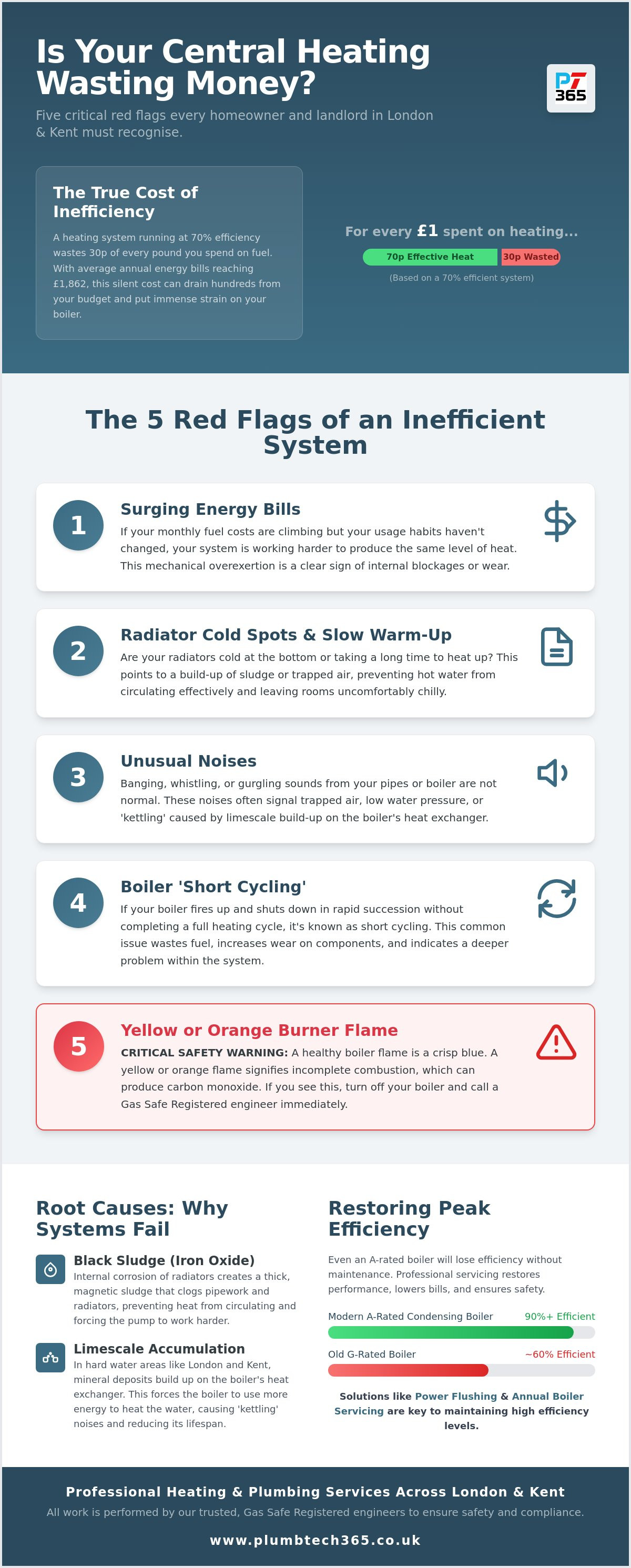
Central heating efficiency is a straightforward technical ratio. It measures the amount of energy your boiler consumes against the actual heat that reaches your radiators and hot water taps. If your system is operating at 70% efficiency, you're essentially throwing away 30p of every pound spent on gas. In 2026, with the average annual energy bill for a typical household reaching £1,862, this "silent cost" is a drain on your finances that no property owner should ignore. Recognising the signs your central heating is inefficient is the first step toward stopping this financial leak.
For landlords and property managers in London and Kent, efficiency is now a legal and commercial priority. The transition from the Standard Assessment Procedure (SAP) to the Home Energy Model in 2026 has refined how EPC ratings are calculated. Because rental properties must reach an EPC rating of 'C' or above by 2030, an underperforming heating system is more than a nuisance; it's a risk to your property's marketability and compliance. Beyond the paperwork, inefficiency places immense mechanical strain on your boiler, often leading to a total safety lockout during the coldest months when you need reliability the most.
To better understand common system failures, watch this helpful video:
The True Cost of a Sluggish System
When a system is sluggish, the boiler must run for longer periods at higher temperatures to achieve the same comfort levels. This constant overworking significantly shortens the lifespan of internal components, potentially leading to a premature replacement costing thousands. For those managing rental portfolios, poor heating performance is a primary driver of tenant dissatisfaction and avoidable void periods. In the context of system neglect, fuel poverty is defined as the inability of a household to maintain a healthy indoor temperature because the cost of heating is disproportionately high compared to their income.
Efficiency Standards for Modern Households
Modern efficiency is governed by ErP (Energy-related Products) ratings, which ensure appliances meet strict environmental targets. Whilst an old G-rated boiler might only convert 60% of fuel into heat, a modern A-rated condensing model can achieve over 90%. However, these high ratings aren't permanent. Without regular maintenance from qualified Boiler Engineers, even the most advanced system will succumb to internal wear. Identifying the signs your central heating is inefficient early allows us to restore these performance levels before they impact your wallet or your comfort.
The 5 Red Flags: Signs Your Central Heating is Inefficient
Identifying the signs your central heating is inefficient requires a keen eye for both physical changes in your home and financial shifts in your bank statements. The most immediate indicator is often a surge in energy bills that cannot be explained by seasonal changes or a rise in wholesale gas prices. If your consumption habits remain identical but your costs are climbing, your system is likely working harder to achieve the same results. This mechanical overexertion is a clear signal that internal components are struggling against friction, blockages, or age.
Property managers and landlords should be particularly alert to these red flags, as they often precede tenant complaints or expensive emergency call-outs. Beyond the costs, pay attention to how the system behaves during its daily programme. Common indicators of failure include:
Unexplained increases in monthly fuel expenditure.
Radiators that remain lukewarm or take significantly longer to reach temperature.
Persistent mechanical noises like banging or whistling.
The boiler "short cycling," which means it turns on and off rapidly without reaching the thermostat's target.
A yellow or orange burner flame, which is a critical safety warning.
Radiator Cold Spots and Uneven Heat
Radiators are the primary heat emitters in your property; when they fail to warm up evenly, it's a diagnostic roadmap of the system's health. If a radiator is cold at the bottom but hot at the top, it usually indicates a build-up of iron oxide sludge. This heavy, metallic debris settles at the lowest point, preventing hot water from circulating through the entire panel. Whilst cold spots at the top suggest trapped air that can be bled away, cold spots in the middle often signal a more stubborn blockage. These issues are best resolved through professional power flushing, which cleanses the entire circuit of performance-robbing debris.
Noisy Systems: Kettling and Banging
A healthy heating system should operate with a quiet, consistent hum. If you hear "kettling," a sound similar to a whistling kitchen kettle, it usually means limescale has restricted the water flow within the heat exchanger. This causes the water to overheat and steam, creating localized boiling. Similarly, banging or "water hammer" noises often occur when air bubbles or debris amongst the pipework disrupt the flow. Don't ignore these sounds. They place extreme stress on the system and frequently precede a total pump failure. If your system has become uncharacteristically loud, it's time to consult our local gas engineers to prevent a minor noise from becoming a major expense.
Finally, always check the colour of your boiler's flame if it's visible. A healthy flame is a crisp, transparent blue. If you see yellow or orange, it indicates incomplete combustion and a potential carbon monoxide leak. This is a life-safety issue that requires an immediate shutdown and a professional inspection. Recognising these signs your central heating is inefficient early ensures your property remains safe, compliant, and cost-effective throughout the year.
Root Causes: Why Your Heating System is Losing Performance
Understanding the technical triggers behind performance drops is essential for any proactive property owner. Whilst the signs your central heating is inefficient are often visible, the root causes usually hide deep within the pipework. In the hard water regions of London and Kent, limescale accumulation is a relentless enemy. It forms a crusty barrier inside the heat exchanger, which acts as an unwanted insulator. This forces your boiler to consume significantly more fuel to transfer heat into the water, leading to the surging bills we discussed earlier.
Mechanical fatigue also plays a major role in system decline. The central heating pump is the heart of your property's infrastructure, responsible for circulating hot water to every room. Over time, bearings wear down and internal seals fail. A struggling pump cannot maintain the flow rates required for peak efficiency. This often results in radiators at the far end of the circuit staying cold whilst the boiler fires at maximum capacity, wasting energy and causing unnecessary wear on the burner.
The Sludge Problem: Iron Oxide Build-up
The most common cause of system degradation is internal corrosion. When water reacts with the internal steel surfaces of your radiators, it creates a thick, black substance known as iron oxide, or "black sludge." This heavy debris settles in low-flow areas, effectively insulating the radiator from the inside and preventing it from emitting heat. Many homeowners mistakenly believe that bleeding radiators will solve the issue, but this only removes trapped air. It does nothing to shift the sludge that is choking your system. In modern combi boilers, this debris is particularly dangerous; it can clog narrow waterways and damage delicate internal sensors, leading to a total system lockout during the coldest months.
Control Failures and Thermostat Accuracy
Even a mechanically sound system will fail if its "brain" is malfunctioning. A faulty room thermostat or an outdated analogue dial can lead to massive energy waste through constant over-heating or uncomfortable under-heating. Old-fashioned thermostats often have a wide "differential," meaning they wait too long to turn the heating on or off. Upgrading to digital controls ensures the boiler only fires when absolutely necessary. We recommend using qualified Boiler Engineers to calibrate your controls and ensure your thermostat is communicating accurately with your heat source. This simple adjustment is one of the fastest ways to eliminate the signs your central heating is inefficient and restore comfort to your home.
How to Restore Efficiency and Lower Monthly Costs
Once you have identified the signs your central heating is inefficient, the priority shifts to restoration. For landlords and letting agents in Kent and London, taking immediate action is the best way to protect your yield and maintain tenant satisfaction. A poorly performing system is a primary cause of avoidable void periods. We focus on delivering professional, high-quality solutions that bring your property back to peak condition whilst strictly adhering to your budget and timelines.
The foundation of any efficient system is a comprehensive boiler service. Our Gas Safe Registered engineers don't just tick boxes; they perform a deep clean of internal components and precise gas pressure checks. This ensures the burner operates at its designed ErP rating. Beyond the boiler, we often find that simple system balancing is required. By adjusting the flow through each radiator, we ensure heat is distributed evenly across all floors, eliminating those frustrating cold spots in distant rooms.
The Power of a Professional Power Flush
If your system is choked by the "black sludge" we discussed earlier, a standard service won't be enough. We recommend a professional power flush to cleanse the entire circuit. This process uses high-velocity, low-pressure water mixed with specialised cleaning chemicals to dislodge and remove debris without damaging your pipework. The results are immediate. You'll notice quieter operation, significantly faster heat-up times, and a reduction in fuel consumption. Industry data confirms that a professional power flush can improve system efficiency by up to 15%, making it one of the most effective ways to lower monthly energy bills. To restore your system to its full potential, you can book a professional power flush with our expert team today.
Smart Technology and TRVs
Modernising an older system doesn't always require a complete boiler installation. Upgrading your controls is often the most cost-effective solution for property managers looking to improve EPC ratings. Smart thermostats learn the behaviour of the occupants, automatically adjusting the schedule to avoid heating an empty house. This is particularly useful in the rental market, where occupancy patterns can vary.
Pairing these controls with Thermostatic Radiator Valves (TRVs) allows for room-by-room temperature management. TRVs prevent energy waste by allowing you to turn down the heat in unused spaces, such as guest bedrooms or storage areas, without affecting the comfort of the main living zones. These upgrades represent a small initial investment that delivers long-term financial clarity and helps you stay ahead of evolving energy regulations. By combining these smart technologies with regular maintenance, you can effectively eliminate the signs your central heating is inefficient and ensure your property remains a warm, comfortable home for years to come.
Professional Heating Solutions with Plumbfix 365
At Plumbfix 365, we understand that a heating system is the lifeline of any property. Since 1996, our team has provided Gas Safe Registered expertise to resolve every variety of heating challenge across London and Kent. We don't just fix faults; we partner with you to ensure your property remains a safe, warm, and efficient environment. Whether you're dealing with the subtle signs your central heating is inefficient or a total system lockout, we deliver the technical competence required to restore order quickly and effectively.
Landlords and property management companies trust us because we prioritise their legal obligations as highly as their tenants' comfort. We specialise in providing Landlord Gas Safety Certificates and CP12 compliance, ensuring that every boiler in your portfolio is both efficient and lawful. Our planned maintenance programmes are designed to catch minor issues before they escalate. This proactive approach helps you maintain high tenant satisfaction levels and avoid the high costs associated with emergency repairs and void periods.
Maintaining Safety and Compliance
An efficient system is almost always a safe system. When a boiler struggles against internal debris or incorrect gas pressures, the risk of incomplete combustion increases. This can lead to the silent danger of carbon monoxide. Our annual health checks do more than just lower your bills; they keep your family or tenants safe and ensure your manufacturer's warranty remains valid. If you've noticed any signs your central heating is inefficient, don't wait for a total failure. A comprehensive system check-up today can prevent a household crisis during the coldest months of the year.
Dependable Workmanship for Homeowners
We pride ourselves on a no-nonsense approach to property maintenance. Homeowners across the region rely on us for transparent billing and honest, technical advice that puts your needs first. We aren't just another service provider; we are the plumbing and heating near me solution that arrives on time and completes every job to a professional standard. Our goal is to provide financial clarity alongside mechanical excellence, ensuring you never pay for fuel that doesn't reach your living space. We handle everything from routine tap replacements to complex boiler installations with the same level of dedication and care.
Don't let a sluggish system drain your bank account or compromise your home's comfort. Contact Plumbfix 365 today to restore your system's efficiency and secure your property's heating for the years ahead.
Secure Your Property's Comfort and Efficiency for 2026
Neglecting the signs your central heating is inefficient is a gamble with your property's safety and your bank balance. We've explored how internal sludge, outdated controls, and mechanical wear turn a once-reliable system into a financial drain. By acting now, you can restore thermal performance, improve your EPC rating, and ensure your boiler remains dependable throughout the winter months. Proactive maintenance is the only way to avoid the stress of emergency failures and the high costs of wasted fuel.
Our team brings over 25 years of heating expertise to every project, specialising in Landlord CP12 compliance and high-performance power flushing. As Gas Safe Registered Engineers, we're dedicated to keeping properties across London and Kent in excellent condition with transparent billing and rapid response times. Don't wait for a total system failure to address performance issues. Book your 2026 boiler service with Plumbfix 365 today to protect your investment and maintain a warm, compliant home. We're ready to help you achieve long-term reliability and lower energy costs starting now.
Frequently Asked Questions
How do I know if my central heating is inefficient?
You'll notice signs your central heating is inefficient through rising fuel costs and rooms that never quite reach the temperature set on your thermostat. If your boiler runs constantly but the house feels draughty, the system is struggling to transfer heat effectively. We also recommend checking for cold spots on radiators and listening for unusual mechanical noises that suggest the system is overworking despite high energy consumption.
Why is one radiator cold when the others are hot?
This usually indicates a localised blockage, a stuck Thermostatic Radiator Valve (TRV), or a system that needs balancing. If the radiator is cold at the bottom, "black sludge" is likely preventing hot water from circulating through the panel. If it's cold all over whilst others are hot, the TRV pin might be seized in the closed position. Our engineers can quickly diagnose and clear these flow restrictions to restore balance.
Can a power flush really lower my energy bills?
Yes, a professional power flush can improve your system’s efficiency by up to 15% by removing performance-robbing iron oxide sludge. This debris acts as an internal insulator, forcing your boiler to work harder and use more gas to achieve the same temperature. By clearing the circuit, we restore the flow rate and heat transfer, which directly reduces your monthly expenditure and protects your boiler's internal components.
Is it normal for my boiler to make a banging noise?
No, banging or "kettling" noises are clear warnings of restricted water flow or air amongst the pipework. These sounds often occur when limescale builds up on the heat exchanger, causing water to steam and bubble like a kettle. Ignoring these noises can lead to a total pump failure or a cracked heat exchanger. We recommend an immediate inspection by a Gas Safe Registered engineer to prevent a costly breakdown.
How often should I have my central heating system serviced?
We recommend a comprehensive service every 12 months to maintain safety, efficiency, and manufacturer warranties. Regular annual maintenance allows us to clean internal parts and check gas pressures before minor wear turns into a household crisis. For landlords, this annual check is often a legal and safety necessity to ensure the property remains compliant with current gas safety regulations and CP12 requirements.
What is the difference between a boiler service and a gas safety check?
A boiler service focuses on the mechanical performance and longevity of the unit, whilst a gas safety check is a legal inspection of the entire gas installation. The safety check confirms that appliances are operating safely and aren't producing carbon monoxide. For landlords, this culminates in a CP12 Certificate, which is a mandatory requirement for any rental property to ensure tenant safety and legal compliance.
Does bleeding radiators improve heating efficiency?
Bleeding radiators only improves efficiency if the issue is trapped air preventing the top of the radiator from getting hot. Whilst it's a useful maintenance task, it won't fix the signs your central heating is inefficient if the cause is sludge or limescale. If your radiators are cold at the bottom, bleeding them won't help; you'll likely need a professional power flush to restore the system's performance.
How much does it cost to fix an inefficient heating system?
The cost depends entirely on the root cause, whether it's a simple control calibration or a full system power flush. We always provide honest, transparent billing based on the specific work required to restore your system to professional standards. Investing in a fix now is significantly cheaper than paying for wasted fuel or a premature boiler replacement, which can cost several thousand pounds in the current market.


Comments