


Air Source Heat Pump vs Gas Boiler Running Costs in 2026: What Should You Compare?

For an air source heat pump vs gas boiler running costs 2026 comparison, the system with the better headline efficiency isn’t automatically the right choice for every home. The answer depends on your property’s heat demand, how well the complete system is designed and the electricity and gas tariffs that apply to you.
Figures based on another household may not reflect your own. Comparing one appliance’s efficiency rating with another system’s performance can also give a misleading picture. What matters is how each complete system meets your home’s heating and hot-water needs.
This guide explains how to compare annual energy use fairly, which details about your home can shape the result, and what to check before replacing or keeping a gas boiler. You’ll see why insulation, system setup and seasonal performance matter, so you can make a better-informed decision based on your home rather than a headline claim.
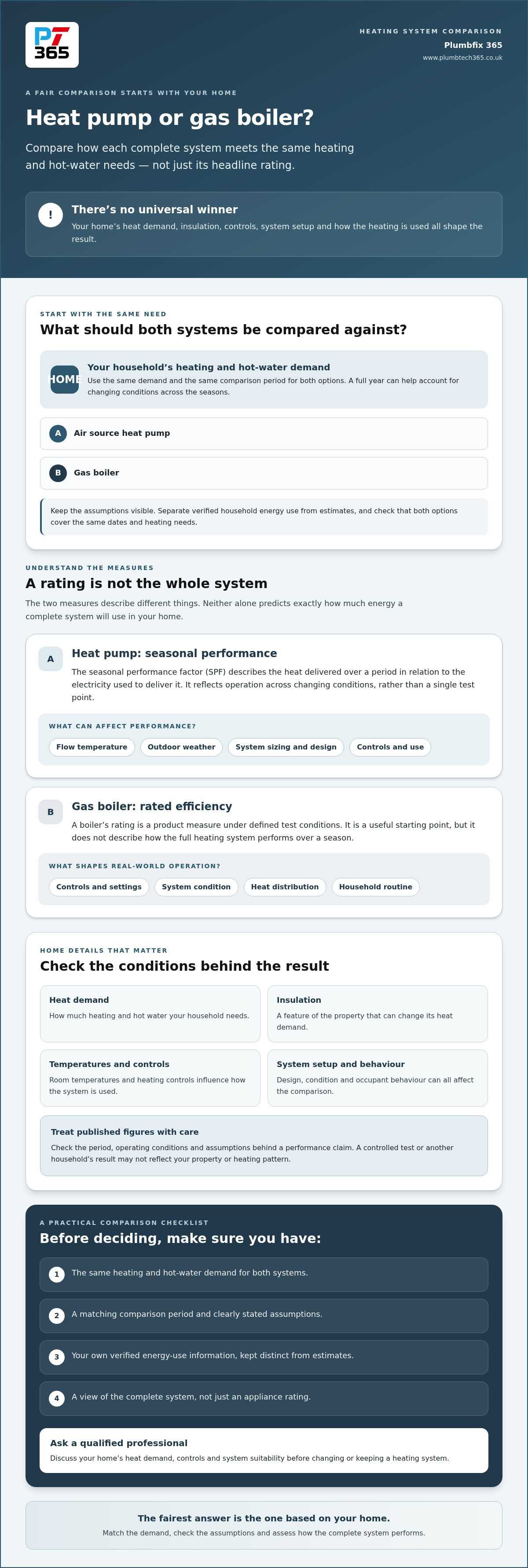
There’s no universal winner: your home and energy tariffs shape which heating system may suit you.
Compare a heat pump’s seasonal performance with how the boiler and full heating system operate in practice.
Check how your home’s heat demand, insulation, controls and existing system affect the assessment.
Use your own verified energy-use and tariff information, and compare both systems against the same heating and hot-water needs.
Before making a change, ask a qualified professional about heat demand, controls and system suitability.
Table of Contents: air source heat pump vs gas boiler running costs 2026
Air source heat pump vs gas boiler: what makes the comparison fair?
There’s no universal winner. The answer depends on your home’s heat demand and the gas and electricity tariffs that apply to you. A useful comparison looks at the energy needed to provide the same heating and hot water over the same period, such as a full year. It doesn’t treat an appliance’s headline efficiency as a prediction of your household’s energy use.
Keep energy consumption separate from other ownership considerations. Installation, servicing and standing charges aren’t part of a comparison of energy used for heating and hot water unless you deliberately include them. State what’s included, what’s excluded and the period being assessed. That makes the result easier to understand and prevents an energy-use estimate from being mistaken for a full comparison of owning each system.
What does an energy-use comparison include?
Start with the heat your household needs, including hot water, then compare how much gas or electricity each system would use to meet that demand. Use your own gas and electricity tariff details rather than assumed national figures. If you’re comparing a winter month rather than a full year, make sure both scenarios cover the same dates and conditions.
Be clear about the boundaries of the comparison. A calculation that includes installation, servicing or standing charges for one system but not the other won’t be fair. Keep estimates separate from verified household consumption, too. The comparison is meaningful only when its assumptions are visible.
Why can published comparisons reach different answers?
Homes don’t all need the same amount of heat. Insulation, room temperatures, heating controls and occupant behaviour can change demand. System condition and setup matter as well: an assumed performance figure may not represent how a particular system operates in a particular home. For a basic explanation of how a heat pump draws heat from outdoor air, see Air source heat pump.
Tariff assumptions and comparison periods can shift the result, too. One comparison may use a household’s current tariff details, whilst another relies on different assumptions or models a different season. Check when any 2026 tariff, performance figure or policy claim was verified, and confirm it still applies before relying on it. Treat an unverified estimate as an estimate, not a forecast.
A fair comparison uses matching heat demand and explicit assumptions. That test helps you judge whether a published claim is relevant to your home, rather than taking a headline result at face value.
How heat-pump performance and boiler efficiency affect energy use
Appliance ratings help describe equipment, but they don’t tell you exactly how much energy a complete heating system will use in your home. The distinction matters in an air source heat pump vs gas boiler running costs 2026 comparison: seasonal heat-pump performance reflects operation over time, whilst a boiler’s rated efficiency is a product measure under defined test conditions.
What seasonal performance means for a heat pump
The seasonal performance factor (SPF) describes the heat a heat pump delivers over a period in relation to the electricity it uses. It compares useful heat output with electrical input across changing operating conditions, rather than reporting performance at just one test point. Seasonal performance is the heat delivered over a period divided by the electricity used to deliver it. No single product rating guarantees that result in your home.
Actual performance depends on system design and use. Flow temperature, the temperature of water sent around the heating system, can affect how hard the heat pump must work. Outdoor weather also changes its operating conditions. Correct system sizing, controls and setup help determine whether the design suits the property. Ask a suitably qualified heat-pump specialist to explain the assumptions behind any projected SPF and how it relates to your home.
When reviewing performance claims, check the period and operating conditions they describe. A result from a controlled test or another property may not represent your household’s heating pattern, system design or local weather. Ask what the estimate is based on and whether it reflects the complete system, including its controls.
What affects a gas boiler’s real-world efficiency?
A boiler’s rated efficiency offers a useful starting point, but it isn’t the same as the performance of the full heating system over a season. Controls, operating settings, system condition and how heat is distributed around the home all influence how much gas is used to meet demand. A rating alone can’t account for every property or household routine.
Regular maintenance can support safe, reliable boiler operation, but it shouldn’t be presented as a guaranteed efficiency gain. If you’re assessing your existing system, review the checks covered in this professional boiler servicing guide. Boiler installation and servicing are available, with technical work carried out by Gas Safe Registered engineers. For information about these services, visit boiler servicing and installation information.
For a useful comparison, ask for the performance assumptions behind both systems, not just their headline ratings. This helps distinguish product testing from a projection for your property.
Which system may suit your home and tariff better?
A heat pump isn’t automatically cheaper to run in every home. The outcome depends on how much heat your property needs, how well the system performs in practice and the relationship between your electricity and gas unit rates. For the air source heat pump vs gas boiler running costs 2026 comparison, check these factors together rather than judging by fuel type alone.
When a heat pump may compare favourably
A heat pump may be worth assessing where it can be designed to meet the home’s heat demand effectively, particularly with well-managed demand and operation at suitable lower flow temperatures. Those conditions need to be checked, not assumed. Include the household’s actual electricity tariff alongside the heat pump’s projected seasonal performance. A technical assessment is needed before deciding whether a particular property is suitable.
When keeping or replacing a boiler needs closer review
Consider the boiler’s condition, controls and ability to meet your household’s heating and hot-water needs. An urgent fault calls for a prompt assessment of the boiler problem; it doesn’t automatically settle the separate, longer-term question of which heating system is right for the property. If replacement is being considered, this boiler replacement signs checklist can help you prepare questions for a qualified boiler engineer.
Change the assumptions and the result may change. A different tariff, improved controls, a revised heat-demand estimate or a heat-pump design with different operating conditions can all affect the comparison. Ask professionals to explain their assumptions. For heat-pump design, seek a suitably qualified specialist; for boiler condition and replacement advice, use a Gas Safe Registered engineer.
How to compare your home’s heating use in 2026
Use your own records and make the assumptions visible. This gives you a more useful starting point for comparing the air source heat pump vs gas boiler running costs 2026 than a headline estimate based on a different household.
Collect your energy records. Check recent statements or account data for gas and electricity consumption, the unit rates on your tariffs and the period they cover. If your figures include cooking or other uses, don’t assume all your gas consumption is for heating.
Identify your home’s heating needs. Note how you use heating and hot water, your usual settings and household routines. Include relevant details about insulation, radiators and existing controls.
Set a like-for-like period. Compare the same dates, and include hot water consistently in both scenarios. Each system must be assessed against equivalent useful heat, not simply against the other system’s fuel consumption.
Record the performance assumptions. For the heat pump, ask what seasonal performance factor has been used and what system design and operating conditions it assumes. For the boiler, record the assumed system efficiency, controls and operating pattern. Seek a qualified assessment if your heat demand or either system’s performance is unclear.
Apply your current tariff information. Use the relevant gas and electricity unit rates for the consumption period. If your tariff or rates change, update the comparison rather than treating an old calculation as a reliable forecast.
Keep a simple note beside each result: the period covered, estimated heat demand, hot-water inclusion, tariff details and assumptions about seasonal performance, boiler efficiency, controls and usage. If an estimate relies on an unexplained figure, ask where it came from and whether it fits your home.
Then test the conclusion. Check how it changes if the electricity or gas tariff assumption shifts, or if the projected heat-pump performance differs from the original estimate. This sensitivity check shows whether the result depends on one uncertain input. Don’t confuse this energy-use comparison with a decision about installation or maintenance; those are separate parts of choosing a system.
For more pointers on spotting issues with your existing heating setup, read this guide to central-heating efficiency warning signs. If you’re reviewing your boiler’s condition or considering a replacement, speak with a boiler engineer about your installation options. For heat-pump design and installation, consult a suitably qualified heat-pump specialist.
Choose your next step before changing a boiler or heating system
There’s no universal verdict in the air source heat pump vs gas boiler running costs 2026 comparison. Your next step is a home-specific assessment that considers heating demand, the condition and controls of your current system, your tariff and the design proposed for any replacement. A running-cost estimate can inform the decision, but it shouldn’t replace a technical assessment.
Questions to ask before committing to a system change
Ask the heating professional to explain the figures and the work behind them. Clear answers make it easier to compare advice and spot assumptions that may not fit your household.
What heat demand has been assumed, and how have heating and hot water been included?
Which tariff, seasonal performance and boiler-efficiency assumptions were used in the comparison?
Who will assess the existing system, including its controls and condition?
Who will design and assess the proposed system for the property, and what evidence supports its suitability?
What ongoing servicing is required, and who is qualified to carry it out safely?
Request a like-for-like explanation, including what could change the result. For a heat pump, ask a suitably qualified heat-pump specialist to assess system design and expected performance for your home. For a gas boiler, ask a Gas Safe Registered engineer to assess its condition and explain the relevant boiler options. Keep a fault that needs attention separate from a considered decision about changing the whole heating system.
Where boiler specialists can help
Boiler installation, servicing and heating maintenance can help you assess and manage your existing heating setup. Technical work should be carried out by a Gas Safe Registered engineer. If you’re considering a heat pump, speak to an appropriately qualified specialist about system design, installation and ongoing care.
For a boiler assessment or to discuss installation and servicing, discuss your boiler requirements. Take your comparison assumptions and recent energy records to the conversation. That gives the professional a clearer starting point and helps you make a decision based on your home, not a headline claim.
Make your next heating decision with confidence
The air source heat pump vs gas boiler running costs 2026 comparison has no universal winner. A fair assessment uses your home’s heating and hot-water needs, your current energy tariffs and realistic assumptions about whole-system performance. Check how seasonal heat-pump performance and the condition and controls of your boiler affect the result, rather than relying on appliance ratings alone.
Use your own energy records as a starting point, then ask a qualified professional to explain the assumptions and assess whether the proposed system suits your property. Boiler installation and servicing are available, with technical work carried out by Gas Safe Registered engineers. For heat-pump design or installation, speak to an appropriately qualified specialist.
Discuss your boiler requirements and take a clear next step. With the right information and professional guidance, you can choose a heating system with greater confidence.
Frequently Asked Questions
Is an air source heat pump cheaper to run than a gas boiler in 2026?
Not necessarily. The air source heat pump vs gas boiler running costs 2026 comparison depends on your home’s heat demand, each system’s real-world performance and the electricity and gas tariffs you pay. A heat pump’s efficiency rating or a boiler’s rated efficiency can’t predict your household’s result on its own. Compare both systems against the same heating and hot-water needs, using clear assumptions for your property.
How do I compare heat-pump and gas-boiler running costs?
Use your own energy records and tariff details to compare the energy each system would need to provide equivalent heat over the same period. Include hot water consistently in both scenarios. Record the heat pump’s assumed seasonal performance, the boiler’s assumed system efficiency, and the controls and usage pattern used. State whether standing charges, installation and servicing are excluded, so you don’t mistake an energy-use comparison for a full ownership assessment.
Can a heat pump cost more to run than a gas boiler?
Yes. A heat pump could have higher running costs if its seasonal performance is lower than assumed, the home has high heat demand, or the electricity tariff makes its energy use less favourable than the boiler’s gas use. System design and operation matter, too. A headline comparison may not reflect these details, so test how the result changes when tariff and performance assumptions are adjusted for your home.
What affects an air source heat pump’s running costs most?
The main factors are the home’s heat demand, the heat pump’s seasonal performance and the electricity tariff. Insulation and household heating habits affect how much heat the property needs. System design, controls, flow temperature and outdoor conditions can influence how efficiently the heat pump supplies it. Ask a suitably qualified heat-pump specialist to explain the performance assumptions for your property rather than relying on a general figure.
Does a gas boiler’s age affect its running costs?
Age can be relevant, but it doesn’t determine running costs by itself. The boiler’s condition, controls, operation and the wider heating system all affect how effectively gas is used to meet your home’s needs. A newer boiler isn’t automatically the right choice, and an older one needs an assessment before you draw conclusions. A Gas Safe Registered engineer can review the boiler and explain whether servicing, repair or replacement merits consideration.
Do I need to replace my radiators when switching to a heat pump?
Not always. Whether existing radiators can provide enough heat depends on the property’s heat demand, the radiators’ output and the proposed system’s design and operating temperatures. A heat-pump specialist should assess the rooms and heating system before confirming what changes, if any, are needed. Don’t assume every radiator must be replaced, or that existing radiators will definitely be suitable, without a property-specific assessment.
Should I replace my boiler with a heat pump in 2026?
Decide after comparing your home’s heat demand, current boiler condition, tariffs and a heat pump’s proposed system design. Ask for the assumptions behind projected energy use and whether your radiators, controls and property are suitable. If considering a heat pump, consult an appropriately qualified specialist. For boiler installation or servicing, Plumbtech 365’s technical work is carried out by Gas Safe Registered engineers. Choose based on a clear assessment, not a universal verdict.


Comments