


Can an Old Boiler Cause Carbon Monoxide Poisoning? A 2026 Homeowner’s Safety Guide

Your twenty-year-old boiler isn't just a sturdy piece of machinery; it's a structural hazard that could be hiding a lethal secret in plain sight. You likely appreciate that your heating system still fires up every morning, yet that nagging anxiety about invisible leaks or conflicting advice from tradespeople never quite disappears. It's natural to worry about the high cost of a new installation whilst questioning if you're being over-cautious. However, the central question remains: can an old boiler cause carbon monoxide poisoning? The short answer is yes, and the risks increase every year as safety mechanisms become obsolete and metal fatigue sets in.
This 2026 homeowner’s guide will help you discover the critical link between ageing heating systems and carbon monoxide risks. We'll show you exactly how to protect your household from this silent killer without falling for industry myths. You'll learn to identify the specific physical symptoms of CO poisoning, understand how cracked heat exchangers develop, and gain a clear plan for professional maintenance or replacement. Our Gas Safe registered engineers have seen these risks firsthand across London and Kent; now, we're giving you the expertise to stay safe and keep your home secure.
Table of Contents
Understanding the Link Between Boiler Age and Carbon Monoxide Risks
Carbon monoxide (CO) is a colourless, odourless, and tasteless gas. It's produced when fuels like natural gas fail to burn fully. Many homeowners in our local community ask, can an old boiler cause carbon monoxide poisoning? The risk is statistically much higher in older systems. As a boiler ages, its efficiency inevitably drops. This decline often stems from 'incomplete combustion'. When burners or injectors become corroded or warped over time, they can't maintain the correct air-to-fuel ratio. This results in the production of toxic CO instead of harmless carbon dioxide.
Why is Carbon Monoxide Called the Silent Killer?
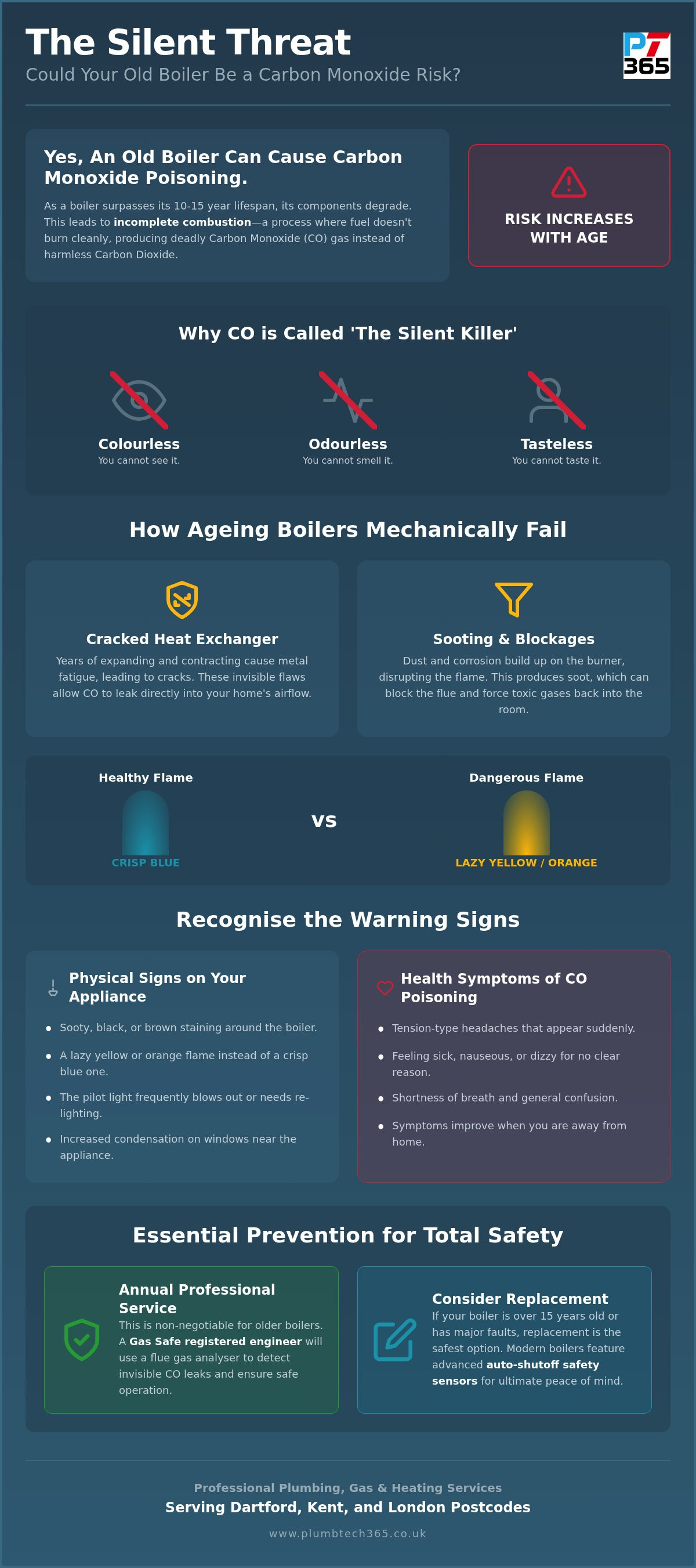
You can't see it. You can't smell it. You can't taste it. Unlike a gas leak, which usually has a 'rotten egg' smell added for safety, CO provides no sensory warning. Carbon monoxide poisoning occurs because the gas binds to your red blood cells far more effectively than oxygen. It starves your vital organs of the air they need. This can lead to rapid failure and, in extreme cases, death. Under 2026 safety standards, any detectable CO within a property requires immediate isolation of the appliance by a qualified expert.
Does Age Directly Increase the Risk of a Leak?
A boiler's safe lifespan usually spans 10 to 15 years. Once you cross this threshold, component reliability becomes a gamble. Older models often use outdated technology that lacks the advanced safety sensors found in modern condensing boilers. These modern units feature fail-safe mechanisms that shut the system down if they detect a combustion imbalance. In areas like Dartford and Bromley, London's hard water poses an extra threat. Limescale builds up inside the heat exchanger, causing 'hot spots'. This internal stress can lead to metal fatigue and eventual cracks that allow gases to escape into your home.
The only way to verify your system's safety is through a professional assessment. Every engineer at Plumbfix 365 is on the Gas Safe Register, ensuring we meet the highest industry standards for boiler servicing. We've been serving London and Kent postcodes since 1996, positioning us as a steady hand during any household crisis. Don't wait for a failure to occur. Proactive safety checks by qualified gas engineers are the only reliable defence against the silent killer.
How Ageing Components in Older Boilers Can Lead to CO Leaks
Understanding the mechanical reality of an ageing system is vital. The primary barrier between your family and toxic combustion gases is the heat exchanger. This metal component carries intense heat from the burner to the water in your central heating system. Over a decade of use, this metal undergoes thousands of heating and cooling cycles. This constant expansion and contraction lead to metal fatigue. When the metal weakens, it becomes prone to warping and failure. This physical degradation is the core reason why many experts answer yes when asked: can an old boiler cause carbon monoxide poisoning?
Another major risk factor in older units is "sooting" on the burner. Over time, dust, debris, and corrosion products accumulate on the burner head. This disrupts the flame pattern, often turning it from a healthy blue to a lazy yellow or orange. This change indicates that the gas isn't burning cleanly. This soot can eventually block the narrow passages in the heat exchanger, forcing combustion gases back into the room instead of out through the flue. In the older properties found across Kent and London, these issues are frequently compounded by narrow chimneys or outdated flue designs that are easily obstructed.
The Danger of Cracked Heat Exchangers
Microscopic cracks in a heat exchanger are a nightmare for home safety. These flaws are often invisible to the naked eye when the boiler is cold and the metal is contracted. However, once the system fires up, the metal expands and the cracks open. This allows carbon monoxide to seep directly into the air being circulated around your home. To Protect Your Family, you must recognise that only a specialist tool can detect these leaks. This makes professional boiler servicing essential, as engineers use electronic analysers to find what the human eye misses.
Obsolete Safety Features and Ventilation Issues
Older "open-flue" boilers are significantly more dangerous than modern "room-sealed" units. An open-flue system draws oxygen for combustion directly from the room it sits in. If you've recently upgraded your home in Dartford or South East London with new double glazing or extra insulation, you might have accidentally starved your old boiler of air. Without enough oxygen, the boiler produces more CO. Modern boilers avoid this by taking air from outside through a sealed pipe. Many terraced houses in our area have boilers tucked into cupboards or small kitchens where ventilation is already limited, making the risk of a leak even more acute. If you're concerned about your current setup, it's worth speaking to local boiler engineers who understand the specific layout of Kent and London homes.
Identifying the Warning Signs of a Dangerous Boiler
Knowing the technical risks is one thing; recognising the danger in your own home is another. Because carbon monoxide is invisible, you must rely on secondary indicators. These signs often appear gradually, making them easy to dismiss as minor maintenance issues or seasonal illnesses. However, ignoring these warnings can be fatal. If you're wondering, can an old boiler cause carbon monoxide poisoning, the answer is often found in the physical state of the appliance and the health of those living near it.
Visual Cues on the Appliance and Surroundings
A healthy gas flame should be crisp and blue. If you see a "lazy" yellow or orange flame, it's a clear sign of oxygen starvation and incomplete combustion. This means the boiler is actively producing carbon monoxide. You should also look for dark, sooty stains on or around the boiler casing. These marks, often called scorching, indicate that combustion gases are "spilling" out of the unit instead of being safely vented through the flue. Excessive condensation on the windows of the room where the boiler is located can also signal a ventilation failure. If you spot any of these indicators, you need emergency boiler repair Dartford immediately to isolate the risk.
Recognising Health Symptoms Before They Escalate
CO poisoning is frequently mistaken for the flu or food poisoning. The critical differentiator is a fever; carbon monoxide poisoning does not cause a high temperature. Symptoms include:
Persistent headaches that improve when you leave the house.
Nausea and vomiting without other signs of infection.
Dizziness, confusion, or a feeling of "fogginess".
Shortness of breath or chest pains whilst resting.
Pay close attention to the "recovery effect". If you feel significantly better after an hour at work or outdoors but the symptoms return shortly after coming home, your boiler is likely the culprit. These issues often peak in winter because we keep windows closed and run the heating constantly, allowing the gas to reach dangerous concentrations. Don't ignore your pets either. Because they have smaller lung capacities, dogs and cats often show signs of lethargy or illness long before humans. If you're asking can an old boiler cause carbon monoxide poisoning, remember that your pet's sudden change in behaviour might be your first warning.
If you suspect a leak, follow these immediate steps. Turn off the gas supply at the meter. Open every window and door to ventilate the property. Evacuate all residents and pets immediately. Do not turn the boiler back on until a Gas Safe registered engineer has certified it as safe. Taking rapid action is the only way to ensure your family's safety during a potential crisis.
Essential Prevention: Protecting Your London or Kent Home
Prevention isn't just a recommendation. It's a lifesaver. When homeowners ask, can an old boiler cause carbon monoxide poisoning, they often overlook the simple, routine steps that prevent tragedy. In the older housing stock of South East London and Kent, boilers are often tucked away in poorly ventilated cupboards, under stairs, or in small utility rooms. These cramped spaces restrict airflow. Without a constant supply of fresh air, the combustion process fails, leading to a build-up of toxic gas. Regular maintenance identifies these airflow issues before they become life-threatening.
The Role of Annual Gas Safe Servicing
An annual service is your primary defence. Our Gas Safe registered engineers perform rigorous technical checks that go far beyond a simple visual inspection. We examine burner pressure, flue integrity, and ventilation rates to ensure your appliance operates within safe parameters. A "cheap" service that skips these steps is a dangerous gamble. The only way to truly confirm safety is with a flue gas analyser. This sophisticated tool measures the exact ratio of oxygen to carbon monoxide in the exhaust gases. If these levels fluctuate even slightly, it indicates a failing component. For those managing rental properties, staying compliant is a legal necessity. Check our Landlord Gas Safety Certificates guide to understand your legal duties under the CP12 requirements.
Installing and Maintaining CO Alarms Correctly
You must install audible carbon monoxide alarms. Avoid the passive "black spot" patches that only change colour. They are useless if you are asleep or in another room. Place your alarms between one and three metres away from the boiler on a wall or ceiling. It's vital to test them monthly using the "test" button. Check the expiry date printed on the back of the unit. Most electrochemical sensors only last five to seven years before they become unreliable.
Remember that an alarm is a second line of defence. It is not a substitute for professional servicing. If you haven't had your system checked recently, book a professional boiler service with our local team today. We've been keeping London and Kent homes safe since 1996, providing the steady hand you need in a crisis.
When to Repair vs. Replace Your Old Boiler for Total Safety
Deciding whether to patch up a failing unit or invest in a new system is a significant financial choice for any homeowner. However, safety must always be the primary factor in your decision-making process. When you ask, can an old boiler cause carbon monoxide poisoning, you're usually dealing with a system that has already shown signs of fatigue. At Plumbfix 365, we use the "Beyond Economical Repair" (BER) threshold to help you decide. If the cost of a repair exceeds 50% of the value of a new unit, or if the safety of the heat exchanger is compromised, replacement is the only responsible path.
Modern condensing boilers provide a level of security that older models cannot match. These systems are "room-sealed", meaning they draw oxygen from outside and vent exhaust gases through a dedicated pipe. This design completely isolates the combustion process from your living area. Modern units also feature advanced auto-shutoff sensors. These sensors kill the gas supply instantly if they detect a flue blockage or a dangerous drop in oxygen levels. Beyond the safety benefits, a new boiler installation often pays for itself through significantly lower gas bills and improved reliability.
Signs Your Boiler is Beyond Safe Repair
If your boiler is over 15 years old, sourcing genuine replacement parts becomes increasingly difficult and expensive. Attempting to fit "pattern" or non-standard parts into an old system can create new safety risks. A recurring fault, such as a pilot light that keeps blowing out or a casing that feels excessively hot, often indicates a fundamental structural failure. When the internal components begin to warp from heat stress, the risk of a CO leak becomes a constant threat. You can check our detailed signs your boiler needs replacing checklist to see if your current system is reaching its limit.
Professional Installation Services in London and Kent
Our approach to boiler installation in Dartford focuses on long-term safety and compliance. We don't just swap the box; we evaluate your entire heating system, including ventilation and flue positioning, to ensure it meets the latest 2026 safety standards. Our Gas Safe registered engineers cover a wide area, providing expert service across Bromley, Maidstone, Medway, and South East London. We've been a steady hand for local residents since 1996, prioritising honest billing and technical excellence. Don't leave your family's safety to chance with an ageing, unpredictable appliance. Book a safety inspection or get a replacement quote today to secure your home for the future.
Secure Your Home and Family Against the Silent Killer
Your home should be a sanctuary, not a source of hidden danger. The technical reality is that can an old boiler cause carbon monoxide poisoning is a question with a serious, affirmative answer. Ageing components like heat exchangers inevitably degrade; older designs lack the sophisticated fail-safes found in modern systems. By recognising the visual warning signs and health symptoms early, you can take the necessary steps to prevent a household crisis before it begins.
Protection starts with professional accountability. Our Gas Safe Registered engineers have been serving London and Kent since 1996, providing the steady hand and technical expertise required to keep your heating system compliant. We offer 24/7 emergency support to ensure you're never left vulnerable. Ensure your home is safe with a professional boiler service from Plumbfix 365. Take action today to secure your property and enjoy total peace of mind for your loved ones.
Frequently Asked Questions
Can a boiler produce carbon monoxide if it is switched off?
A boiler cannot produce carbon monoxide whilst it is completely switched off and the gas supply is isolated. However, many older models in Dartford and Bromley still utilise a permanent pilot light that stays lit even when the heating is inactive. If this small flame burns inefficiently due to dust or corrosion, it can still produce toxic gas. Always ensure the gas valve is fully closed if you suspect a leak.
How often should I test my carbon monoxide alarm?
You should test your carbon monoxide alarm at least once a month by pressing the "test" button until the siren sounds. Under 2026 safety standards, these devices are mandatory for UK landlords and highly recommended for all homeowners across Kent. Check the expiry date on the back of the unit; most electrochemical sensors only last five to seven years. Replace the entire unit immediately if it fails the monthly test.
Is it legal for a landlord to have an old boiler in a rental property?
It is perfectly legal for a landlord to have an older boiler provided it passes the annual Gas Safe inspection. There is no statutory age limit for appliances in rental properties across London or Kent. However, the landlord must provide a valid CP12 certificate every twelve months. If an engineer deems the system "At Risk" or "Immediately Dangerous," the landlord is legally required to repair or replace it to ensure tenant safety.
What colour should my boiler flame be if it is working safely?
A safe, well-maintained boiler should produce a crisp, blue flame. If you notice a lazy yellow or orange flame, this is a primary indicator of incomplete combustion. This change suggests that the air-to-fuel ratio is incorrect, which answers the concern: can an old boiler cause carbon monoxide poisoning? If the flame looks discoloured, turn off the appliance and contact a Gas Safe engineer in Bexleyheath or Sidcup immediately for a safety assessment.
Can I get carbon monoxide poisoning from a modern combi boiler?
Yes, you can still experience carbon monoxide poisoning from a modern combi boiler, though the risk is significantly lower than with older open-flue models. Modern units are room-sealed, but external factors like a blocked flue, physical damage to the casing, or poor installation can still result in CO leaks. Regular boiler servicing remains essential for all systems to ensure the internal seals and safety sensors are functioning correctly according to manufacturer standards.
How long does a carbon monoxide safety check take?
A dedicated carbon monoxide safety check usually takes between 30 and 45 minutes when performed by a qualified engineer. During this time, the technician will use a flue gas analyser to measure the combustion levels and check the integrity of the flue and ventilation points. At Plumbfix 365, we include this vital check as standard in every service we provide across Dartford and the surrounding London postcodes to ensure your total peace of mind.
What should I do if my CO alarm starts sounding?
If your CO alarm sounds, you must evacuate the property immediately and leave the doors and windows open. Turn off the gas supply at the meter if it is safe to do so. Do not stop to collect belongings or investigate the source yourself. Once outside, call the National Gas Emergency Service. You should also contact a Gas Safe registered engineer to inspect the property before you attempt to re-enter or restart any appliances.
Does a standard boiler service include a carbon monoxide test?
A standard, professional boiler service must always include a carbon monoxide test as part of the flue gas analysis. This is the only way an engineer can verify that the appliance is burning fuel safely and efficiently. If you're worried that can an old boiler cause carbon monoxide poisoning, ensure your engineer uses an electronic analyser to provide a printed report of the CO levels. This documentation is a critical part of your home safety record.


Comments