


Commercial Heating Upgrades: 2026 Business Case Guide

Is your aging plant room becoming a ticking financial time bomb for your business? With emergency repair costs climbing and the 2026 EPC standards approaching, sticking with an inefficient system is no longer the safe choice for any property manager. Successfully presenting a business case for commercial heating upgrades requires more than just a list of technical specifications. It demands a clear focus on risk mitigation, long-term stability, and the protection of your profit margins.
We understand that securing board approval for major capital expenditure is a significant hurdle for many management companies. This guide provides you with the exact structure needed to win budget approval by demonstrating clear ROI and improved operational resilience. You will learn how to align your heating plant upgrade with 2026 energy standards to ensure your properties remain compliant and your tenants stay satisfied. As specialists in London and Kent commercial plant rooms since 1996, we will walk through the financial drivers, the impact of current UK regulations, and the step-by-step process of building a proposal that your directors cannot ignore.
Table of Contents
Identifying the Drivers for a Commercial Heating System Upgrade
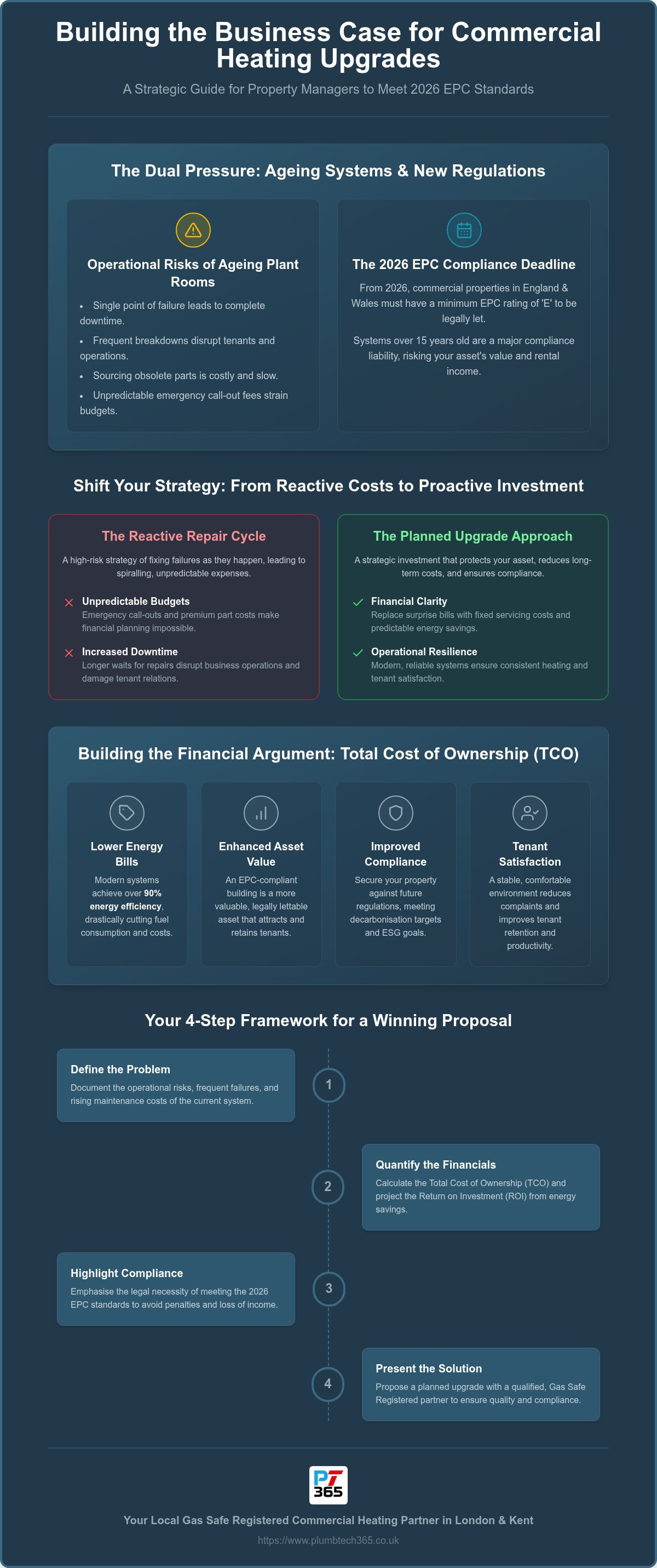
Many property managers fall into the trap of reactive maintenance. They wait for a boiler to fail before acting. This is a high-risk strategy that often leads to expensive downtime and tenant disputes. A strategic upgrade, by contrast, is a planned investment designed to modernise HVAC systems before they reach a point of total failure. When you start presenting a business case for commercial heating upgrades, you're shifting from a mindset of fixing problems to one of protecting assets.
The regulatory landscape has made this shift mandatory. As of September 2026, commercial properties in England and Wales must hold a minimum Energy Performance Certificate (EPC) rating of 'E' to be legally let. Systems installed over fifteen years ago rarely meet these modern requirements. These old plant rooms are no longer just inefficient; they're financial liabilities that can prevent you from leasing your space. You can't afford to ignore terminal signs like frequent pressure drops or unusual mechanical noises.
Operational Risks of Ageing Plant Rooms
Older plant rooms often rely on single, large boilers without modular backup. This creates a single point of failure. If that unit goes down, the entire building loses heat. For businesses in Kent and London, this means halted operations and potential data centre overheating. Waiting for a total breakdown is the most expensive path you can take. Emergency parts for obsolete models are difficult to source and carry a premium price tag. Proactive boiler servicing can identify these terminal signs early, but eventually, the hardware simply reaches the end of its reliable life.
The Cost of Inefficiency in Modern Business
Inefficient systems drain your annual maintenance budget through constant reactive call-outs. When you're budgeting for property heating maintenance, you must account for the high utility bills caused by poor control interfaces. Modern systems offer precision that old mechanical valves can't match. Reliability also directly impacts tenant productivity; a cold office leads to higher staff turnover and reduced output. By 2026 standards, a high-efficiency commercial boiler should achieve at least 90% seasonal space heating energy efficiency to remain competitive and compliant. Upgrading isn't just about heat; it's about maintaining a stable, profitable environment.
Building the Financial Argument: ROI and Long-Term Savings
When you are presenting a business case for commercial heating upgrades, the most persuasive data points are found in the Total Cost of Ownership (TCO). Many boards focus solely on the initial capital expenditure. However, a ten-year analysis usually reveals that the cost of maintaining a failing plant room exceeds the price of a new boiler installation. New systems provide financial clarity. They replace unpredictable repair bills with fixed servicing costs and protected performance.
Calculating Energy Consumption Reductions
Historical billing data is your best tool for projecting future savings. Older, non-condensing boilers often operate at significantly lower efficiency levels than modern counterparts. By switching to high-efficiency condensing technology, you can drastically cut fuel spend. Integrating smart heating controls further reduces waste by ensuring heat is only delivered when and where it is needed. For those considering low-carbon transitions, the Boiler Upgrade Scheme provides a viable route for eligible properties. You should also factor in the benefits of professional power flushing. This process removes sludge and debris, ensuring your new investment operates at peak efficiency from day one.
Reducing Reactive Maintenance and Emergency Call-Outs
The hidden drain on facilities budgets is the 'patch-and-mend' cycle. As plant rooms age, sourcing obsolete parts becomes a logistical nightmare. These components often carry a high premium and lead to extended downtime. A new system eliminates this risk entirely. Modern plant is backed by valid manufacturer warranties, which often cover parts and labour for several years. This shifts the financial risk from your business back to the manufacturer. When presenting a business case for commercial heating upgrades, emphasise the stability that a manufacturer warranty brings to the balance sheet. If you are struggling to justify the spend, an audit from expert boiler engineers can help quantify your current reactive spend versus the stability of a modern system.
Compliance, ESG, and Legal Responsibilities
Compliance is no longer a "nice to have" feature; it's a legal baseline. When you are presenting a business case for commercial heating upgrades, you must highlight the shift from voluntary green initiatives to mandatory statutory duties. Failing to upgrade an inefficient plant room doesn't just waste energy; it creates legal exposure for directors and property owners in London and Kent. Modernising your plant room ensures you stay ahead of tightening environmental laws rather than scrambling to react to them.
Meeting Decarbonisation Targets and EPC Standards
UK commercial buildings are under intense pressure to meet carbon reduction targets. Modern heating systems are a primary driver for improving building efficiency and supporting corporate ESG reporting. If your building fails to meet minimum standards, it effectively becomes unrentable, leading to significant void periods and lost revenue. As of September 2026, commercial properties in England and Wales are required to have a minimum Energy Performance Certificate (EPC) rating of 'E' to be let. Beyond this immediate hurdle, large organisations must also navigate the Streamlined Energy and Carbon Reporting (SECR) framework. This requires detailed disclosures on energy efficiency actions taken during the year. A new installation provides a clear, documented path toward these environmental goals while meeting Energy Savings Opportunity Scheme (ESOS) assessment requirements.
Ensuring Health and Safety Compliance in the Workplace
Employers have a strict duty of care to provide a safe environment for staff and visitors. Large commercial plant rooms carry inherent risks, including potential carbon monoxide leaks if systems are poorly maintained or incorrectly installed. You must ensure all works are carried out by Gas Safe Registered engineers to maintain your insurance validity and legal standing. This includes securing valid landlord gas safety certificates every twelve months without exception. For multi-site operations, maintaining a reliable CP12 register is essential for tracking compliance. Since 1996, we've helped management companies across London and Kent navigate these complex requirements. By presenting a business case for commercial heating upgrades that leads with safety, you protect the business from catastrophic reputational damage. This proactive approach ensures you are never caught out by sudden regulatory changes or inspection failures.
Structuring Your Business Case: A Step-by-Step Guide
A successful proposal translates technical failures into financial risks. Your executive summary must lead with the primary benefit, such as protecting the annual maintenance budget or ensuring 2026 EPC compliance. Directors care about stability and risk mitigation. By framing the project around these priorities, you align the upgrade with the company's broader commercial goals. Presenting a business case for commercial heating upgrades requires a logical flow that moves from current failures to future savings. You must prove that the status quo is more expensive than the investment.
Gathering Performance Data and System Audits
Data is the foundation of any board-level request. You need to collect detailed logs of every breakdown, repair, and emergency call-out from the last two years. This creates a clear paper trail of the 'patch-and-mend' cycle. Consulting with expert boiler engineers provides the technical weight your case needs. Professional assessments using efficiency tests or thermal imaging can prove exactly where heat is being lost. These facts remove emotion from the decision and replace it with undeniable evidence of terminal inefficiency. Don't rely on anecdotal evidence; use hard numbers to show how often the system has failed and the exact cost of each incident.
Presenting the 'Do Nothing' vs 'Upgrade' Comparison
Your case must include an options appraisal. Comparing a full replacement against a 'do nothing' approach often reveals the true cost of inaction. Visualise the rising maintenance spend against the flat, predictable cost of a new system. Emphasise the risk of catastrophic failure during peak winter months. A mid-winter breakdown doesn't just mean a cold office; it means potential building closures and tenant compensation claims. Capital tied up in constant repairs is an opportunity cost that prevents investment elsewhere. A phased upgrade might seem cheaper initially, but often results in higher long-term labour costs and mismatched components. Presenting a business case for commercial heating upgrades is about showing that a new installation is the only way to secure operational resilience.
Your financial analysis should clearly state the payback period. If the energy savings and avoided repair costs cover the investment within a few years, the board is much more likely to sign off. Factor in the zero rate of VAT on certain energy-saving materials available in the UK until March 2027 to strengthen your ROI projection. To get an accurate assessment of your current plant room's health, contact our boiler engineers in Dartford to schedule a professional audit.
Selecting a Qualified Commercial Heating Partner in London and Kent
Choosing the right contractor is as critical as the hardware itself. When you are presenting a business case for commercial heating upgrades, the board will want to know who is responsible for the long-term performance of the investment. Local accountability ensures a rapid response during a winter failure. You need a partner who understands the specific pressures of London and Kent plant rooms. A reliable firm provides more than just a quote; they provide the technical certainty that your business continuity is protected.
Why Gas Safe Registered Expertise is Non-Negotiable
The legal implications of using non-qualified persons for commercial gas works are severe. Domestic qualifications are not enough for complex plant rooms. You must verify that your chosen engineers hold specific commercial categories on the Gas Safe Register. This is a vital part of your duty of care. Using uncertified labour can immediately invalidate your building insurance and leave directors liable for safety breaches. Since 1996, we've seen how professional certification acts as a safety seal for management companies. Professional engineers ensure that every component meets current UK safety standards, including the management of carbon monoxide risks in large-scale systems. Always ask to see a valid Gas Safe ID card before any work begins on your site.
Planning for Minimal Operational Disruption
A major installation should not paralyse your business. Strategic scheduling is key. We often recommend planning works during shoulder seasons or outside of core business hours to avoid downtime. Working with heating engineers Dartford businesses have trusted for decades allows for better logistical coordination. A local partner can manage the delivery of heavy plant and the removal of old boilers without blocking essential access routes. They also ensure a clean, safe site throughout the process, which is critical for tenant satisfaction.
Once the installation is complete, the focus shifts to longevity. Evaluating a contractor's experience with central heating maintenance is essential for protecting your ROI. A long-term service agreement provides business peace of mind and keeps your manufacturer warranty valid. It ensures that minor issues are caught before they become expensive emergencies. When presenting a business case for commercial heating upgrades, include a planned maintenance schedule to show the board you have a strategy for the next ten years. This proactive approach is what separates a successful upgrade from a temporary fix.
Securing Your Building's Future Performance
Modernising your plant room is no longer a choice; it is a strategic necessity to protect your asset's value and ensure legal compliance. By presenting a business case for commercial heating upgrades that focuses on total cost of ownership and risk mitigation, you move away from the expensive cycle of reactive repairs. You ensure your property meets the 2026 EPC standards whilst providing a reliable, productive environment for your tenants. Operating since 1996, we are a trusted plumbing & heating company providing reliable, high-quality services across London and Kent.
Our Gas Safe Registered engineers are ready to support your transition to a more efficient, compliant system. We offer 24/7 emergency support to keep your operations running smoothly throughout the year. Don't wait for a terminal failure to disrupt your business continuity. Take control of your facilities budget and secure long-term stability for your property portfolio today. Secure your commercial heating audit with Plumbtech 365 today and start building a more resilient operation.
Frequently Asked Questions
What are the primary benefits of upgrading a commercial heating system?
Modern systems provide immediate reductions in utility bills and a significantly lower carbon footprint. Upgrading improves operational resilience by eliminating the high costs of emergency repairs and sourcing obsolete parts for failing hardware. Better temperature control also boosts tenant satisfaction and productivity. By 2026, high-efficiency systems are essential for maintaining building value and ensuring your property remains legally rentable under the latest UK Energy Performance Certificate standards.
How long does a typical commercial boiler installation take?
A standard commercial boiler installation typically takes between three to seven working days. The exact duration depends on the complexity of your plant room and whether you require significant pipework alterations. We conduct a detailed site survey to provide a precise timeline before work begins. Our engineers in Dartford and Kent work efficiently to minimise disruption, often scheduling major installations during shoulder seasons to reduce impact on building occupants.
Can I upgrade my heating system in stages to manage the budget?
Yes, upgrading in stages is a viable way to manage your annual capital expenditure. You might choose to replace a single failing unit in a modular system or update your controls first. However, a full replacement is often more cost-effective due to reduced labour costs and improved system integration. When presenting a business case for commercial heating upgrades, we recommend comparing the long-term savings of a full installation against a phased approach.
What legal certifications are required for commercial heating in the UK?
UK law requires all commercial heating work to be performed by Gas Safe Registered engineers with specific commercial qualifications. You must hold a valid Landlord Gas Safety Certificate (CP12) and renew it every twelve months. Additionally, systems over certain outputs require regular inspections to meet Energy Performance of Buildings Regulations. Maintaining these certifications ensures your building remains compliant, your insurance stays valid, and your environment stays safe from risks like carbon monoxide.
How do I calculate the ROI for a commercial heating upgrade?
To calculate ROI, compare the total installation cost against projected savings from reduced fuel consumption and avoided repair bills. Use your maintenance logs from the last two years to track reactive spend. Factor in the energy efficiency gains of modern condensing technology, which often achieves over 90% seasonal efficiency. A clear ROI projection, including the payback period, is the most persuasive part of presenting a business case for commercial heating upgrades to your board.
What happens if my commercial boiler fails and I don't have a business case ready?
Boiler failure without a plan leads to expensive emergency replacements and significant operational downtime. You lose the chance to select the most efficient technology or secure the best value. This reactive approach often results in tenant disputes and lost revenue. Having a prepared business case allows you to act decisively during a crisis, turning a technical failure into a planned investment that improves the long-term resilience of your Kent property.
Are there any grants available for commercial heating upgrades in 2026?
In 2026, eligible businesses can access the Boiler Upgrade Scheme for low-carbon transitions like air source heat pumps. The UK government also offers a zero rate of VAT on certain energy-saving materials until March 2027. These financial incentives are designed to help businesses meet decarbonisation targets. Whilst availability depends on your specific property type, these schemes significantly strengthen the financial argument for upgrading your plant room to modern, high-efficiency standards before regulations tighten further.
Why should I choose a local London or Kent engineer for my upgrade?
Local engineers from Dartford, Bromley, or London provide rapid emergency response times that national firms often cannot match. Local accountability is essential for commercial properties where downtime directly impacts profit. Plumbfix 365 has operated across Kent and London since 1996, providing deep expertise in regional plant room configurations. We offer a steady hand during technical failures, ensuring your system is back online quickly with the professional, Gas Safe Registered expertise your business demands.


Comments