


Expert Solutions for a Blocked Outside Drain Pipe in London & Kent
- darrell
- Apr 4
- 12 min read
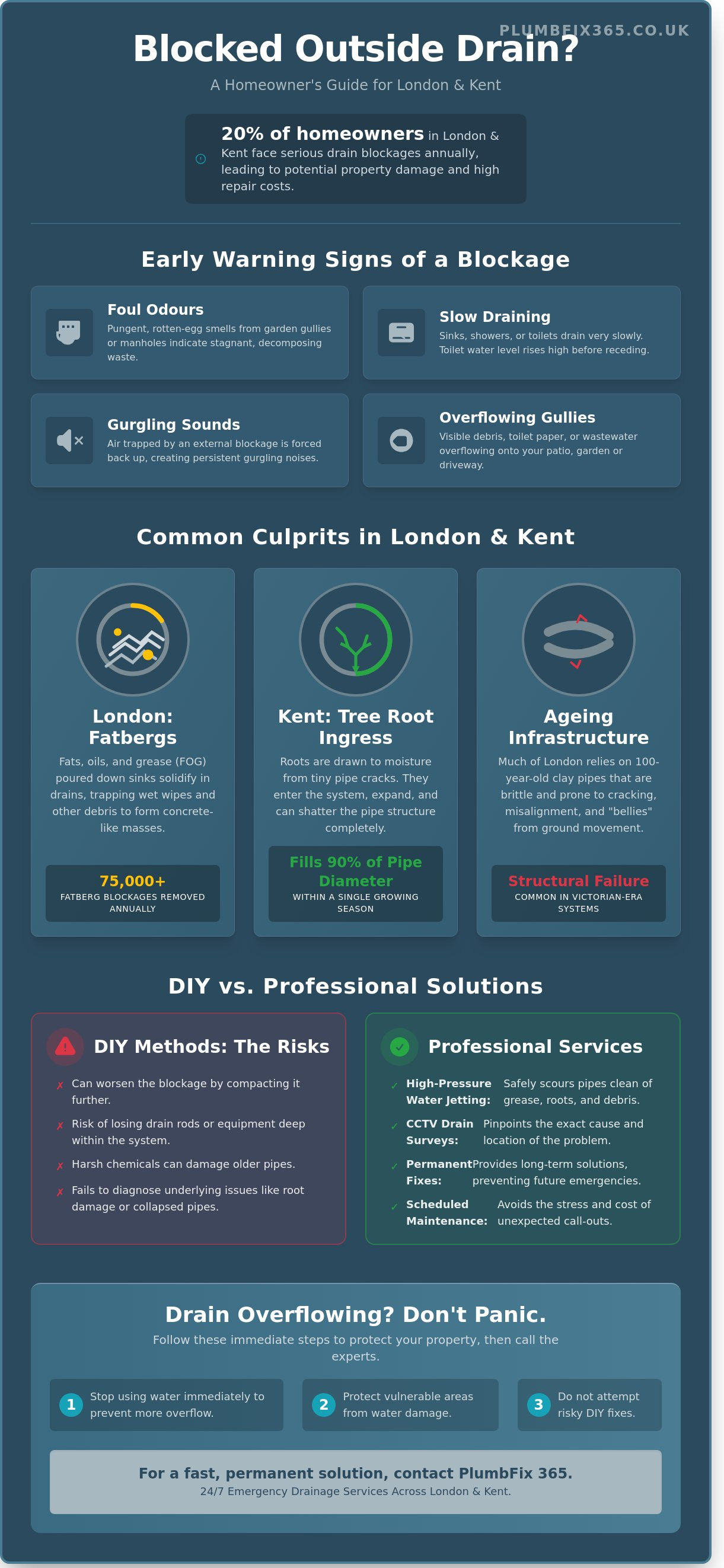
Last Tuesday, a homeowner in Dartford noticed a foul smell near their kitchen window that quickly escalated into standing water pooling against the house foundations. They soon discovered the culprit was a severely blocked outside drain pipe that threatened to flood their garden and ruin their patio. It's a stressful situation that roughly 20% of homeowners in London and Kent will face this year, often leading to immediate concerns about property damage and high repair bills.
You probably agree that drainage problems never happen at a convenient time and feel like a massive disruption to your daily life. The good news is that these issues don't have to result in a dug-up garden or an empty bank account. We promise to show you exactly how to identify the source of the clog and resolve it using professional, transparent methods that save you time. This guide provides a clear roadmap to clearing your pipes and implementing simple prevention steps to keep your home smelling fresh 365 days a year.
Key Takeaways
Identify early warning signs like foul odours and slow-draining sinks to stop a minor issue from becoming a costly emergency.
Understand the local causes of drainage failure, from London’s notorious fatbergs to the tree root ingress common across the Kent suburbs.
Discover why standard DIY methods for a blocked outside drain pipe can be risky and how to avoid losing equipment deep within your system.
Follow our immediate action plan to manage an overflowing gully and protect your property from sewage back-up and water damage.
Learn how professional CCTV surveys and scheduled maintenance provide a permanent fix while eliminating the stress of unexpected emergency call-out costs.
Table of Contents Recognising the Signs of a Blocked Outside Drain Pipe in London & Kent Why Outside Drains Block: Common Culprits in London and Kent DIY Methods vs. Professional Drainage Equipment What to Do When Your Outside Drain Overflows: A Step-by-Step Guide Professional Unblocking Services and Long-Term Prevention
Recognising the Signs of a Blocked Outside Drain Pipe in London & Kent
Identifying a blocked outside drain pipe early is the best way to prevent a household emergency from escalating into a structural disaster. You'll often detect the problem with your nose before you see it. Pungent, rotten egg smells drifting from garden gullies or manhole covers are clear indicators of stagnant water and decomposing organic matter. These foul odours suggest that waste isn't moving freely through the system. Don't ignore these scents; they're the first warning that your external drainage is failing.
Internal symptoms often point to external issues. If your kitchen sink takes several minutes to empty or your toilet water level rises alarmingly high before slowly receding, the obstruction is likely outside. You might also hear persistent gurgling noises from your internal plumbing. This sound occurs when air becomes trapped by an external obstruction and is forced back up through the traps in your plumbing and drainage systems. Watch for these key indicators:
Water levels in outside gullies sitting much higher than the usual 50mm depth.
Visible debris, toilet paper, or greywater overflowing onto your patio or driveway.
Slow drainage across multiple fixtures, including showers and ground-floor basins.
Gurgling sounds that persist long after a tap is turned off.
To better understand how these blockages are cleared, watch this helpful video:
The Difference Between a Gully and a Main Sewer Pipe
It's vital to distinguish between different parts of your system to diagnose a blocked outside drain pipe correctly. A gully is the open basin at ground level that collects greywater from your sinks and showers, as well as rainwater from your downpipes. In contrast, the main sewer pipe is a larger, subterranean conduit that carries all combined waste toward the property boundary. If you're confident, you can use a manhole key to safely lift a cover and inspect the flow. If the chamber is empty, the blockage is likely in a specific gully. If the chamber is full of standing water, the issue lies further down the main sewer line.
Surface Water and Flooding Risks for South East Homes
London clay soil is notoriously dense and impermeable, which complicates drainage across the South East. During heavy Kent downpours, this soil doesn't absorb water quickly, placing immense pressure on your external pipes. If your drains are blocked, water can pool rapidly against your home's foundations. This creates a significant risk of dampness penetrating your walls. If water levels rise within 150mm of your damp-proof course, it's a critical situation. You'll need emergency plumbing repairs immediately to prevent long-term structural damage. PlumbFix365 provides 24/7 support across the region to keep your property safe and dry.
Why Outside Drains Block: Common Culprits in London and Kent
London and Kent present a unique set of challenges for residential drainage. The causes of a blocked outside drain pipe vary significantly depending on whether you live in a dense urban borough or a leafy suburb. Understanding these local factors is the first step toward a permanent fix. In London, the primary antagonist is the "fatberg." These massive deposits form when cooking fats, oils, and grease (FOG) are poured down sinks. Thames Water engineers remove roughly 75,000 of these blockages every year. When grease hits the cooler temperatures of an outside drain, it solidifies instantly, trapping wet wipes and hair to create a stubborn, concrete-like obstruction.
In the greener areas of Kent and Bromley, the threat is often biological. Tree root intrusion is a relentless issue for homeowners. Roots can detect the moisture leaking from tiny fissures in a pipe from over 5 metres away. Once they find a gap, they enter the system and expand. This doesn't just cause a blocked outside drain pipe; it often shatters the structure entirely. We frequently see this in properties near large oaks or willows, where root mass can fill 90% of the pipe's diameter within a single growing season.
The Impact of London’s Victorian Infrastructure
Much of South East London still relies on drainage systems installed in the late 1800s. These 100-year-old clay pipes are brittle and prone to structural failure. Over time, the mortar between sections dissolves, leading to misalignment. Ground movement is another silent killer. When the London clay shifts, it creates "bellies" or sunken sections in the line. Waste collects in these low points rather than flowing away, leading to stagnant water and foul odours. While newer developments in Dartford use modern plastic piping, these face different risks. Poor installation or inadequate shingle bedding can cause these flexible pipes to "ovalise" or sag under the weight of the soil above.
Environmental Factors: Leaves, Silt, and Stormwater
Seasonal debris remains a leading cause of gully failures across the region. During autumn, a single heavy downpour can wash enough leaves and silt into an unprotected drain to cause an immediate backup. Silt from garden runoff is particularly deceptive. It settles in the trap of the drain and hardens into a thick sludge that standard plungers cannot shift. London’s combined sewer systems, which handle both sewage and rainwater, are often overwhelmed during flash floods. When 20mm of rain falls in under an hour, the system pressure spikes, forcing debris back up into domestic outside drains. If your garden is prone to pooling, our expert plumbing team can assess your gully guards to prevent future emergencies.
Fatbergs: 70% of London blockages are caused by fat, oil, and grease.
Root Damage: Responsible for 45% of pipe collapses in suburban Kent.
Silt Buildup: Common in properties with large driveways or gardens.
Structural Decay: Victorian clay pipes are at high risk of misalignment.
DIY Methods vs. Professional Drainage Equipment
Chemical unblockers sold in supermarkets rarely solve a blocked outside drain pipe. These liquids usually sit on top of the standing water, failing to reach the actual obstruction. For a serious blockage, manual agitation is necessary. However, DIY attempts often lead to more expensive repairs. At PlumbFix365, approximately 25% of our drainage call-outs in London and Kent involve retrieving lost DIY rod heads or repairing pipes damaged by aggressive rodding.
A standard hand-cranked drain snake works for minor sink clogs, but it lacks the torque to clear external 100mm clay or PVC pipes. If you encounter resistance from tree roots or solidified fat, a basic snake will simply coil back on itself. Professional intervention ensures the blockage is removed without compromising the structural integrity of your drainage system. We use industrial-grade equipment that identifies the root cause rather than just poking a hole through the debris.
When to Use Drainage Rods Safely
If you choose to use rods, you must follow strict safety protocols to avoid making the situation worse. Always rotate your drainage rods in a clockwise direction. If you turn them anti-clockwise, even for a second, the joints will unscrew. This leaves the rod head stuck deep inside the pipe, creating a secondary blockage that is much harder to clear. It's a mistake that can turn a simple fix into a costly excavation.
Feel, don't force: Gently probe the obstruction. If the rod won't move, stop immediately to prevent snapping the plastic.
Wear PPE: Raw sewage carries harmful bacteria. Use heavy-duty waterproof gloves and wrap-around eye protection.
Clear the area: Ensure you have enough space to pull the rods back without hitting walls or fences.
The Power of High-Pressure Water Jetting (HPWJ)
High-Pressure Water Jetting is the industry gold standard for clearing a stubborn blocked outside drain pipe. Our equipment delivers water at pressures exceeding 3000 PSI. This is powerful enough to strip decades of grease, limescale, and debris from the pipe walls. Unlike mechanical rodding, which can crack old salt-glazed pipes, HPWJ uses the flow of water to descale the system safely and thoroughly.
For homes with persistent drainage issues, the problem sometimes extends to the internal plumbing. If your external drains are clear but your radiators are cold or your internal pipes are sluggish, a professional power flush of your internal system might also be beneficial. We provide transparent, fixed-fee quotes for jetting services across Kent and London, ensuring your home is back to normal within sixty minutes of our arrival.
What to Do When Your Outside Drain Overflows: A Step-by-Step Guide
An overflowing drain is a household emergency that requires immediate action to prevent property damage and health risks. If you notice water pooling around your gully or waste backing up, you must act fast. First, stop using all internal water sources. This includes taps, showers, dishwashers, and washing machines. Every litre of water sent down the sink will only worsen the flooding around your blocked outside drain pipe.
Put on heavy-duty rubber gloves and eye protection before approaching the area. Sewage and stagnant water carry pathogens that pose serious health risks. Clear any visible leaves, silt, or debris from the surface of the gully grate. If the water level doesn't drop after clearing the surface, the obstruction is deeper within the system. You'll need to locate your manhole cover to identify the location of the blockage.
Checking Responsibility: Is it Yours or the Water Company’s?
Understanding who is responsible for the repair can save you hundreds of pounds. The 2011 private sewer transfer regulations simplified these rules across the UK. You're responsible for the "drain," which is the pipework serving only your property within your boundary. If the pipe is shared with a neighbour or sits outside your property line, it's usually a "public sewer."
Thames Water: The primary authority for most London postcodes.
Southern Water: Covers large sections of Kent and the South East.
The Neighbour Rule: If your neighbours also have issues, it's almost certainly a public sewer problem. Contact your water authority immediately as they're legally required to fix this for free.
Immediate Safety and Hygiene Protocols
Never underestimate the dangers of "black water." This is water contaminated with raw sewage, which contains harmful bacteria like E. coli and Salmonella. Keep children and pets away from the affected area. If the overflow has reached your patio or garden, you'll need to disinfect the space thoroughly. Use a professional-grade disinfectant or a 10% bleach solution once the blocked outside drain pipe is clear.
For urgent situations, it's vital to check emergency plumber london availability for 24/7 support. Rapid response is the only way to mitigate long-term damp issues or structural damage to your foundations. At PlumbFix365, we provide transparent pricing and arrive within 60 minutes for most drainage emergencies in London and Kent.
If you're dealing with a stubborn blockage that won't budge, contact our experts for
today.
Professional Unblocking Services and Long-Term Prevention
A blocked outside drain pipe often signals a deeper structural issue that manual rodding cannot resolve. Plumbfix 365 provides a rapid, 24/7 response across London and Kent to tackle these crises before they lead to internal damp or subsidence. While we specialise in emergency clearance, we prioritise long-term reliability for your property. Installing high-quality leaf guards can stop up to 90% of organic debris from entering your gullies during the autumn months. For properties with high kitchen usage, fitting professional fat traps is a critical step. These units capture grease before it solidifies in your external pipework, reducing the risk of a total system failure by approximately 65%.
CCTV Drain Surveys: Seeing the Unseen
Our engineers use high-definition, waterproof cameras with a 30-metre reach to navigate your drainage network. This technology identifies the exact location of cracks, structural collapses, or invasive root clusters that thrive in the clay-heavy soil of Kent. For those buying a new home in areas like Maidstone or Sevenoaks, a CCTV report is a vital investment. It provides a transparent assessment of the infrastructure you are inheriting. Detecting a hairline fracture early can prevent a full pipe collapse, potentially saving you over £3,500 in future excavation and landscaping costs.
Preventative Maintenance for London Homeowners
Scheduled maintenance is significantly more cost-effective than emergency repairs, often saving homeowners up to 40% on annual plumbing outlays. We recommend a comprehensive "health check" every October to ensure your system is clear before winter temperatures cause pipe expansion. Our team frequently pairs these inspections with boiler servicing to guarantee total home reliability during the coldest months. We advise using biological enzymatic cleaners for monthly upkeep. These solutions break down organic matter effectively without corroding your pipes, unlike the harsh caustic chemicals found in most supermarkets.
Plumbfix 365 remains the dependable expert for any drainage emergency in London and Kent. We arrive within 60 minutes to tackle your blocked outside drain pipe, providing immediate relief and professional advice to prevent a recurrence. Our Gas Safe registered team operates 365 days a year because we know household crises don't follow a standard schedule. With our transparent, fixed-rate pricing and no hidden costs guarantee, you can trust us to restore your home's flow with speed and precision. We combine the personal accountability of a local tradesman with the sophisticated equipment of a major firm to deliver a permanent solution for your drainage needs.
Restore Your Home's Drainage Performance Today
Don't let a blocked outside drain pipe escalate into a costly property emergency. Identifying signs like slow drainage or foul smells early saves you from the stress of a sewage overflow. While DIY methods might offer a temporary fix, our professional high-pressure jetting ensures a clear system for the long term. You shouldn't have to battle rising water levels alone when expert help is a single phone call away.
Plumbfix 365 provides the rapid support you need across London and Kent. We operate with a 60-minute rapid response time to tackle urgent issues before they cause structural damage. Our Gas Safe Registered engineers provide transparent pricing with no hidden costs, so you know exactly what you're paying before the work starts. We're available 24/7, 365 days a year, to keep your home running smoothly and safely.
Take back control of your home's plumbing with a service that's fast, reliable, and local. Your peace of mind is just an hour away.
Frequently Asked Questions
Who is responsible for a blocked outside drain, me or the council?
You are responsible for any drains located within your property boundary that serve only your home. Once the pipe leaves your boundary or joins a neighbour's pipe, it becomes a lateral drain or public sewer managed by companies like Thames Water or Southern Water. Since the 2011 private sewer transfer, water companies handle most shared pipes. We help you identify exactly where the blockage sits to determine liability quickly.
How much does it cost to have an outside drain unblocked in London?
A standard unblocking service in London typically costs between £90 and £160 depending on the severity. Emergency 24/7 call-outs may carry a premium, but we maintain transparent pricing with no hidden costs for all Kent and London residents. We provide a fixed quote before work begins. This ensures you aren't hit with unexpected charges during a household crisis.
Can I use a pressure washer to unblock an outside drain pipe?
Most domestic pressure washers only reach 1,500 PSI, which is often insufficient for a stubborn blocked outside drain pipe. Professional high-pressure water jetting equipment operates at 3,000 PSI or higher to strip grease and scale effectively. Using the wrong nozzle can also push the blockage further down the line. Our engineers use specialised van-mounted units to clear 95% of blockages on the first visit.
Will bleach or boiling water clear a blocked outside drain?
Boiling water can help dissolve minor fat deposits, but it won't clear heavy silt, wet wipes, or root ingress. You must be careful because water over 60 degrees Celsius can soften or deform modern uPVC drainage pipes. Bleach is a disinfectant rather than a de-clogger. It kills bacteria but leaves the physical obstruction in place, meaning the problem will likely return within 48 hours.
How do I know if my outside drain is collapsed or just blocked?
A collapsed pipe typically shows symptoms like ground subsidence, cracks in nearby brickwork, or a blockage that returns within 24 hours of being cleared. If you see soil or stones in your gully, the pipe structure has likely failed. We use CCTV drain surveys to provide a 100% accurate diagnosis. This prevents you from wasting money on repeated jetting for a structural issue.
What are the signs that a tree root has entered my drainage pipe?
The most common signs are recurring slow drainage and gurgling sounds from your ground-floor toilets. Tree roots can enter through a gap as small as 2mm in a pipe joint. Once inside, they grow rapidly, catching debris and causing a total blocked outside drain pipe. If you notice an unusually lush, green patch of grass near your drainage run, roots are likely feeding on the effluent.
Is a blocked outside drain considered a plumbing emergency?
Yes, a blocked drain is an emergency if sewage is backing up into your home or if you cannot use your toilets and sinks. Under the Public Health Act 1984, property owners must ensure drainage doesn't pose a health risk. We offer a 60-minute response time across London and Kent to mitigate water damage and hygiene hazards. Don't wait for the problem to flood your garden or ground floor.
Can I prevent outside drains from smelling in the summer?
Prevent summer smells by pouring a bucket of water down rarely used gullies once a week to replenish the water trap. Stagnant organic matter causes 85% of foul odours during dry spells. You should also clear the debris from the grate every 30 days to stop leaves from rotting in the standing water. If smells persist, a professional high-pressure clean will remove the bacterial biofilm from the pipe walls.


Comments