


G3 Unvented Cylinder Regulations: 2026 Compliance Guide

Imagine trying to sell your home in Dartford, only to find the entire deal stalling because you lack a simple piece of paper for your hot water system. It's a common frustration for homeowners across London and Kent who realise too late that their high-pressure setup doesn't meet the g3 building regulations for unvented cylinders. You likely worry about the safety of storing mains-pressure water or the risk of a catastrophic failure if the system wasn't installed correctly. We understand that navigating technical paperwork and finding a truly qualified engineer can feel like a major headache.
This guide will give you total clarity on the latest safety standards and legal requirements for 2026, ensuring your home remains safe and your documentation stays valid for insurance. We'll break down the core G3 requirements for systems over 15 litres and explain how the July 2026 industry guidance affects your property. Whether you are looking at a new boiler installation or need advice on gas hobs and gas cookers, we'll show you exactly how to maintain compliance and protect your home's value.
Table of Contents
Understanding Approved Document G: What are G3 Building Regulations?
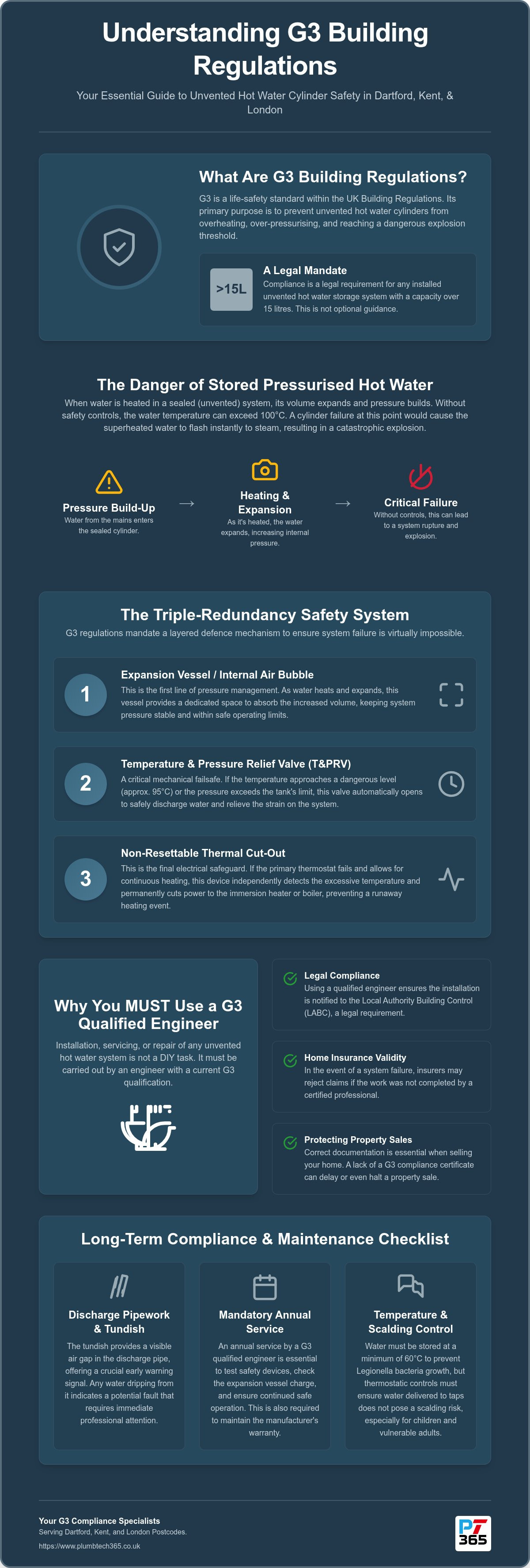
G3 is a life-safety standard. It is the specific section of the Building Regulations dedicated to sanitation, hot water safety, and water efficiency. The primary goal is straightforward: stop your cylinder from becoming a physical hazard. When water is heated under pressure, its boiling point rises. Without proper controls, the water could exceed 100°C. If the tank fails at this temperature, the water instantly turns to steam, causing a catastrophic explosion. G3 ensures this "explosion threshold" is never reached.
Unvented systems operate differently from traditional vented setups. They don't rely on a cold water header tank in the loft. Instead, they take water directly from the mains. This creates the high-pressure flow that homeowners in London and Kent expect for their showers. Modern Water heating systems must use specific safety groups to manage this pressure. This includes expansion vessels and pressure relief valves to keep the system stable whilst it heats up.
Compliance is a legal mandate for any unvented hot water storage system with a capacity over 15 litres. It's not just a recommendation; it's a statutory requirement. If your system holds more than 15 litres, you must adhere to the g3 building regulations for unvented cylinders. Failure to do so can lead to prosecution or significant issues when selling your property. At Plumbfix 365, we specialise in keeping these high-stakes systems compliant. Whilst our expertise covers boiler installation and fitting new gas hobs, the unvented cylinder remains a critical focus for our safety work across Dartford.
The Scope of G3 Compliance in 2026
These regulations apply to all major brands, including Megaflo and similar unvented units. Whether you're installing a system in a new London apartment or retrofitting one in a Kent terrace, the rules remain the same. In 2026, there's a stronger link between safety and water efficiency. The g3 building regulations for unvented cylinders ensure that your system doesn't just work safely, but also minimises waste. This protects your utility bills and your environmental impact.
Why "Safe and Wholesome" Water Matters
The term "wholesome" refers to water that's fit for human consumption and hygiene. G3 ensures your hot water doesn't become contaminated by bacteria or waste. Backflow prevention is a critical part of this. It stops used water from being sucked back into the mains supply if there's a sudden drop in pressure. By maintaining these standards, you protect the health of your household and the integrity of the wider water network in your community.
Key Safety Requirements for Unvented Hot Water Systems
To meet the g3 building regulations for unvented cylinders, every system must feature triple-redundancy safety. This isn't just a technical preference; it's a vital safeguard for homes in London, Kent, and Dartford. Whilst we often discuss safety in terms of boiler installation or the correct fitting of gas hobs, the unvented cylinder requires a unique level of mechanical precision. It's a layered defence designed to ensure that if one component fails, another is ready to take over immediately.
The expansion vessel is your first line of management. As water heats up, it expands in volume. Without an expansion vessel to absorb this extra water, the internal pressure would quickly reach dangerous levels. Most modern systems use a pre-charged vessel or an internal air bubble to manage this fluctuation. If your system begins to discharge water regularly, it's a clear sign the vessel needs recharging or replacement. Our local plumbers can quickly diagnose these issues during a routine safety check.
The Temperature and Pressure Relief Valve (T&PRV) acts as the final mechanical safeguard. It's designed to open and vent water if the temperature hits 95°C or if the pressure exceeds the cylinder's safe limit, as detailed in the official Approved Document G guidance. Additionally, unvented units must have a non-resettable thermal cut-out. This component independently shuts off the power to the immersion heater or boiler if the thermostat fails, preventing the water from reaching a runaway heating state.
Temperature Control and Scalding Prevention
Safe water delivery requires precise thermostatic control. Systems must be set to store water at a minimum of 60°C to prevent Legionella bacteria growth, yet this temperature is high enough to cause serious scalds. We use blending valves at the point of use to ensure water arrives at the tap at a safe temperature. This balance is a core requirement of the g3 building regulations for unvented cylinders, protecting vulnerable residents whilst maintaining high hygiene standards.
Pressure Management Components
Incoming mains pressure can be unpredictable across different London postcodes. A Pressure Reducing Valve (PRV) is essential to regulate this flow to a stable level, usually around 3 bar. Check valves are equally critical; they prevent heated water from flowing back into the cold mains supply. You can often identify a failed expansion vessel if your pressure gauge fluctuates wildly during a heating cycle. Don't ignore these signs; a quick service now prevents a costly emergency later. Whether you need help with a cylinder or a new installation of gas cookers, professional oversight is non-negotiable.
Why You Must Use a G3 Qualified Engineer for Installation
Only a specialist can legally sign off an unvented hot water system. The g3 building regulations for unvented cylinders are clear: if the unit holds more than 15 litres, the installer must have a verified G3 qualification. This is about accountability. After we finish an installation in Dartford or London, we notify Building Control. You receive a Certificate of Compliance. This document is essential for home sales. Without it, your property transaction could collapse before it even begins.
Professional accountability goes beyond paperwork. Because these cylinders are often paired with a boiler, your engineer must also be Gas Safe Registered. We don't just fit the tank; we ensure the entire system operates safely. This includes everything from the boiler installation to the gas hobs and gas cookers. Hiring independent boiler engineers who hold both credentials is the only way to guarantee a safe, high-pressure system that meets every legal standard in Kent.
What Does a G3 Qualification Actually Mean?
It represents specific technical training in high-pressure hot water systems. An engineer with this badge understands how to manage safety controls and expansion vessels. The Association of Plumbing and Heating Contractors emphasises that this qualification ensures the installer can correctly calculate discharge pipework requirements. A G3 qualification allows the engineer to issue a legally recognised Certificate of Compliance. Always verify your engineer's credentials before work begins. A genuine professional will always show their ID card upon arrival.
The Risks of Unqualified Installation
DIY is never an option here. An incorrectly installed cylinder can lead to a "rocket" effect if the safety valves fail. This is a genuine physical risk. Using an unqualified plumber will also immediately invalidate your home insurance and manufacturer warranties. For landlords in London and Kent, failing to meet G3 standards is a serious legal breach, similar to missing a CP12 gas safety certificate. If you are planning a Professional boiler installation London homeowners trust, ensuring G3 compliance is a non-negotiable part of the project. We prioritise your safety by following every regulation to the letter.
Discharge Pipework and Tundish Requirements (The G3 Essentials)
The tundish is the most critical visual component of a compliant installation. It acts as a safety window, providing a physical "air gap" between the cylinder's relief valves and the discharge pipe. If you see water here, the system is telling you it's over-pressured or over-heated. Under the g3 building regulations for unvented cylinders, this component must be installed in the same room as the cylinder. It has to be visible to the homeowner. You can't hide it behind a panel or in a crawl space where its warning signs go unnoticed.
The pipework setup is split into two distinct sections. D1 is the short pipe connecting the safety valve to the tundish. D2 is the larger pipe that carries the water from the tundish to a safe termination point outside. Materials matter here. Standard plastic waste pipe isn't enough; it will melt if the system releases boiling water. Installers must use metal or specific high-temperature plastics capable of withstanding 100°C. This level of technical detail is why we treat every unvented cylinder with the same precision as a complex boiler installation or the fitting of new gas hobs.
The Correct Path for Discharge Water
Water must flow away rapidly to prevent a backup. G3 rules dictate specific gradients for the D2 pipe to ensure gravity does the work. Typically, the pipe must have a continuous fall of at least 1 in 200. The termination point is equally vital. It must exit the building in a way that doesn't put people at risk. Hot water should never discharge over a public footpath or near an entrance where it could cause injury. We ensure every setup in Dartford and London meets these strict safety layouts, terminating into a safe gully or at a low level with a wire cage.
Identifying Faults via the Tundish
A dry tundish is a happy tundish. If you notice a constant drip, your expansion vessel likely needs attention or a recharge. However, a full flow of water through the air gap signals a major safety release. This means the Temperature and Pressure Relief Valve (T&PRV) has opened to prevent a crisis. If this happens, turn off your heat source immediately. Whether you're in Kent or Central London, ignoring a flowing tundish is a risk you shouldn't take. We handle these emergencies with the same urgency as a gas leak or a broken boiler.
If you spot water in your tundish or need a professional safety assessment for your system, contact our local plumbers for an urgent inspection.
Ensuring Long-Term Compliance: Servicing and Maintenance
Annual maintenance is the only way to keep your system on the right side of the g3 building regulations for unvented cylinders. Many homeowners in London and Kent view their hot water tank as a "fit and forget" appliance. This is a dangerous mistake. Without a yearly check, safety valves can seize and expansion vessels can lose their pre-charge. An unmaintained system is a safety risk that also voids your manufacturer’s warranty. At Plumbfix 365, we provide the steady hand needed to keep these complex systems running perfectly in Dartford.
A professional G3 service is a technical deep dive into your system's safety layers. It's not just a visual inspection. We physically test the mechanical components that prevent over-pressurisation. This proactive approach identifies small issues, like a dripping tundish, before they escalate into a household crisis. Our engineers have operated since 1996, bringing decades of local accountability to every service call across London postcodes. We prioritise results, ensuring your high-pressure system remains a safe asset rather than a liability.
The G3 Service Checklist
Testing the Temperature and Pressure Relief Valve manually is the first step. We ensure it opens and closes fully without sticking or leaking. We also check the pressure reducing valve and clean the internal filters to maintain high flow rates. Verifying the integrity of all discharge pipework and connections ensures that if a fault occurs, the water has a safe path out of your home. This vital work is often completed alongside an Expert Boiler Service London & Kent residents rely on for year-round peace of mind.
Compliance for Landlords and Property Sellers
A missing G3 certificate can stall a house sale in Dartford or London for weeks. Solicitors now routinely request proof of G3 compliance and recent service records during the conveyancing process. If you can't provide these documents, you may be forced to pay for an expensive emergency inspection or a full system upgrade to satisfy the buyer's surveyor. For landlords, the stakes are even higher. Your annual gas safety check should always include your unvented cylinder to protect your tenants and your legal standing.
Ensuring your gas hobs and gas cookers are also part of your safety regime creates a complete, professional record of care. If you are still debating between an Unvented Cylinder vs Thermal Store, remember that unvented systems require this specific, qualified maintenance to remain legal under the g3 building regulations for unvented cylinders. We offer total financial clarity and honest billing for all our maintenance packages across Kent and London, providing the valid documentation you need for insurance and future property sales.
Secure Your Home’s Safety and Legal Compliance Today
Your hot water system is a high-performance asset that requires professional oversight to remain safe and legal. By mastering the g3 building regulations for unvented cylinders, you've taken the first step toward protecting your household from mechanical failure and your property from legal delays. Remember that the combination of triple-redundancy safety valves, correct discharge pipework, and mandatory annual maintenance is what keeps your high-pressure system within the law.
Don't leave your compliance to chance or unqualified hands. Whether you are managing a complex boiler installation or need a safety sign-off for your gas hobs and gas cookers, our Gas Safe Registered engineers are here to help. We have served London, Kent, and Dartford since 1996, positioning ourselves as specialists in boiler installation and unvented systems who prioritise your safety and financial clarity. Take action now to validate your insurance and ensure your property remains market-ready.
Book a G3 Compliance Check with Plumbfix 365 to secure your home’s future. We are ready to provide the professional certification and peace of mind you deserve.
Frequently Asked Questions
Do I legally need a G3 certificate for my unvented cylinder?
Yes, you legally require a Certificate of Compliance for any unvented hot water storage system with a capacity exceeding 15 litres. This document proves the installation meets the g3 building regulations for unvented cylinders. You'll need this paperwork when selling your home in London or Kent. Without it, local building control may take enforcement action and your home insurance could be invalidated. Always keep this certificate safe.
Can any plumber install an unvented hot water system?
No, only engineers holding a specific G3 "Unvented" qualification can legally install or service these systems. Standard plumbing skills aren't enough because unvented cylinders operate under high pressure and require specialised safety controls. Our independent boiler engineers are both Gas Safe Registered and G3 qualified to ensure your system remains safe. This expertise is vital for complex tasks like a new boiler installation or maintaining high-pressure hot water units.
What happens if my unvented cylinder is not G3 compliant?
Non-compliance creates a serious physical risk, including the potential for a catastrophic system explosion if safety valves fail. Legally, you'll struggle to sell your property in Kent or London without a valid compliance certificate. Additionally, most insurance providers will refuse to pay out for water damage or injury caused by an uncertified system. It's much safer to have our local plumbers perform a check to rectify any dangerous g3 building regulations for unvented cylinders violations.
How often should an unvented cylinder be serviced under G3 rules?
You must have your unvented cylinder serviced every 12 months by a G3 qualified professional. This annual check is often a condition of the manufacturer's warranty. During the service, we test the temperature and pressure relief valves and recharge the expansion vessel to prevent over-pressurisation. We recommend booking this alongside your annual boiler servicing to ensure your entire heating system, including any gas hobs or gas cookers, remains in peak condition.
Is water dripping into the tundish a sign of a G3 violation?
A dripping tundish isn't necessarily a violation, but it's a clear warning that a safety valve is leaking or the expansion vessel has failed. If left unaddressed, the system is no longer operating within safe parameters. You should never see water in the tundish air gap. If you do, contact us immediately for plumbing repairs. Ignoring this sign can lead to a full safety discharge, which indicates a high-stakes pressure crisis.
Does G3 compliance affect my home insurance in London or Kent?
Yes, G3 compliance is a standard requirement for most UK home insurance policies. If an unvented system causes fire or flood damage and was found to be installed by an unqualified person, your claim will likely be rejected. Insurers view non-compliant cylinders as a high-risk hazard. Maintaining your G3 status through annual servicing provides the documentation needed to prove your home in London or Dartford is safe and professionally maintained.
How do I check if my engineer is G3 qualified?
You should always ask to see your engineer's G3 qualification card before they begin work. A professional will carry a valid ID showing they've completed the necessary unvented hot water training. You can also verify their Gas Safe registration online. At Plumbfix 365, all our engineers are fully accredited for boiler installation and unvented maintenance. We take pride in our local accountability, ensuring you know exactly who is working in your home.
Are small water heaters exempt from G3 building regulations?
Only if they hold 15 litres of water or less. Systems with a capacity under 15 litres are generally exempt from the full G3 notification requirements, although they still require safe installation. Any unit larger than this must strictly follow the building regulations for unvented cylinders. This includes having a visible tundish and correct discharge pipework. If you're unsure about your system's size, our team can provide a quick assessment in Dartford.


Comments