


How Much Does a Dripping Tap Add to a Water Bill in the UK?

Could the same dripping tap have no direct effect on one household’s water bill but increase another’s? The answer to “how much does a dripping tap add to a water bill UK” depends first on whether your home has a water meter. Metered households pay for the water they use, while an unmetered bill generally isn’t directly affected by a small leak. A hot tap may also waste energy if heated water is escaping.
It’s understandable to wonder whether a slow drip is worth fixing, especially when it’s difficult to judge how much water is going down the plughole. You don’t have to guess. Catching the drips in a measuring container for a set time gives you a practical starting point for estimating the daily and yearly water loss.
This guide explains which billing details affect the answer, how to measure your tap’s drip rate and how to account for the possible extra energy use from a hot tap. You’ll also learn when it makes sense to monitor the leak and when, if basic checks haven’t stopped it, a professional tap repair is the sensible next step.
Table of Contents
How much does a dripping tap add to a UK water bill?
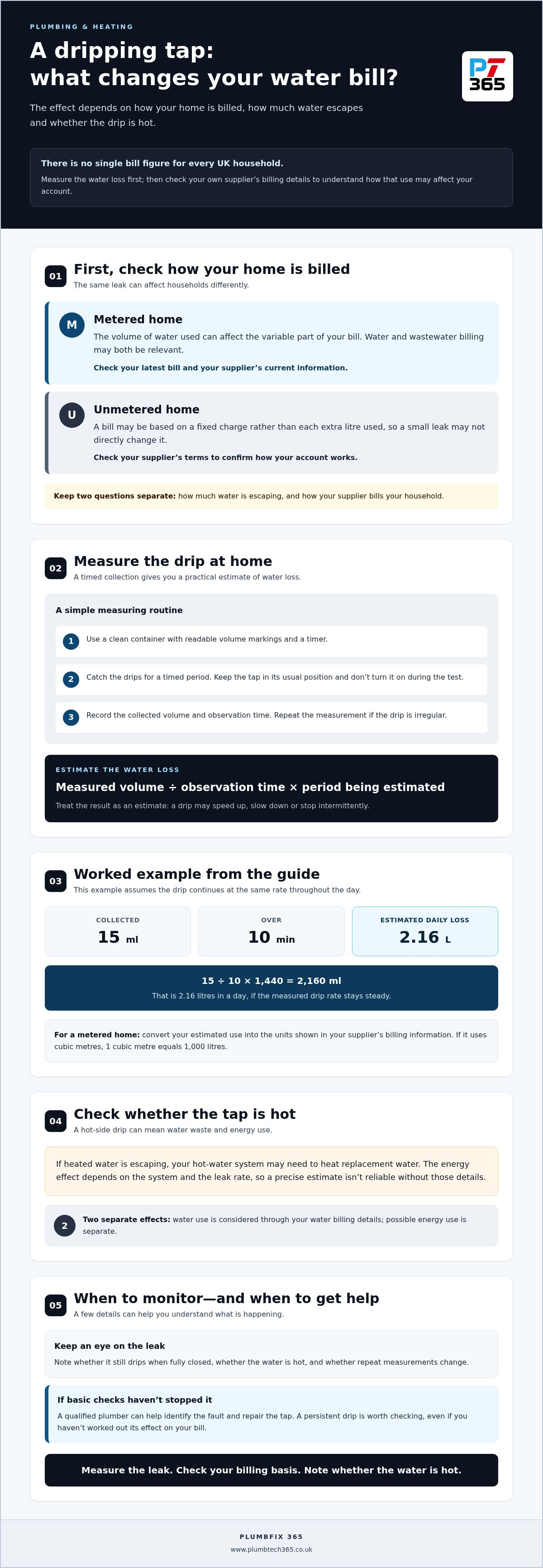
There’s no reliable single bill figure for every UK household. The answer to how much does a dripping tap add to a water bill UK depends on whether you’re metered, how much water the tap loses, how long it drips and how your supplier charges for water and wastewater. Measure the leak first, then check your bill and supplier information to understand how that usage may affect your account.
The amount of water wasted and the amount you’re billed for are not always the same thing. Measuring the leak shows how much water is escaping, but it doesn’t reveal the bill impact on its own.
For a practical look at a tap repair, watch this video:
Why there is no single UK figure
With a water meter, the volume used can affect the variable part of your bill. Water and wastewater charges may both be relevant, but tariffs and charging arrangements vary between suppliers. Check your latest bill and your supplier’s current information rather than relying on a generic estimate.
If your home is unmetered, your bill may be based on a fixed charge rather than each extra litre used. In that case, a dripping tap may not change the bill directly. However, don’t assume every account works the same way. Check your supplier’s terms to confirm your billing basis. That distinction is why the same leak can affect households differently.
Keep the two questions separate: how much water is escaping, and how does your supplier charge your household? Measuring the drip helps answer the first; your bill and supplier information help answer the second. Preventing avoidable waste also supports water conservation.
Does a hot tap change the impact?
It can. If the drip comes from the hot side, your hot-water system may need to heat replacement water. That means there can be energy use as well as water use, but the amount depends on the system and the leak rate. Without those details, a precise estimate wouldn’t be reliable.
Water and energy are separate parts of the picture, and your water supplier’s charges won’t explain the energy effect. If you’re also having trouble getting hot water from the tap, see this guide to what to do when your boiler has no hot water. A persistent drip is worth checking, even if you haven’t worked out its effect on your bill.
How to estimate the water a dripping tap wastes
Estimate the loss from your own tap instead of relying on an assumed drip rate. Catch the water over a set period, record the volume, then scale it up. The result is an estimate, not an exact forecast: a drip may speed up, slow down or stop intermittently.
Measure the drip rate at home
Use a clean container with readable volume markings and a timer. Position it to catch the drips without touching or moving the tap. Leave the tap in its usual position, and don’t turn it on during the test.
Note the starting time, then collect the drips for a timed period.
Record the volume collected and the length of the observation.
Repeat the measurement if the drip is irregular, and use the results as an approximate range.
Formula: measured volume ÷ observation time × period being estimated = estimated water loss.
For example, if you collect 15 millilitres in 10 minutes, the estimated daily loss is 15 ÷ 10 × 1,440, or 2,160 millilitres (2.16 litres). This assumes the drip continues at the same rate throughout the day. If repeat measurements differ, don’t treat one reading as exact.
Use the estimate to assess the bill effect
For a metered home, convert your estimated water use into the units shown on your supplier’s tariff. If the tariff uses cubic metres, remember that 1 cubic metre equals 1,000 litres. Check your current bill or supplier information for the applicable water and wastewater charges; don’t substitute a generic UK rate. An estimate of volume alone can’t tell you the precise bill impact.
Affinity Water offers guidance on leaks, but use your own supplier’s charging details when estimating your account. Your measured leak and billing information give a more relevant answer to “how much does a dripping tap add to a water bill UK” than another household’s example.
If you want to understand possible repair steps, read this guide to fixing a dripping tap. If basic checks don’t stop the leak, a qualified plumber can assess the tap. You can also find information about plumbing repairs.
Does a water meter change what a dripping tap adds to your bill?
Yes, your billing basis can change how a dripping tap affects your water bill. A meter records household water use, so water escaping from a tap may contribute to the volume charged. Without a meter, bills may not be based on each litre used. Check your bill and your supplier’s terms before drawing conclusions.
What if your home has a water meter?
With metered billing, the volume recorded by the meter can inform usage-based charges, where these apply. Your account may also include standing charges, and wastewater charges can be worked out under supplier-specific arrangements. Use the tariff and charging information for your own account, not a national average or a rate quoted for another supplier’s area.
If you’re unsure whether a meter is fitted or how your bill is calculated, check the billing details on your latest statement or contact your water supplier. Affinity Water provides guidance on water leaks, but its example should not be treated as a calculation for every household. Your measured water loss and your supplier’s current charges are what matter for your estimate.
What if your water bill is unmetered?
An unmetered bill may be based on a fixed charge rather than directly on the volume used. That means an extra litre from a dripping tap may not be added to the bill in the same way as it can be for a metered account. However, billing arrangements and account terms vary. Confirm yours with your supplier rather than assuming a leak has no possible effect.
So, the answer to how much does a dripping tap add to a water bill UK starts with one simple check: find out whether your home is billed by measured use. Then use your supplier’s information to interpret the water loss you’ve measured.
What affects the estimate, and when should you act?
The answer to how much does a dripping tap add to a water bill UK depends on how quickly it drips, how long the leak continues and whether it’s on the hot or cold side. Your measurement is a snapshot, not a guaranteed long-term total. A slow, intermittent drip and a steady stream won’t produce the same estimate.
Why drip speed and duration matter
Note whether water falls at a steady pace or only appears now and then. A brief collection period can miss an intermittent leak, so repeat your observation if the pattern changes. Treat any daily or annual projection as an estimate: it assumes the rate you measured continues throughout that period.
Duration matters too. The longer water escapes, the greater the total loss may be. Record when you first notice the drip and check whether it becomes faster or more frequent. If the tap is on the hot side, replacement water may also need heating, so there can be an energy effect as well as water use. The size of that effect depends on your system and the leak rate.
When should you arrange a repair?
If the drip is minor and there are no other signs of trouble, you can monitor it briefly while checking that the tap is fully closed. Note whether it continues once shut. This observation helps you judge whether the leak is ongoing, but it won’t fix the cause.
If the drip persists after basic checks, becomes faster or is joined by signs of a leak elsewhere, arrange professional help rather than relying on monitoring alone. Dampness or water appearing around the tap or nearby surfaces warrants further attention. For broader signs to watch for, read about slow water leak damage.
For practical checks you can make without guesswork, see how to stop a dripping tap. If it still leaks, a qualified plumber can assess and repair it. Ask about a dripping tap repair if you need professional help.
How to stop a dripping tap and prevent ongoing waste
To judge the likely impact, check how your household is billed, measure the drip and use your supplier’s information to interpret the result. If the tap continues to leak, fixing the cause is the only lasting way to stop water being wasted. Catching the drips in a container may help you measure or reuse the water temporarily, but it doesn’t repair the tap.
What to check before arranging a repair
Make a few simple observations first. They can help you explain the problem clearly without taking the tap apart.
Check that the tap is fully closed, but don’t force the handle.
Note whether water drips from the spout or appears around the tap body.
Record when it happens, such as only after use or continuously while the tap is shut.
If you’ve already measured the drip, keep that result with your notes. It can help describe whether the leak is steady or intermittent. Avoid attempting repair work if you’re unsure how the tap is assembled or how to isolate its water supply.
What a plumber can help with
A qualified plumber can assess the tap, identify where the leak is coming from and advise on suitable repair work. The right approach depends on the tap and the fault, so don’t assume every drip has the same cause. For an overview of possible checks and repair steps, read this guide to how to fix a dripping tap.
Taking action doesn’t mean treating every drip as an emergency. But if the tap keeps dripping after you’ve checked that it’s fully closed, or the leak worsens, arrange a professional assessment rather than relying on a container or repeated monitoring. Plumbtech 365 offers plumbing repairs, including dripping-tap repairs, carried out by qualified professionals.
If you’re still weighing up how much does a dripping tap add to a water bill UK, remember that your measured water loss and billing basis give you a better guide than a general figure. For help with a persistent leak, contact a plumbing repair professional.
Take the next step towards stopping the drip
There’s no single answer to “how much does a dripping tap add to a water bill UK”. The effect depends on your billing basis, the amount of water escaping and your supplier’s charges. Check your bill to see whether you’re metered, then measure the drip over a timed period for a useful estimate.
If the tap is on the hot side, remember that replacement water may also need heating. A short measurement is only a guide, so repeat it if the drip varies. Check that the tap is fully closed without forcing the handle. If it keeps dripping or gets worse, arrange a repair rather than relying on collecting the water.
Plumbfix 365 provides plumbing repairs, including fixing dripping taps, with work carried out by qualified professionals. Contact Plumbfix 365 about a dripping tap if the leak persists. With a clear measurement and the right repair, you can take a sensible next step to stop ongoing waste.
Frequently Asked Questions
How much water can a dripping tap waste in a day?
There’s no reliable daily figure for every leak because the amount depends on how quickly the tap drips and whether it leaks steadily. Catch the water in a marked container for a timed period, note the volume, then scale it to a day. Repeat the check if the drip is irregular. Any daily or longer-term total is an estimate, as the leak rate may change.
Does a dripping tap increase a water bill if I have a meter?
It can, if your bill includes charges based on measured water use. The effect depends on the volume lost and your supplier’s charges, including any applicable wastewater element. To estimate how much does a dripping tap add to a water bill UK, measure your tap’s drip and check your current bill and supplier information. A national average may not reflect the charges that apply to your account.
Can a dripping tap affect my bill if I do not have a water meter?
An unmetered bill may be based on something other than the volume of water you use, so a drip may not affect it in the same way as a metered bill. However, billing arrangements and account terms can vary. Check your bill or ask your water supplier how your account is charged. Don’t assume all unmetered households have identical terms or that a leak can never affect another charge.
Does a dripping hot tap use more than a cold tap?
A leak from the hot side can mean your system needs to heat replacement water, so it may use energy as well as waste water. A cold-side drip doesn’t have that same hot-water heating element. The energy effect depends on your plumbing and hot-water system, as well as the leak rate. Without those details and a measurement, it isn’t possible to give a reliable comparison.
How do I calculate what a dripping tap adds to my bill?
Collect the drips in a marked container for a timed period, record the volume, then scale it to the period you want to estimate. For a metered account, check your supplier’s current consumption-based charges and whether wastewater charges apply. This gives you an estimate, not a guaranteed bill change: the drip rate can vary, and your supplier’s tariff determines how measured use is charged.
Should I wait to fix a dripping tap if it is only a slow drip?
A slow drip may not need an emergency response, but it can keep wasting water and may worsen. Check that the tap is fully closed without forcing the handle, then note whether the drip continues and if its rate changes. If it persists after basic checks, spreads around the tap or becomes harder to control, arrange for a plumber to assess it rather than monitoring indefinitely.
Can I use the water collected from a dripping tap?
You can collect clean water temporarily and use it for a suitable household purpose if the container stays clean and the water is appropriate for that use. This may put some of the water to use, but it won’t stop the leak or fix its cause. If the tap continues dripping, arrange a repair. Treat collection as a temporary measure, not a substitute for dealing with the fault.


Comments