


How to Find a Gas Leak in Your Home: A Step-by-Step UK Safety Guide

Would you know the difference between a common kitchen odour and a life-threatening emergency? Many homeowners feel a sharp spike in anxiety when they catch a faint, unusual whiff near the boiler or gas hob. It's a valid fear, as the risk of fire or carbon monoxide poisoning is a serious concern for any household. Learning how to find a gas leak in your home requires more than just a keen nose; it demands a calm, methodical approach to ensure everyone stays out of harm's way.
We recognise that uncertainty during a potential crisis is incredibly stressful. You need facts and fast action, not guesswork. This guide provides a clear, professional walkthrough to help you identify subtle signs of a leak using your senses and reliable technical checks. We'll outline the immediate steps you must take to secure your property, the correct evacuation protocols, and how to find a qualified Gas Safe registered engineer to restore safety to your London or Kent home.
Table of Contents
Recognising the Immediate Signs of a Gas Leak
Detecting a leak quickly is the best way to prevent a disaster. If you are wondering how to find a gas leak in your home, your senses are your most reliable tools. Most people assume they'll just smell it, but there are several other indicators that require your attention. Acting on these signs immediately can save lives and protect your property from fire or explosion.
To better understand how to identify these signs, watch this helpful guide:
The "Rotten Egg" Smell: Why it Exists
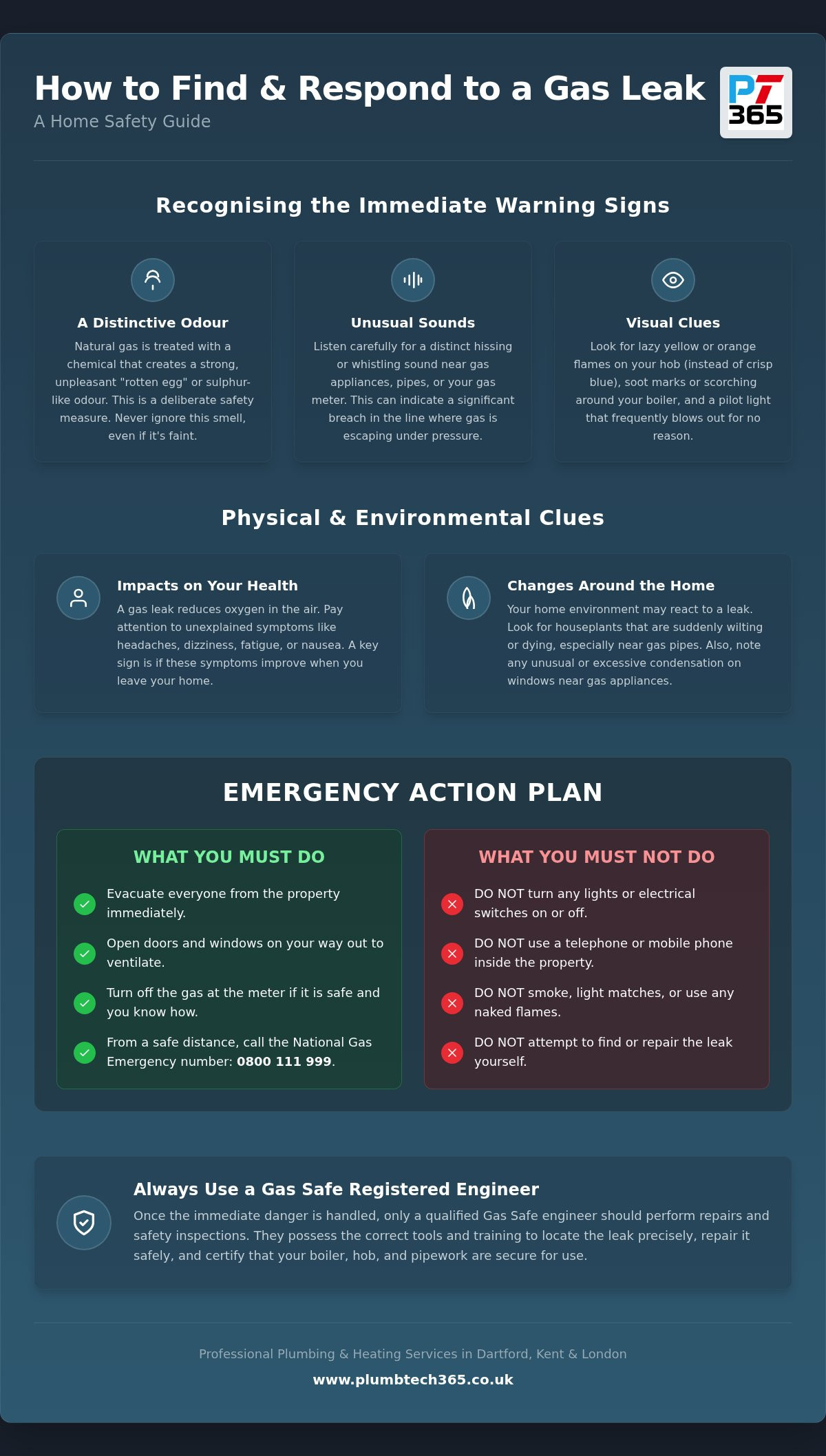
Natural gas is actually odourless in its raw state. To help with recognising the smell of gas, suppliers add a chemical called mercaptan. This creates a sharp, unpleasant odour similar to rotten eggs or sulphur. It's an intentional safety feature designed to grab your attention immediately. Even a faint smell should never be ignored; it's often the first indicator of a failing connection or a faulty appliance. If you catch a whiff near your gas cooker or boiler, treat it as a priority.
Auditory and Visual Warnings
Gas escaping from a high-pressure pipe doesn't always just sit there. You might hear a distinct hissing or whistling sound near your meter or boiler. This often suggests a significant breach that needs urgent intervention. Beyond the smell, knowing how to find a gas leak in your home involves looking for physical evidence on your appliances. Visual cues are just as telling as what you hear or smell.
Check your gas hob or fire. A healthy flame is crisp and blue. If you see a lazy yellow or orange flame, it indicates incomplete combustion and a potential carbon monoxide risk. You should also regularly inspect your boiler for physical damage. Look for these specific warning signs:
Scorched patches or discolouration on the outer casing of the boiler.
Soot marks or dark brown staining on or around the unit.
Pilot lights that frequently blow out without an obvious reason.
Condensation on windows that seems excessive or unusual for the room.
These physical markers show that your system isn't burning fuel correctly. If you spot soot or staining, it's a clear signal that your appliance is unsafe. Contacting local boiler engineers for a safety check is the only way to confirm your system is secure. Never attempt to tighten gas pipes or dismantle appliances yourself.
Physical and Environmental Clues in Your Property
Whilst a sharp smell is a primary indicator, your body and your surroundings often provide the first warnings of a problem. Gas leaks displace oxygen in confined spaces, leading to physical symptoms that are easy to mistake for a common cold or flu. If you are investigating how to find a gas leak in your home, you must pay close attention to how you feel when you are inside the property versus when you leave.
How Gas Leaks Affect Your Health
High concentrations of natural gas reduce the amount of oxygen available to breathe. This can cause sudden, unexplained headaches, dizziness, fatigue, and nausea. A key indicator that these issues are environmental is if your symptoms improve whilst you're away from the home and return shortly after you step back inside. If multiple people in the household, or even pets, start showing similar signs of lethargy or sickness at the same time, you must act fast.
It is vital to distinguish between a natural gas leak and carbon monoxide (CO) poisoning. Natural gas is highly flammable and carries a "rotten egg" scent. Carbon monoxide is a byproduct of incomplete combustion; it is completely odourless and much more toxic. If you suspect an immediate danger, you should contact the National Gas Emergency Service on 0800 111 999 to report the issue from a safe location outside your property.
Environmental Changes Around the Home
Your property itself can react to escaping gas. Houseplants are surprisingly sensitive to changes in air and soil quality. If you notice a healthy plant suddenly wilting or dying, especially one located near a gas pipe or appliance, it could be due to gas displacing the oxygen in the soil or air. Similarly, look for unusual condensation on windows. Whilst damp is common in UK homes, excessive moisture on the glass near a boiler or gas fire can indicate a ventilation failure or a leak.
For visible external pipework, you can perform a simple "bubble test" to confirm your suspicions. Mix a small amount of washing-up liquid with water and brush it over the gas joints or valves. If gas is escaping, the soapy solution will form large, growing bubbles at the source of the leak. This is a safe, non-technical way to identify the exact location of a fault on exposed pipes. To keep your system in top condition, it's wise to book regular boiler servicing with a qualified professional to catch these issues early.
Identifying these signs is only half the battle. Knowing how to spot hidden leaks before they cause significant damage is essential for long-term safety. If you find bubbles or notice your plants dying back, follow the emergency evacuation protocols immediately.
Conducting a Gas Meter Check to Confirm a Leak
Your gas meter is the most accurate diagnostic tool available to you. Whilst your senses detect the presence of gas, the meter provides technical confirmation of whether the system is losing pressure. The Gas Safe Register emphasizes that the meter is a critical safety component that should be accessible and in good working order. If you suspect a problem, the meter can help you verify your fears before you call for emergency assistance.
Locate your meter box, which is typically found in a hallway cupboard, under the stairs, or in an external box on the front or side of your property. Digital meters usually have a clear LCD screen, whilst older analogue models use a series of rotating numbered dials. Regardless of the model, the principle for testing remains the same. You are looking for any movement in the numbers when no gas should be flowing through the pipes.
The Standstill Test: A Step-by-Step Guide
This test is a standard industry method for identifying leaks. If you want to know how to find a gas leak in your home, this process offers definitive proof. You must be thorough to ensure the results are accurate. Follow these steps carefully:
Shut down all appliances: Turn off your boiler, gas hob, and any gas fires. Ensure that no pilot lights are active.
Check the meter: Look at the far-right digit or the small "test" dial on an analogue meter. Record the exact reading or take a photo with your phone.
Wait for ten minutes: Do not use any gas during this period. Avoid flushing toilets or running hot taps, as this might trigger the boiler.
Re-check the reading: Compare the new number to your initial record.
If the reading has changed even slightly during those ten minutes, you must evacuate the property immediately and call the National Gas Emergency Service. A moving meter dial when all appliances are off is a certain sign that gas is escaping somewhere in your pipework.
Interpreting Your Meter Readings
Understanding the difference between a minor fluctuation and a steady increase is vital. In a perfectly sealed system, the meter should not move at all. Some modern digital meters may show very tiny "settling" movements, but a consistent "tick over" suggests a breach. If the dial or digital display continues to advance, you have a leak that requires professional intervention.
A moving dial is a definitive sign of a leak in the system that no homeowner should ignore. This often points to a failure in the internal pipework or a faulty connection behind an appliance. To understand more about how professionals handle these risks, you can read about how local boiler engineers keep homes safe through rigorous testing and maintenance. Once the meter confirms a leak, your priority shifts from detection to immediate safety and evacuation.
Essential Safety Steps Once a Leak is Suspected
Once you've followed the steps on how to find a gas leak in your home and confirmed a problem, the time for investigation ends. Immediate action is your only priority. Gas is highly volatile; a small leak can become a major hazard in minutes. You must ensure everyone, including pets, leaves the property straight away. Don't waste time packing bags or searching for the source of the leak once the danger is identified.
As you exit, open all doors and windows. This allows fresh air to circulate and helps to disperse the concentrated gas. If it's safe and you can reach it quickly, turn off the gas supply at the main control valve. This valve is usually located next to your gas meter. Turn the handle 90 degrees so it's at a right angle to the pipe. This simple action stops more fuel from entering your home's internal pipework.
The "Do Not" List for Gas Emergencies
Natural gas needs very little energy to ignite. Even a tiny electrical spark from a light switch or a doorbell can trigger an explosion if the gas concentration is high enough. If a light is already on, leave it on. If it's off, don't touch the switch. Avoid using landline phones or plugging in any electrical appliances. Even using a mobile phone inside the property carries a small but real risk of ignition.
Never use matches, lighters, or any naked flames to search for a leak. It sounds obvious, but in a moment of panic, people often reach for a torch or a lighter to see into dark cupboards. If you're uncertain about the severity of a plumbing or gas issue, you can consult our guide on When Should You Call An Emergency Plumber. However, if you smell gas, you should always treat it as a life-threatening emergency.
Securing the Property and Calling for Help
Wait until you're a safe distance from the building before calling for help. Use a neighbour's phone or your mobile once you're well away from the suspected leak area. Contact the National Gas Emergency Service immediately on 0800 111 999. They're available 24 hours a day and will provide instructions on what to do while you wait for their arrival. Be ready to give your full address and explain whether you've managed to turn off the main gas valve.
Once the emergency service has capped the leak and declared the area safe to enter, the gas will remain turned off until a permanent repair is made. You'll need a qualified professional to get your heating and cooking facilities back online. For expert assistance from Gas Safe Registered professionals, contact We are a trusted plumbing & heating company providing reliable, high-quality services across London and Kent. to arrange a prompt and safe repair for your home.
Professional Gas Leak Detection and Boiler Maintenance
While your own sensory checks are the first line of defence, they cannot replace the precision of professional diagnostic equipment. If you've been searching for how to find a gas leak in your home, you've likely identified the initial symptoms. However, locating the exact point of failure within a wall or behind an integrated appliance requires a specialist. Gas Safe Registered engineers use advanced tools like electronic leak detectors and digital manometers to provide a definitive assessment. These devices pick up trace amounts of gas that the human nose simply cannot detect.
A manometer measures the pressure within your gas system with total accuracy. By performing a formal tightness test, an engineer can see if the system pressure drops over a specific period. If the pressure falls, a leak is present. This technical approach ensures that no microscopic crack in a pipe or faulty valve goes unnoticed. It moves the situation from guesswork to a guaranteed resolution.
Why Only a Gas Safe Engineer Should Handle Repairs
In the UK, it's a legal requirement for anyone carrying out gas work to be on the Gas Safe Register. This isn't just a formality; it's a safety standard that protects your family and your property. DIY gas repairs are illegal and incredibly dangerous. A professional doesn't just fix the immediate leak. They inspect the entire installation to ensure it meets current safety regulations and is operating at peak efficiency.
For property owners and agents, this professional oversight is often a matter of legal compliance. Landlords have a specific duty to arrange annual inspections for their tenants. You can learn more about these requirements in our guide to Landlord Gas Safety Certificates Explained. These checks ensure that every appliance, from the boiler to the gas hob, is safe for continued use.
Preventative Care and Safety Inspections
The best way to handle a gas leak is to prevent it from ever happening. Most leaks occur due to age, corrosion, or poor maintenance over several years. An annual boiler service is your best protection against these hazards. During a service, an engineer cleans internal components, checks seals, and tests flue gases for carbon monoxide. This proactive approach identifies wear and tear before it develops into a hazardous breach.
We are a trusted plumbing & heating company providing reliable, high-quality services across London and Kent. and we have provided expert safety inspections since 1996. Our team of Gas Safe Registered engineers is dedicated to keeping your household secure year-round. We don't just solve crises; we provide the routine maintenance that prevents them. Suspect a fault or need a safety check? Contact We are a trusted plumbing & heating company providing reliable, high-quality services across London and Kent. for expert Gas Safe assistance to ensure your home remains a safe environment for everyone.
Securing Your Home Against Gas Hazards
Protecting your family starts with awareness and ends with decisive action. By mastering the sensory cues and technical meter checks outlined in this guide, you now have a clear protocol for understanding how to find a gas leak in your home. Remember that even the smallest suspicion warrants an immediate evacuation and a call to the emergency services from a safe distance. Never compromise on safety by attempting DIY repairs or ignoring a faint odour.
Since 1996, our team has provided reliable support across Dartford, London, and Kent. All our work is carried out by Gas Safe Registered engineers who prioritise your household's safety above all else. Expert boiler servicing is the most effective way to prevent leaks before they start and ensure your heating system remains compliant and efficient. Don't leave your property's safety to chance.
Ensure your home is safe with a professional Gas Safe inspection from We are a trusted plumbing & heating company providing reliable, high-quality services across London and Kent. Stay vigilant and keep your appliances in peak condition for total peace of mind.
Frequently Asked Questions
How can I tell if I have a gas leak if I cannot smell anything?
You can identify a leak through auditory and visual signs even without a scent. Listen for hissing near pipes or look for a lazy yellow flame on your hob instead of a blue one. Physical symptoms like sudden headaches or wilting houseplants are also clues. Performing a meter standstill test is the most reliable way for how to find a gas leak in your home when sensory indicators are missing.
Is a small gas leak dangerous if it is in a ventilated area?
Yes, any gas leak is a serious hazard regardless of ventilation. While airflow might reduce the immediate concentration, the source remains a fire and explosion risk. Gas can accumulate in pockets or wall cavities where ventilation cannot reach. Even a minor leak indicates a failure in your pipework or appliance that could worsen suddenly. You must contact a Gas Safe Registered engineer in Dartford or London to investigate immediately.
What does a gas leak actually smell like?
Natural gas is infused with a chemical called mercaptan to give it a distinct "rotten egg" or sulphur-like odour. This makes an otherwise odourless gas easy to detect with your nose. If you catch a whiff of this sharp, unpleasant scent near your boiler or kitchen appliances, you must act fast. Never assume it is just a drains issue; treat any sulphur smell as a potential emergency until a professional confirms otherwise.
Can I use my mobile phone if I suspect a gas leak in the house?
No, you should never use a mobile phone inside a property where you suspect a leak. All electronic devices, including phones, light switches, and doorbells, can create a tiny spark when operated. This spark is enough to ignite a high concentration of gas and cause an explosion. Always leave your phone behind and only call the National Gas Emergency Service once you are a safe distance away from the building.
Should I open the windows if I smell gas?
Yes, you should open windows and doors to ventilate the property as you are leaving. This helps to disperse the gas and lower the risk of ignition by reducing its concentration in the air. However, you should not stay inside the building to do this. Open what you can on your way out and then proceed to a safe location outside. Your priority is always a swift and safe evacuation.
Who is responsible for fixing a gas leak in a rented property?
Landlords are legally responsible for the safety of gas appliances and pipework in rented properties across the UK. They must ensure that a Gas Safe Registered engineer carries out an annual safety check and provides a CP12 landlord gas safety certificate. If you suspect a leak, report it to the emergency services first, then notify your landlord or letting agent. They are required to arrange and cover the cost of all necessary repairs.
How long does it take for a professional to find a gas leak?
A qualified engineer can typically locate the source of a leak within thirty to sixty minutes using specialised equipment. Tools such as electronic leak detectors and manometers allow for rapid, pinpoint accuracy that sensory checks cannot match. Our team serves London and Kent with high standards of efficiency to ensure your home is secured quickly. The total time for repair will then depend on the complexity of the pipework failure.
What is the difference between a gas leak and carbon monoxide?
The primary difference is that natural gas is highly flammable, whilst carbon monoxide is a toxic byproduct of incomplete combustion. Natural gas has a strong added odour, but carbon monoxide is completely odourless, tasteless, and invisible. Both are life-threatening. A gas leak creates an explosion risk, whereas carbon monoxide leads to poisoning. This is why learning how to find a gas leak in your home and installing CO alarms are both essential.


Comments