


System boiler vs combi boiler for a 4-bed house: which suits your home?

A combi boiler isn’t automatically the wrong choice for a four-bedroom home. When comparing a system boiler vs combi boiler for a 4-bed house, a key question is how much hot water your household needs at once, not simply how many bedrooms it has.
If several people shower or use taps at the same time, you may be concerned that a combi won’t keep up. That’s worth discussing before choosing a boiler. A combi heats water on demand and doesn’t need a separate hot water cylinder. A system boiler works with a cylinder that stores heated water and can supply multiple outlets, but the cylinder takes up space.
This guide compares how each option handles heating, simultaneous hot water use and space. It also explains what to consider about your household routines, pipework, controls and existing hot water storage. A Gas Safe registered engineer can assess your home and current setup before recommending a suitable installation.
Table of Contents
System vs combi boiler for a 4-bed house: which to choose?
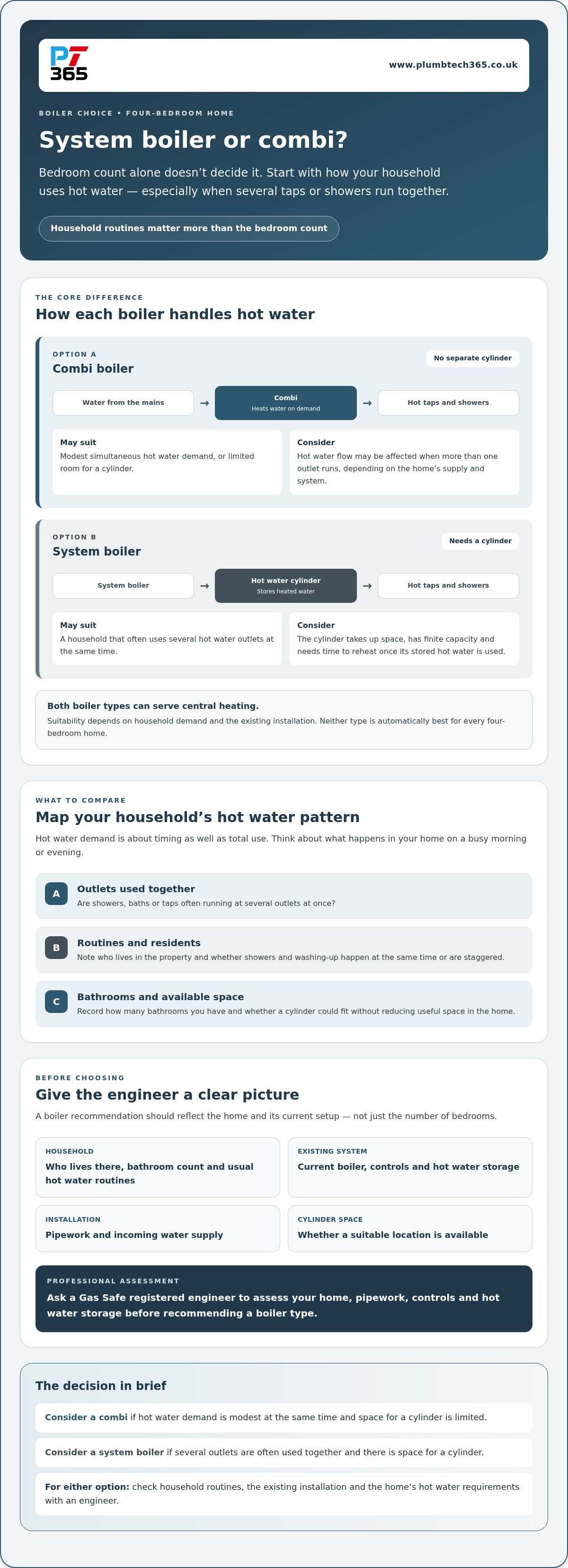
Four bedrooms don’t, by themselves, tell you which boiler your home needs. The right choice depends on who lives there, how many bathrooms are used, whether hot water outlets run at the same time and how your existing heating system is set up. The system boiler vs combi boiler for a 4-bed house decision should start with your household’s actual routines, not its bedroom count.
A combi boiler heats water directly from the mains when you turn on a hot tap. A system boiler heats water for storage in a separate hot water cylinder, which supplies taps and showers when needed. Both can serve your home’s central heating. You can read a general overview of a central heating system for background on how heating components work together.
For a visual comparison of the two boiler types, watch this overview:
Does a four-bedroom house automatically need a system boiler?
No. Bedroom count offers some context, but it doesn’t show how many people live in the house or how often hot water is needed at once. A household with one bathroom and staggered routines may have different needs from one where several showers and taps are used together. Simultaneous demand matters: a combi’s hot water flow may be affected when more than one outlet is running, depending on the home’s supply and system. Neither boiler type is automatically best for every larger property.
What is the basic difference between a system and combi boiler?
A combi provides hot water as it’s requested, without a separate hot water cylinder. A system boiler works with a cylinder that stores heated water, making that supply available to taps and showers. Once the stored hot water has been used, it needs to be heated again. The cylinder takes up space, often in a cupboard, so check whether your home can accommodate one. For more on stored hot water options, see this guide to unvented cylinders and thermal stores.
At a glance
Combi: heats water on demand and doesn’t need a separate hot water cylinder.
System: stores heated water in a separate cylinder, so you’ll need space for it.
Either type: suitability depends on household demand and the existing installation.
Before recommending a replacement, an engineer should check the current boiler, pipework, controls and hot water storage. This helps establish whether the existing setup is compatible with the option you’re considering, rather than assuming a boiler type based on the number of bedrooms.
How system and combi boilers handle a busy household’s hot water
Hot water demand is about timing as well as total use. A combi heats water as you open a hot tap, so the experience can change if another shower or tap is drawing water at the same time. A system boiler stores heated water in a cylinder, providing a supply that can be drawn on while the boiler reheats it. Neither arrangement is automatically faster. The result depends on the boiler, cylinder and installation. The Energy Saving Trust guide to boiler types offers further background on the differences.
When could a combi boiler suit a four-bedroom household?
A combi may suit a household with modest simultaneous hot water demand, particularly if people tend to shower at different times and there’s limited room for a cylinder. Occupant numbers matter, but so do routines: a smaller household may use fewer outlets together, while a larger one may stagger showers and washing-up. Don’t assume a particular flow or performance without checking. The boiler model, incoming supply and existing pipework all need to be considered.
When might a system boiler and cylinder be worth considering?
If showers, baths or taps are often used at several outlets together, a stored supply may fit the household’s pattern better. However, the cylinder has a finite capacity, and once its hot water is used, reheating takes time. Consider its size, location and recovery time alongside your peak demand. These are details to check, not to guess from the number of bedrooms.
Imagine a busy morning when one person is showering while another uses a bathroom tap. With a combi, simultaneous use can affect the hot water flow available at each outlet. With a cylinder, both may draw from stored hot water, but that demand still uses up the supply. How well either arrangement serves the home depends on the equipment and system configuration.
Before choosing, note when hot water is used together, which outlets are involved and whether you have space for a cylinder. An engineer can assess the boiler, supply, pipework, controls and any existing storage, then advise what is compatible. For more detail on stored hot water options, read this unvented cylinder and thermal store comparison.
That assessment is the practical next step in deciding system boiler vs combi boiler for a 4-bed house. If you’re considering a boiler installation, you can discuss your household’s heating requirements with a boiler engineer.
System boiler or combi boiler: compare space, routines and existing heating
The main trade-offs are space, how hot water is supplied and how well the proposed boiler fits the heating system already in place. This comparison can help you prepare, but it can’t confirm which option is suitable without a property assessment.
What trade-offs matter most when comparing the two boiler types?
A combi keeps the hot water arrangement compact, but supplies water on demand. A system boiler adds a cylinder and takes up more room, while keeping a store of heated water ready for use. That stored supply is finite and must be reheated after use. Your usual pattern matters: a household that staggers showers has different needs from one where bathrooms are often used together. For independent guidance on how to choose the right boiler, Which? also explains why home requirements matter.
How do existing pipework and hot water storage affect the decision?
Start with what’s already installed. Is there a cylinder, and is it in suitable condition? What space is available, and could the pipework or controls support the proposed arrangement? Replacing one boiler type with another may call for changes to parts of the system, but the work required depends on the property. Don’t assume the existing setup can simply be transferred unchanged.
A qualified engineer should inspect the boiler and wider heating system, then assess the home’s heating demand before recommending a suitable type and output. This is more reliable than choosing from bedroom count alone. Ask what will be checked and how the existing system affects the recommendation.
How to assess which boiler suits your four-bedroom house
Prepare a clear picture of how your household uses heating and hot water before discussing a replacement. This gives an engineer practical information to assess, rather than leaving the decision to bedroom count alone. A combi boiler can be suitable in some four-bedroom homes. Demand, available space and the existing system are all relevant.
What household details should you record before getting advice?
Keep notes for a few typical days, including busy mornings and evenings. Record who lives in the home, when hot water use peaks and which outlets are used together. Also note any recurring problems, such as hot water changing during simultaneous use or rooms taking longer to heat. Describe what happens without trying to diagnose the cause.
Occupants: Record how many people live in the home and whether this changes regularly.
Bathrooms and outlets: List showers, baths and frequently used taps.
Routines: Note when showers, washing-up and appliances that use hot water tend to overlap.
Current arrangement: Record the boiler type, whether there’s a hot water cylinder and where it’s located.
Space: Check where the boiler and any cylinder are installed, and note possible alternative locations.
Issues: Write down repeated heating or hot water concerns and when they occur.
What should a Gas Safe registered engineer check?
Ask the engineer to inspect the current boiler, heating system, hot water arrangement, pipework, controls and space for equipment. Explain the demand you’ve recorded and ask how the proposed option would meet it. If changes are recommended, request a clear explanation of what needs altering and why. Work varies by property, so don’t assume a change of boiler type always requires the same modifications.
Boiler suitability and output should be assessed against the property and its heating system, not selected from the number of bedrooms alone. An engineer can also check whether existing hot water storage and other components are suitable for the proposed setup. The aim is to match the installation to your home’s actual requirements.
Use your notes to make the conversation specific. For the system boiler vs combi boiler for a 4-bed house decision, share how many outlets run together, whether cylinder space is available and what’s already installed. Then ask the engineer to explain the recommendation and any proposed changes in plain language.
To discuss your home’s requirements, find out about a boiler installation assessment with a Gas Safe registered engineer.
Choosing and installing a system or combi boiler with confidence
The right choice comes from matching your household’s real hot water patterns with available space and the heating system already in place. Bedroom count alone can’t confirm the boiler type or specification your home needs. Before agreeing to an installation, ask the engineer to explain how their recommendation fits your household and what the work involves.
What questions should you ask before agreeing to an installation?
Use your notes on occupants, bathrooms and overlapping hot water use to make the discussion specific. Ask direct questions and make sure you understand the answers:
Why does this boiler type suit our usual hot water demand, including showers or taps used at the same time?
Will the proposed system need changes to the cylinder, pipework or controls? If so, what needs changing and why?
What work is included in the installation, and which parts of the heating and hot water system will be checked afterwards?
How does the proposed boiler’s output match the property and its heating system?
These questions help you understand the recommendation without assuming every replacement requires alterations. The work depends on the existing installation and the option selected. Ask for the proposed scope to be explained clearly before you make a decision.
How can professional installation reduce uncertainty?
A qualified assessment connects what your household needs with what the property can support. The engineer can consider the current boiler, hot water arrangement, available cylinder space, pipework and controls before advising on a suitable option. That gives you a reasoned recommendation based on the home, rather than a guess based on the number of bedrooms.
Technical work is carried out by Gas Safe registered engineers. Their assessment can help clarify whether a system or combi boiler is appropriate and whether any changes should be planned. No boiler type can be confirmed as right for your home without checking the installation and household requirements.
Before agreeing to a boiler installation, make sure you understand why the chosen type fits your routines, what work is proposed and how the system will be checked once installed. The system boiler vs combi boiler for a 4-bed house decision should rest on those details, not the floor plan label alone.
Speak to a boiler installation specialist about assessing your home’s heating and hot water needs.
Make your next boiler decision with confidence
Choose only after an engineer has matched your household’s hot water use and available space with the heating system in your home. A four-bedroom label can’t confirm which boiler type or specification is suitable. Ask for the recommendation and any proposed installation changes to be explained clearly.
Plumbtech 365 provides boiler installation, servicing and other heating services, with technical work carried out by Gas Safe registered engineers. An assessment gives you a practical basis for deciding without assuming either boiler type is right for every home. The system boiler vs combi boiler for a 4-bed house question is best answered using the needs and condition of your own property.
Ready to take the next step? Speak to a boiler installation specialist about assessing your home’s heating and hot water needs.
Frequently Asked Questions
Is a combi boiler suitable for a four-bedroom house?
Yes, a combi boiler can suit a four-bedroom house if it can meet the home’s heating and hot water needs. The number of bedrooms alone doesn’t decide this. Consider how many people live there, how often taps and showers are used together, and whether there’s space for a cylinder. A Gas Safe registered engineer should assess the property and existing system before recommending a boiler type or output.
Can a combi boiler run two showers at the same time?
It may be possible, but the experience depends on the boiler, incoming water supply and installation. Because a combi heats water on demand, running two showers together can affect the flow available at each outlet. Don’t rely on a general rule or promised flow rate without checking the specific equipment and property. Ask an engineer to assess your setup and explain what simultaneous use is likely to mean for your household.
Is a system boiler better than a combi boiler for a large family?
Not automatically. A system boiler’s cylinder stores hot water for use, which may suit a household that regularly needs hot water at several outlets at once. A combi avoids a separate cylinder and may suit a family with staggered routines. The right option depends on actual demand, cylinder space and the existing heating system. For the system boiler vs combi boiler for a 4-bed house decision, compare routines as well as household size.
What is the main difference between a system boiler and a combi boiler?
A combi boiler heats domestic hot water as it’s requested, so it doesn’t need a separate hot water cylinder. A system boiler works with a cylinder that stores heated water for later use. This affects both space and how hot water is supplied around the home. Neither setup is automatically quicker or more suitable. Performance depends on the equipment, installation and household demand.
Does a system boiler need a hot water cylinder?
Yes. A system boiler works with a separate hot water cylinder, which stores heated water for taps, baths and showers. You’ll need a suitable place for the cylinder, and the stored supply is finite. Its capacity and reheating time should be considered against your household’s routines. An engineer can check the existing cylinder, its location and whether it fits the proposed installation.
Can you replace a system boiler with a combi boiler in a four-bedroom house?
It may be possible, but an engineer must first check whether a combi suits the property and its hot water demand. The assessment should cover the current boiler, cylinder, pipework, controls, available space and how outlets are used together. A change of boiler type may involve adjustments to the existing system, but the work required depends on the home. Don’t assume the cylinder can simply be removed without further checks.
What should an engineer check before recommending a boiler type?
A Gas Safe registered engineer should assess the current boiler, heating system, pipework, controls and hot water arrangement, including any cylinder and its location. Explain how many people live in the home and when showers or taps are used together. Ask how the proposed boiler type and output will meet those needs, and request a clear explanation of any changes needed. This grounds the recommendation in your property, not bedroom count alone.


Comments