


The Critical Consequences of Not Servicing a Boiler: A 2026 Homeowner’s Guide

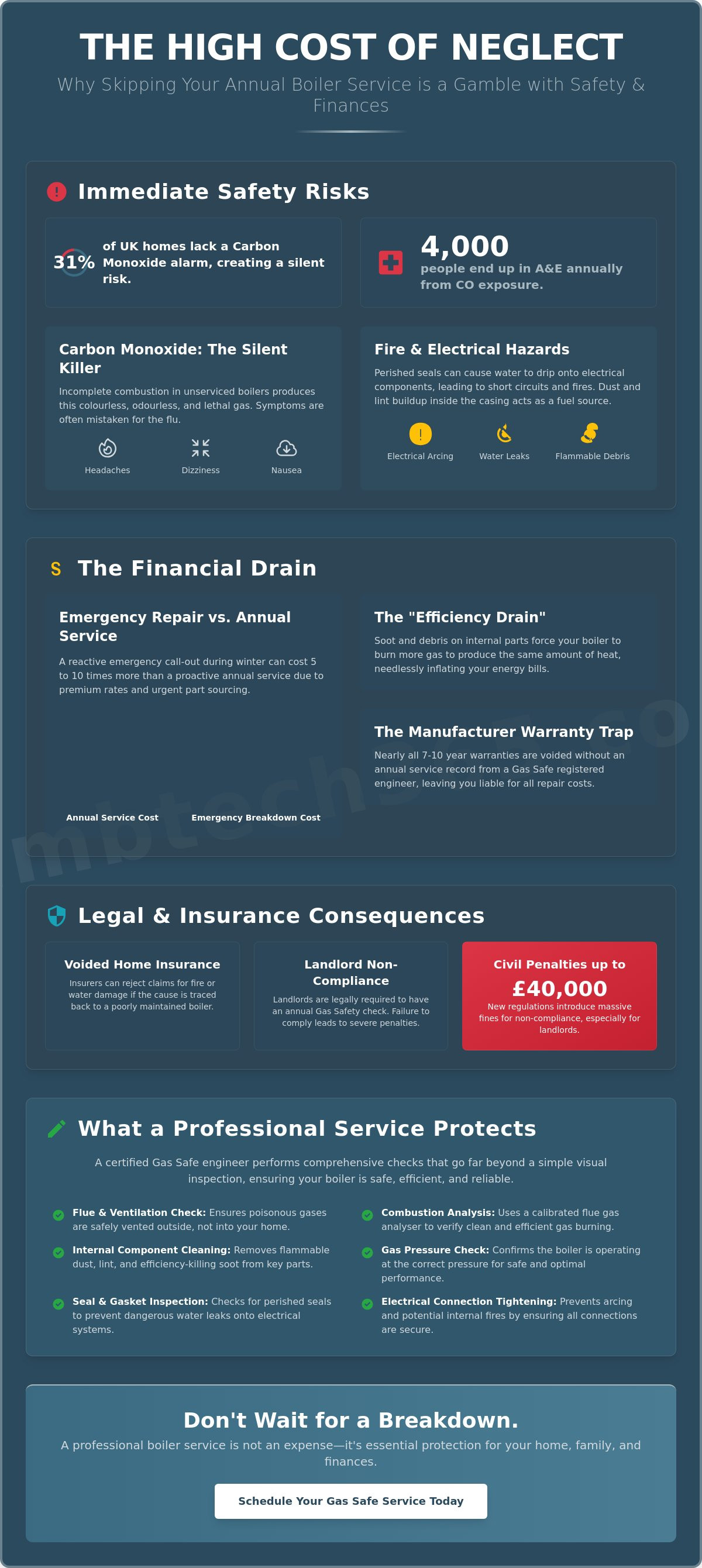
Did you know that 31% of UK residents still don't have a carbon monoxide alarm in their homes? It's a staggering figure when you consider that 4,000 people end up in A&E every year due to accidental exposure. The consequences of not servicing a boiler go far beyond a cold house on a snowy morning; they can be life-threatening. You likely feel like that annual service reminder is just another chore or a way for companies to charge you extra. It's easy to ignore a quiet boiler when your energy bills are already rising and the winter chill hasn't quite set in yet.
We'll show you exactly why skipping this simple check-up is a massive gamble with your family's safety, your legal standing as a homeowner, and your long-term bank account. Our central heating engineers have seen how minor issues turn into catastrophic failures when neglected, regardless of whether you have a recent boiler installation or an older system. This guide provides a clear look at the 2026 regulations, including the Renters' Rights Act 2025. You'll learn how to maintain your manufacturer warranty, avoid the new £40,000 civil penalties, and ensure your boiler remains a reliable source of warmth rather than a sudden financial burden.
Table of Contents
The Immediate Safety Risks of Neglecting Your Boiler
A professional boiler service isn't just a quick check-up. It's a mandatory safety verification designed to ensure your gas appliance operates within strict legal and technical parameters. To understand the risks, it's helpful to first define What is a boiler? and how it manages intense heat and pressure. When a system is neglected, the delicate balance of air and fuel required for safe operation is lost. One of the most severe consequences of not servicing a boiler is the transition from clean combustion to a hazardous state known as incomplete combustion.
This process occurs when the burner doesn't receive enough oxygen to burn the gas fully. Over time, household dust, lint, and metallic debris build up inside the casing, physically obstructing the flow of air. This lack of oxygen causes the flame to produce carbon monoxide instead of harmless carbon dioxide. Without an annual inspection by qualified boiler engineers, these internal blockages remain hidden until they cause a total system failure or a safety crisis.
To better understand the high stakes involved, watch this breakdown of the primary risks:
During a professional visit, our central heating engineers perform critical flue and ventilation checks. The flue is the "exhaust pipe" for your home. If it's cracked, blocked, or poorly sealed, those poisonous gases enter your living spaces rather than being vented outside. We use specialist equipment to ensure every joint is airtight and every vent is clear, providing a level of security that a visual check simply cannot offer.
Carbon Monoxide: The Invisible Threat
Carbon monoxide (CO) is often called the "Silent Killer" because it's colourless, tasteless, and odourless. Physical symptoms of exposure include persistent headaches, nausea, and dizziness, which many people mistake for a common cold. While standard CO alarms are helpful, they're a secondary defence only. They trigger after gas is present. Our team uses a calibrated flue gas analyser to detect trace leaks and combustion issues long before they reach levels that trigger a household alarm.
Fire Hazards and Electrical Failures
Safety risks aren't limited to gas leaks. Internal components like seals can perish over time, causing water to drip onto sensitive electrical boards. This moisture leads to "arcing," where electricity jumps between connections, potentially starting an internal fire. Furthermore, the accumulation of lint and dust inside the casing acts as a fuel source. Regular servicing involves tightening all electrical connections and cleaning out these flammable materials to prevent a catastrophic electrical failure.
The Financial Impact: Why Skipping a Service Costs More
Many homeowners view the annual boiler service as an optional expense. In reality, it's one of the most effective ways to prevent a total financial collapse of your household budget. The immediate consequences of not servicing a boiler manifest in your monthly gas bill. When internal components become coated in soot and debris, the heat exchanger cannot transfer energy efficiently. This creates an "Efficiency Drain" where your system burns significantly more fuel just to reach the temperature set on your thermostat.
Thermal efficiency is the direct measurement of how much gas your boiler converts into usable heat for your radiators. When this efficiency drops due to neglect, you are essentially paying for gas that disappears out of the flue. Beyond the monthly waste, the cost of a breakdown during a peak winter freeze is often five to ten times higher than a proactive maintenance visit. Emergency call-outs involve premium labour rates and the immediate need for parts that could have been replaced cheaply during a scheduled inspection.
The Manufacturer Warranty Trap
Modern boiler installations often come with impressive 7 or 10-year warranties. However, these are not unconditional guarantees. Almost every major manufacturer, including Vaillant, explicitly states that the warranty is only valid if the unit is serviced annually by a Gas Safe registered engineer. If a major component like the heat exchanger or PCB fails and you cannot provide a stamped service history, the manufacturer will likely reject your claim. This leaves you facing a repair bill reaching hundreds of pounds. For those with specific brands, consulting specialist Vaillant engineers ensures your documentation meets these strict 2026 compliance standards.
Rising Energy Consumption and Fuel Waste
Soot build-up acts as a powerful insulator inside your boiler. It prevents the burner's flame from heating the water effectively, forcing the system to work harder and run longer. This leads to "cycling," where the boiler constantly turns on and off to maintain heat. Frequent cycling accelerates the wear and tear on the fan, pump, and gas valve. By the time you notice your radiators taking longer to warm up, the internal damage is already done. A quick check from local gas engineers can recalibrate your system, restoring its factory-standard efficiency and protecting the lifespan of your entire central heating network.
Neglecting maintenance also impacts the wider system. Sludge and debris that originate in an unserviced boiler eventually migrate to your radiators and unvented hot water cylinders. This causes cold spots and further increases your energy demand. Investing in a professional service today is the only way to avoid these compounding financial risks.
Mechanical Degradation and the Emergency Breakdown Trap
Your boiler is a complex machine with moving parts that endure extreme temperature shifts every time your heating kicks in. One of the most overlooked consequences of not servicing a boiler is the gradual mechanical decay that happens out of sight. While the exterior might look fine, the internal components are likely fighting a losing battle against corrosion and wear. Small issues, such as a perishing seal or a slightly sticking valve, are easy for central heating engineers to fix during a routine visit. Left alone, these minor faults inevitably lead to a total system lockout at the worst possible time.
Most modern systems are designed to shut down entirely if they detect an internal fault to prevent further damage. This "lockout" is a safety feature, but it often occurs when the system is under the most pressure. Minor leaks inside the casing frequently go unnoticed by homeowners because the water evaporates on hot surfaces before it can drip onto the floor. This constant moisture corrodes electrical sensors and ruins expensive circuit boards. Identifying these trace leaks early is the difference between a simple seal replacement and a full-scale emergency repair.
To avoid these high-pressure situations, you can explore Boiler Repair & Installation with Plumbing & Boilers London, ensuring your system receives the expert attention it needs before a minor leak becomes a major crisis.
The Role of System Sludge and Corrosion
Inside your radiators and pipes, water reacts with metal to create black iron oxide sludge, technically known as magnetite. This heavy, abrasive substance circulates through your system and settles in the heat exchanger and pump. It acts like sand in an engine, grinding down delicate components and causing the boiler to overheat. During a service, we check the levels of chemical "inhibitor" in your water, which prevents this sludge from forming. If your radiators have cold spots or your boiler is making a "kettling" noise, you may need Power Flushing to clear the blockage before the pump fails completely.
Avoiding the Mid-Winter Emergency
The "Winter Peak" is a well-known phenomenon in the heating industry. Boilers that have sat idle or worked lightly through the summer often fail during the first sustained cold snap of December. Components like the diverter valve, which switches heat between your water and radiators, often seize up after months of inactivity. Finding an available Boiler Engineer during a freeze is notoriously difficult and stressful. We strongly recommend a "Summer Service" strategy. Testing your system under high-demand loads while the weather is warm ensures it won't let you down when you need it most. Proactive maintenance guarantees that your system is ready for the heavy workload of a British winter.
Legal and Insurance Consequences for Homeowners
Owning a home carries a significant "Duty of Care" that extends to every guest, family member, and tenant who enters your property. If a fire or carbon monoxide incident occurs because of a neglected appliance, you could be found legally negligent in a court of law. The consequences of not servicing a boiler are often framed as a mechanical inconvenience, but they can quickly escalate into a legal nightmare when safety is compromised. Proving you have taken reasonable steps to maintain your home is your primary defence against liability claims.
Home Insurance and the "Maintenance" Clause
Many homeowners assume their insurance policy is a catch-all safety net for any sudden disaster. This is a dangerous misconception. Almost all standard residential policies contain a "gradual deterioration" or "lack of maintenance" exclusion. Consider a scenario where a heat exchanger, weakened by years of internal corrosion, finally bursts. The resulting flood destroys your flooring and electrical systems. If the insurer discovers you haven't had an annual service, they may argue the damage was preventable. They can, and often do, reject claims for water damage or fire when the homeowner cannot provide proof of professional maintenance. Check your policy wording today; many insurers now explicitly require an annual service by a Gas Safe registered engineer as a condition of your cover.
Landlord Legal Obligations (CP12)
If you rent out a property, the legal stakes are even higher. Under the Gas Safety (Installation and Use) Regulations 1998, landlords are legally required to have a gas safety check performed every 12 months. Failing to provide a valid Landlord Gas Safety Certificate (CP12) is a criminal offence. In the current 2026 regulatory environment, the Renters' Rights Act 2025 has increased civil penalties for housing offences to a maximum of £40,000. It's important to remember that a CP12 is a safety check, not a full service. While a safety check confirms the appliance is safe to use at that moment, only a full service ensures it remains reliable. Our boiler engineers recommend performing both simultaneously to ensure total compliance and peace of mind.
Whether you are a homeowner or a landlord, your records are your shield. Keep every service report and certificate in a safe place. In the event of an insurance claim or a legal dispute, these documents prove you have acted responsibly and met your legal obligations. Don't leave your assets vulnerable to a technicality. Ensure your home is fully protected and legally compliant by booking your Boiler Servicing with our expert team now.
Protecting Your Home: What a Professional Service Includes
A professional boiler service is an exhaustive technical procedure that goes far beyond a simple visual check. It begins with a meticulous inspection of the casing and internal components for signs of overheating or external corrosion. Our central heating engineers strip down the unit to perform an internal cleaning of the burner and heat exchanger, removing the debris that leads to the efficiency issues discussed earlier. We then conduct component testing to verify that all safety devices function within strict factory specifications. Every visit concludes with a comprehensive Service Report. You must keep this document safe, as it serves as your primary legal proof of maintenance for insurance providers and manufacturer warranty claims.
Safety Checks vs. Full Servicing
It's vital to understand that a basic safety check is not a replacement for a full service. A safety check simply confirms the appliance is not currently dangerous; a full service ensures it continues to work reliably. During a full service, we test the expansion vessel and check the pressure relief valve for minor leaks. We also perform a gas tightness test, checking the entire pipework from the meter to the appliance. Neglecting these deep-level checks is one of the primary consequences of not servicing a boiler, as it allows hidden faults to fester until they cause a total system lockout.
Choosing the Right Boiler Engineer
Never trust your home to an unverified tradesman. You should always verify your engineer on the Gas Safe Register before they start any work. A qualified professional will carry an ID card showing their specific qualifications for boiler installations and maintenance. Choosing local, reliable trade assistance ensures you have a steady hand available for long-term system health. Plumbtech 365 is your dependable expert for everything from major Boiler Installations to minor home repairs. We recommend booking your 2026 service well before the winter rush begins to guarantee availability.
If you are located in the West Midlands, NBS Plumbing & Heating is a highly-regarded local specialist that provides a clear checklist of what to expect from your engineer during a 2026 service visit.
Our expertise isn't limited to the boiler room. We provide a versatile service profile that addresses a wide variety of plumbing and heating needs for the home. Our team handles everything from urgent leak detection and repair to routine toilet repairs and tap replacements. Whether you require assistance with complex bathroom plumbing or a simple radiator adjustment, Plumbtech 365 delivers the same professional, technical precision. Don't wait for a failure to tell you that maintenance was due; stay ahead of the cold and protect your household with proactive care.
Secure Your Home’s Warmth and Safety Today
Skipping your annual maintenance creates a domino effect of risks that compromise your family's safety and your financial security. You've seen how internal sludge and soot buildup drive up energy bills while perishing seals lead to catastrophic electrical failures. The consequences of not servicing a boiler aren't just limited to a cold house; they include voided warranties and rejected insurance claims that can cost thousands. These are avoidable burdens that a single professional visit can prevent.
Take control of your home's health before the winter rush begins. Our team of Gas Safe Registered Engineers provides the technical expertise and transparent, honest billing you need for total peace of mind. We offer a rapid response to keep your system running at peak efficiency year-round. Book your professional boiler service with Plumbtech 365 today to ensure your central heating remains a reliable, safe asset for your property. Staying proactive is the smartest way to protect your budget and your loved ones.
Frequently Asked Questions
How often should a boiler be serviced by a professional?
You must have your boiler serviced every 12 months. This annual interval is the only way to ensure safety controls work and warranties remain valid. Skipping a single year triggers the severe consequences of not servicing a boiler, including hidden carbon monoxide leaks or sudden mechanical failure. Regular checks keep your energy efficiency high and your monthly bills manageable.
Can I service my own boiler to save money?
You cannot service your own boiler. It's illegal for anyone who isn't a Gas Safe registered engineer to work on gas appliances. DIY attempts are incredibly dangerous and can lead to gas leaks or explosions. You'll also void your home insurance and any existing manufacturer warranties. Always hire professional boiler engineers to ensure the job is done safely and correctly.
Will my home insurance be void if I don’t service my boiler?
Your home insurance claim will likely be rejected if you haven't maintained your system. Most providers exclude damage caused by lack of maintenance. If a leak or fire occurs, the insurer will demand your service history. Without a stamped record, you face the financial consequences of not servicing a boiler alone, paying for all property repairs and water damage yourself.
What are the first signs that my boiler needs an urgent service?
Look for yellow or orange flames instead of a crisp blue one, as this indicates improper combustion. Other warning signs include unusual noises like banging or whistling, which often point to internal sludge buildup. If you notice dark stains around the casing or if the pressure constantly drops, you need an urgent inspection. Don't wait for a total breakdown during a cold snap to call for help.
How long does a standard boiler service take to complete?
A standard boiler service typically takes between 45 and 90 minutes. The exact time depends on the age of your system and when it was last maintained. Our engineers perform a thorough internal clean, check all seals, and test gas pressure. If the boiler is in poor condition or heavily fouled with debris, the process may take longer to ensure every safety check is completed properly.
Is a landlord gas safety check the same as a boiler service?
No, a landlord gas safety check (CP12) is not the same as a full boiler service. The CP12 is a legal requirement that focuses solely on the safety of the gas installation and appliances. A service is a comprehensive maintenance routine that cleans internal parts and optimizes efficiency. To protect your investment and your tenants, we recommend performing both tasks during the same visit.
What happens if a Gas Safe engineer finds a fault during a service?
If an engineer identifies a fault, they'll explain the issue and provide a clear quote for the repair. If the fault is dangerous, the engineer has a legal duty to label the appliance as "At Risk" or "Immediately Dangerous" and may isolate the gas supply. We prioritize honest billing and rapid repairs to get your heat back on safely without hidden costs.
Does a new boiler need servicing in its first year?
Yes, a new boiler installation requires its first service exactly 12 months after it was fitted. Most manufacturers make the 7 or 10-year warranty conditional on this annual maintenance. If you miss the first-year service, you lose that long-term protection immediately. It's a small investment to protect a high-value appliance and ensure it continues to operate at its peak efficiency rating.


Comments