


What Are the Signs of a Cracked Heat Exchanger? The 2026 Homeowner’s Guide

Did you know that approximately one in six domestic gas appliances inspected during random audits are found to have safety defects? While your boiler might appear to be working normally, a hidden fracture within its core could be a serious hazard, making it vital to understand what are the signs of a cracked heat exchanger. We know that heating failures cause immediate anxiety, especially when you are worried about the potential for a total breakdown or the silent threat of carbon monoxide poisoning. Technical jargon from engineers often makes a stressful situation feel even worse.
You deserve clear answers and a safe home. This guide helps you identify early warning signals before they lead to a household crisis. We will outline the specific symptoms to check, explain the legal safety requirements for UK homeowners, and clarify when it is essential to contact a Gas Safe registered engineer. By spotting these issues early, you can keep your household warm and, most importantly, protected from dangerous gas leaks whilst avoiding unnecessary stress. Our goal is to provide the expert clarity you need to make informed decisions about your heating system.
Table of Contents
Understanding the Role and Function of Your Boiler Heat Exchanger
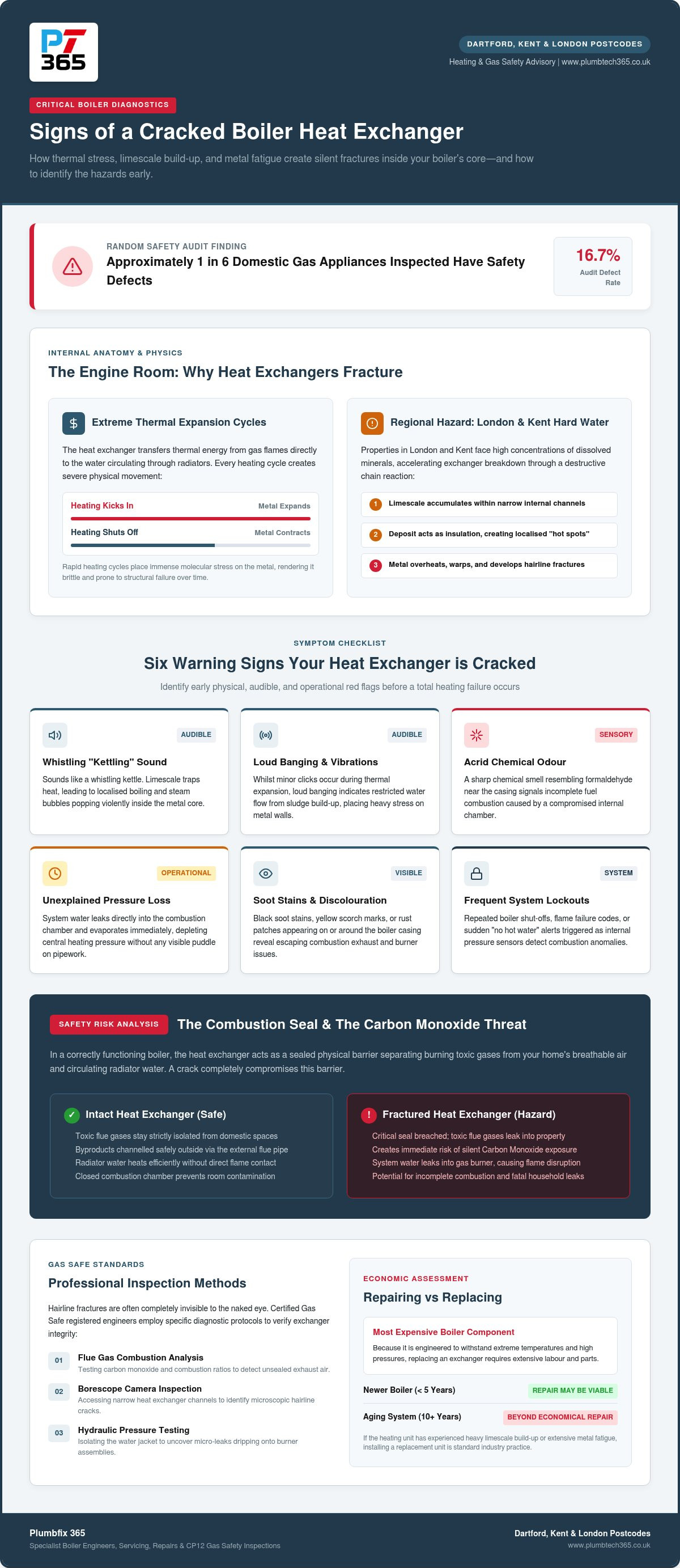
The heat exchanger is the engine room of your boiler. It transfers thermal energy from gas flames directly to the water that circulates through your radiators. This process involves extreme temperature shifts. Every time your heating kicks in, the metal expands. When it shuts off, it contracts. This constant movement creates significant physical stress. Because it is engineered to withstand such high pressure and intense heat, it's often the most expensive component to replace. If it fails, the repair can be so complex that it often makes more sense to install a new unit entirely.
In London and Kent, this component faces a specific local challenge. These regions are notorious hard water areas. Limescale builds up inside the exchanger's narrow channels, creating "hot spots" where the metal overheats. This accelerated fatigue is a primary reason why many homeowners eventually ask what are the signs of a cracked heat exchanger. Without regular maintenance, mineral deposits act like an insulating layer, forcing the metal to work harder and fail much sooner than expected.
To better understand how these components function and fail, watch this helpful video:
How Metal Fatigue Leads to Internal Fractures
Rapid heating cycles place immense molecular stress on the metal. Over time, the material becomes brittle and less flexible. If you notice a "kettling" noise, which sounds like a whistling kettle, it often indicates limescale deposits are trapping heat. This causes the metal to overheat in specific spots, leading to warping. Small hairline fractures appear first. While they seem minor, they expand into dangerous cracks as the boiler works. Ignoring these early warnings often leads to a sudden breakdown.
Why a Sealed Combustion Chamber is Vital
The exchanger serves as a critical barrier between the gas burner and your home’s air. Its job is to keep toxic flue gases separate from the water jacket and the living spaces. In a healthy boiler, these gases travel through the unit and out of the flue pipe. If a crack occurs, this seal is broken. Toxic byproducts can then escape into your property. Keeping this chamber sealed is the foundation of gas safety and prevents life-threatening situations. Identifying what are the signs of a cracked heat exchanger is a critical skill for any property owner.
Six Warning Signs Your Heat Exchanger is Cracked or Failing
Recognising a failing boiler early prevents a total household crisis. If you are wondering what are the signs of a cracked heat exchanger, start with your senses. You might notice an acrid, chemical odour near the unit that resembles formaldehyde. This is a clear indicator of incomplete combustion. Additionally, frequent lockouts or "no hot water" errors often stem from internal pressure loss. When the exchanger is breached, system water leaks into the combustion chamber and evaporates, causing the pressure to drop without any visible external leaks on your radiators or pipework.
Audible Symptoms: Banging and Whistling Noises
Mechanical failure often announces itself through sound. Whilst small clicks are normal as metal expands, loud banging or "kettling" noises are major red flags. These sounds occur when limescale or sludge restricts water flow, causing localised boiling and steam bubbles to pop violently inside the unit. This physical vibration stresses the metal and can lead to structural fractures. These symptoms are closely linked to the 5 warning signs your central heating is inefficient, as restricted flow eventually damages the boiler's core beyond repair.
Visible Indicators: Soot, Corrosion, and Flame Colour
Visual inspections provide the most direct evidence of a problem. A healthy burner produces a crisp, steady blue flame. If you see a flickering yellow or orange flame, the air-to-fuel ratio is likely compromised by a crack in the exchanger. This is a critical safety issue. According to the Health and Safety Executive guidance on carbon monoxide, yellow flames and soot accumulation are primary indicators of dangerous gas leaks and incomplete combustion.
Look for dark staining or soot around the boiler casing and internal components. This carbon buildup restricts the flue and increases internal heat pressure, creating a cycle of damage that accelerates component fatigue. You should also check the base of the boiler for water. A puddle inside the lower casing often suggests the water jacket has finally breached. If you notice any of these issues, you should contact boiler engineers Dartford residents trust to perform a professional safety check. Understanding what are the signs of a cracked heat exchanger allows you to act before a minor fault becomes a life-threatening emergency.
The Dangerous Link Between Cracked Components and Carbon Monoxide
A cracked heat exchanger is more than a mechanical failure; it's a critical safety breach. When the metal casing that separates combustion gases from your home's air supply fails, carbon monoxide (CO) can leak into your living spaces. This gas is lethal because it's colourless, odourless, and tasteless. You can't see it or smell it. This makes understanding what are the signs of a cracked heat exchanger a matter of life and death. If you or your tenants experience persistent tension headaches, dizziness, nausea, or fatigue that improves when you leave the house, you must act immediately.
Official Gas Safe Register advice on carbon monoxide risks highlights that faulty boiler components are a leading cause of poisoning. Data shows between 50 and 70 accidental carbon monoxide deaths are registered annually across England and Wales. Identifying what are the signs of a cracked heat exchanger is the first step in protecting your household from this invisible threat. To mitigate this risk, you must have working BS EN 50291 carbon monoxide alarms installed near every gas-burning appliance.
Why Flue Gases Must Remain Contained
In a functional boiler, flue gases follow a sealed path from the burner through the exchanger and out via the external terminal. A crack creates a shortcut. It allows these toxic byproducts to bypass the flue system entirely. Under current gas safety regulations (IGEM/G/11), an engineer who finds a crack that allows combustion products to leak must classify the appliance as "Immediately Dangerous" (ID). They're legally required to isolate the unit and affix a "Danger Do Not Use" label to prevent a fatal incident. Approximately 68% of domestic carbon monoxide incidents occur during autumn and winter, making seasonal vigilance vital.
Protecting Your Home with Gas Safe Expertise
Only a Gas Safe registered engineer can legally inspect the internal combustion chamber of your boiler. It is a criminal offence for anyone else to perform these diagnostics. Regular maintenance is the only way to catch these faults before they become hazardous. We've seen how local boiler engineers keep homes safe by using high-precision flue gas analysers to detect CO levels that human senses cannot. If you suspect a leak, follow these safety steps:
Turn off the gas at the meter immediately.
Ventilate the property by opening all windows and doors.
Evacuate everyone, including pets, from the building.
Call for help by contacting a qualified engineer or the National Gas Emergency Service.
Don't ignore the warning signs. A quick assessment today prevents a tragedy tomorrow. Our team is ready to provide the professional certification and safety checks your property requires.
Professional Inspection Methods Used by Gas Safe Engineers
Identifying what are the signs of a cracked heat exchanger from the outside is just the start of a safety assessment. To confirm a breach, a Gas Safe registered engineer performs a series of technical tests that go beyond a simple visual check. We use water pressure testing to find pinhole leaks that don't show up on your carpets or floorboards. If your boiler pressure drops constantly but your radiators and pipework are bone dry, the water is likely leaking into the combustion chamber and turning into steam. This internal loss is a primary indicator that the metal casing has finally failed.
In some cases, engineers use specialised fluorescent dyes or thermal imaging cameras to locate microscopic cracks in tight spaces. These fractures are often invisible to the naked eye but expand rapidly under the intense heat of the burner. By pressurising the system and using these diagnostic aids, we can pinpoint the exact location of a breach before it leads to a total system shutdown or a dangerous gas leak. This level of precision is essential for maintaining the safety of modern, high-efficiency boilers.
The Role of the Flue Gas Analyser
This digital tool is the gold standard for gas safety. It measures the ratio of oxygen to carbon monoxide in the flue gases. An imbalance usually points to a crack in the internal heat exchange wall. If air is being drawn into the burner through a fracture, the combustion process becomes unstable and produces dangerous levels of CO. This test is a mandatory part of expert boiler engineers performing a standard service. It provides a definitive reading that human senses simply cannot detect, ensuring your boiler is burning fuel safely and efficiently.
Detailed Internal Assessments
Modern boilers are compact and complex, often requiring us to strip down the burner assembly to gain access to the heat exchanger's surface. Engineers use mirror tools and high-definition endoscopes to inspect the tight coils for hairline fractures and signs of heat stress. We also examine the condensate trap for metal debris, soot, or white "chalky" deposits. These materials suggest the metal is corroding or burning improperly. Catching these microscopic details is the only way to identify what are the signs of a cracked heat exchanger before the unit becomes "Immediately Dangerous."
Don't leave your home's safety to chance. If your boiler is making unusual noises or losing pressure, you need a professional diagnostic check. Contact our Gas Safe engineers today for a thorough safety inspection and peace of mind.
Resolving the Issue: Repairing vs Replacing Your Heating Unit
Once you've identified what are the signs of a cracked heat exchanger, you face a critical choice. Replacing this component is a major operation. It requires a complete teardown of the internal assembly, which is why labour time is significant. For many homeowners, the discovery of a breach marks the point where a boiler transitions from a reliable asset to a liability. The technical difficulty of swapping an exchanger often means your system will be out of commission for a full day whilst the work is completed.
The "Beyond Economical Repair" (BER) threshold is a standard industry benchmark. If your unit is over 10 years old, the cost of a new exchanger often rivals a significant portion of a full boiler installation. Older systems also suffer from secondary wear on fans, pumps, and sensors. Fixing one major part doesn't guarantee the rest of the aging system will hold up through the next winter. In these cases, investing in a repair can be like throwing good money after bad.
When a Repair is the Sensible Choice
Repairing the unit is often the right path if the boiler is relatively new. If your system is still under a manufacturer warranty, the component replacement might be covered, provided you've kept up with annual servicing. We always recommend that landlords and homeowners consult the Signs Your Boiler Is Beyond Economical Repair Checklist before committing to a fix. For units under five years old, an isolated fault in the exchanger is rare but usually worth addressing to extend the life of the machine.
The Benefits of a Modern Boiler Installation
Choosing a new installation offers long-term financial and safety advantages. Modern A-rated condensing boilers are significantly more efficient than older models. They use advanced heat exchanger designs that resist limescale buildup more effectively, which is a major benefit for properties in hard water areas like Kent. By upgrading, you can lower your monthly energy bills and reduce the frequency of expensive emergency call-outs. It's a proactive way to manage your property's long-term maintenance.
A new system also comes with a fresh manufacturer warranty, often lasting up to 10 or 12 years. This provides total peace of mind that a single-part repair cannot match. If you suspect a fault or have spotted what are the signs of a cracked heat exchanger in your home, don't wait for a total breakdown. As We are a trusted plumbing & heating company providing reliable, high-quality services across London and Kent, you should book a priority inspection with us today to receive a professional assessment of your system's health. We provide the steady hand and technical expertise needed to restore your home's safety and comfort.
Take Control of Your Home Heating Safety
A cracked heat exchanger is never a minor fault; it's a critical safety breach that demands immediate action. By learning what are the signs of a cracked heat exchanger, you can spot unusual noises or pressure drops before they escalate into a carbon monoxide emergency. Remember that only a Gas Safe registered engineer has the legal authority and technical tools to safely inspect your boiler's internal combustion chamber. Whether your unit needs a complex repair or a high-efficiency replacement, prioritising safety today prevents a household crisis tomorrow.
Plumbfix 365 has served as a trusted local expert since 1996, providing 24/7 emergency support across London and Kent postcodes. Our Gas Safe registered engineers are ready to act as the steady hand during your heating emergency, ensuring your home remains warm and protected year-round. Don't wait for a total breakdown to occur. Secure Your Home with a Professional Boiler Inspection from Plumbfix 365 today and enjoy the peace of mind that comes with a rigorous safety certification.
Frequently Asked Questions
Can a boiler still work with a cracked heat exchanger?
Yes, a boiler can often continue to run with a fractured core, but it is extremely dangerous to do so. A breach in the metal allows toxic combustion byproducts to escape into your home. Even if your heating appears to be working, you must turn the unit off immediately if you suspect a leak. A cracked unit is a serious safety hazard that requires professional attention from a Gas Safe registered engineer.
How much does it cost to fix a cracked heat exchanger in the UK?
The total expense depends on your boiler's specific make and model, as well as the complexity of the internal teardown required. Because the exchanger is one of the most technical components to replace, labour time is often significant. In many cases, especially for boilers over 10 years old, engineers categorise the unit as beyond economical repair. You should request a professional assessment to compare repair viability against a new installation.
What causes a heat exchanger to crack in a relatively new boiler?
Manufacturing defects are rare; the most common culprit in newer units is poor water quality. In hard water areas like Dartford and Bromley, limescale builds up quickly inside the exchanger's narrow channels. This creates hot spots where the metal overheats and warps. If the system wasn't properly power flushed during the initial installation, internal sludge can also cause localised overheating, leading to premature stress and fractures in the metal casing.
Is a cracked heat exchanger an emergency that needs immediate repair?
Yes, this is considered a high-priority safety emergency that demands immediate action. Under UK gas industry unsafe situations procedures, an engineer must classify a leaking exchanger as Immediately Dangerous. This means the appliance is a direct threat to life and must be isolated from the gas supply. If you suspect a breach, contact our emergency repair specialists in London and Kent to ensure your property remains safe and compliant.
Can a cracked heat exchanger cause a carbon monoxide leak?
A crack provides a direct path for carbon monoxide to escape the sealed combustion chamber and enter your living space. This is the primary reason why knowing what are the signs of a cracked heat exchanger is so vital for every homeowner. Since carbon monoxide is odourless and tasteless, a breach can be fatal without any warning. Always ensure you have working BS EN 50291 alarms installed near your gas appliances.
How long does a boiler heat exchanger usually last before failing?
Most domestic condensing boilers have a life expectancy of 10 to 15 years. The heat exchanger is designed to last the lifetime of the unit, but factors like hard water and lack of annual servicing can shorten this significantly. Beyond the 12-year mark, the metal often reaches its fatigue limit due to thousands of thermal expansion cycles. Regular maintenance is the best way to maximise this lifespan and prevent sudden failures.
Will a boiler service identify a cracked heat exchanger before it fails?
A professional service by a Gas Safe registered engineer is designed to catch these issues early. We use digital flue gas analysers to detect incomplete combustion and visual tools like endoscopes to check for hairline fractures. Identifying what are the signs of a cracked heat exchanger during a routine check prevents sudden winter breakdowns. It ensures your system complies with current safety regulations and operates at peak efficiency.
What should I do if my carbon monoxide alarm goes off near my boiler?
You must treat every carbon monoxide alarm trigger as a life-threatening emergency. Turn off the gas at the meter, open all windows to ventilate the property, and evacuate everyone immediately. Do not turn the boiler back on until it has been inspected and cleared by a qualified professional. Contact a Gas Safe engineer for a priority safety check to locate the source of the leak and restore your home's safety.


Comments