


Chemical Flush vs Power Flush: Which is Better for Your Heating in 2026?

Is your heating system working for you, or are you simply burning money to keep the sludge warm? When faced with cold spots on radiators or a noisy boiler, many property owners ask: chemical flush vs power flush which is better for their specific system? We understand the anxiety that comes with rising gas bills and the fear of a total boiler failure during a London winter. For landlords and property managers in Kent, a sluggish system doesn't just mean a cold house; it means unhappy tenants and potential compliance issues.
We've designed this guide to help you make an informed decision and restore your heating efficiency. You'll learn the technical differences between these two maintenance methods and how to protect your boiler from costly breakdowns. We will compare the preventative nature of a chemical treatment against the restorative power of a full system flush. By the end, you'll know exactly how to ensure your property remains warm, your bills stay low, and your system stays compliant with BS 7593:2019 standards.
Table of Contents
Understanding the Build-up: Why Your Heating System Needs a Flush
We often see heating systems struggling because owners overlook what is happening inside the pipes. Most UK homes rely on Hydronics to distribute warmth, using water as the medium to transfer heat from the boiler to your radiators. Over time, the internal steel components of your radiators react with water and oxygen. This chemical reaction creates black iron oxide, a heavy, magnetic substance commonly known as sludge. As this material settles amongst your pipework, it creates a thick, tar-like barrier that prevents water from flowing freely.
To better understand how this debris accumulates and how a professional clean can resolve it, watch this helpful video:
Sludge doesn't just sit there; it clings to the internal walls of your heating circuit. This reduces the internal diameter of your pipes, which forces your system pump to work significantly harder to move water. When the pump is under constant strain, it consumes more electricity and is far more likely to suffer a mechanical failure. In 2026, with energy prices remaining a primary concern for London landlords and homeowners, this inefficiency is a direct drain on your finances. You are paying for gas to heat water that simply cannot reach its destination due to these internal blockages.
What is 'Sludge' and How Does it Damage Your Boiler?
Magnetite is the primary byproduct of internal corrosion. It is particularly dangerous for modern condensing boilers, which feature narrow passages within their high-efficiency heat exchangers. If sludge enters the boiler, it can cause "kettling" noises, which sound like a boiling kettle. This happens when debris traps water against the hot surface of the heat exchanger, causing it to flash into steam. This process doesn't just sound alarming; it causes localised "hot spots" that can crack the heat exchanger, leading to a total system breakdown. Determining chemical flush vs power flush which is better often starts with assessing how much of this material has already reached your boiler.
Recognising the Warning Signs of an Inefficient System
We recommend checking your radiators regularly for cold spots. If the bottom of the radiator feels cold whilst the top is hot, you have a classic case of sludge accumulation. The heavy magnetite has settled at the base, blocking the flow of warm water. You might also notice your boiler "cycling" or locking out frequently as it struggles with poor circulation. Look out for these specific symptoms:
Radiators that are cold at the bottom but hot at the top.
Discoloured water appearing when you bleed your radiators.
The boiler making loud banging or whistling noises.
Slow heat-up times across the entire property.
System sludge acts as an unwanted insulator that can increase your fuel consumption by up to 15% as the boiler works overtime to compensate for the lack of heat transfer. When deciding chemical flush vs power flush which is better, these symptoms serve as your first diagnostic tool.
The Chemical Flush: A Preventative Approach to System Health
A chemical flush is primarily a maintenance procedure designed for systems that are already in relatively good condition. Unlike more aggressive methods, this process relies on the "chemistry" of specialised cleaning agents rather than the "physics" of high-pressure water. We use the system's existing circulation pump to move these chemicals through the pipework. This gravity-fed or low-pressure approach is gentle on older seals and joints, making it a safe choice for routine upkeep. It's an effective way to mobilise light debris before it has the chance to harden into the stubborn blockages we discussed in the previous section.
When deciding chemical flush vs power flush which is better, you must consider the current state of your heating. A chemical flush is not a deep-clean for a neglected system. Instead, it serves as a vital preventative tool. It uses pH-neutral or slightly acidic cleaners to break down loose magnetite and lime scale. If your radiators are already suffering from significant cold spots, the system's own pump may lack the velocity required to push these chemicals through the heavy blockages. In those cases, a more robust solution is required.
How the Chemical Cleaning Process Works
The process begins by adding a concentrated cleaning agent to the system water. We then run the heating at a high temperature for several hours, or sometimes even days, to allow the chemicals to penetrate the sludge. Once the debris is mobilised, we drain the entire system and rinse it thoroughly with fresh water. This rinsing stage is critical; any leftover cleaning chemicals could potentially damage the internal components of your boiler over time. To finish, we add a high-quality corrosion inhibitor. This chemical creates a protective film on the internal surfaces of your radiators to stop the oxidation process. Following industry guidance on how to effectively powerflush and treat water ensures that your system remains efficient for years to come.
When a Chemical Flush is the Most Appropriate Choice
We recommend a chemical flush for systems less than five years old that show no signs of circulation issues. It is also an essential requirement during a new boiler installation. Most manufacturers will only honour their warranty if the system is cleaned and treated in accordance with BS 7593:2019 standards before the new unit is commissioned. For landlords in London and Kent, organising a routine chemical flush is a cost-effective way to avoid emergency call-outs and keep gas bills manageable for tenants. If you are preparing for a tenancy change, our professional boiler engineers can assess if a simple chemical treatment is enough to protect your investment.
Property owners often ask chemical flush vs power flush which is better for their budget. Whilst the chemical option is generally more affordable, its value lies in prevention. It keeps a healthy system running at peak performance, whereas a power flush is required to bring a failing system back to life.
The Power Flush: Restoring Performance to Heavily Sludged Systems
When the build-up of magnetite reaches a critical level, chemistry alone is no longer enough to resolve the issue. We must move from a preventative approach to a restorative one. A power flush is a mechanical cleaning process that uses a specialised high-velocity, low-pressure pumping station to physically dislodge sludge. Whilst a chemical flush relies on the system's own weak pump, a power flush provides the force needed to mobilise heavy deposits that have settled over years. It is a robust solution for systems that have been neglected or are showing severe symptoms of inefficiency.
During the procedure, we integrate powerful magnetic filters into the circuit. These magnets capture metallic debris as it circulates, preventing it from re-entering the boiler or settling back into the pipework. This is a restorative procedure designed to bring an old, failing system back to its original performance levels. It's often the last line of defence before a costly system replacement becomes inevitable. For property managers in London and Kent, this service is a vital tool for maintaining aging housing stock and avoiding the disruption of a full boiler installation.
High-Velocity Cleaning: The Science Behind the Power Flush
The secret to a successful power flush lies in the 'reverse flow' mechanism. By rapidly changing the direction of the water, we create intense turbulence inside the radiators. This turbulence is far more effective at lifting heavy sludge than a single-direction flow. We also use specialised vibrating tools, known as radiator agitators, to loosen hardened magnetite from the bottom of the units. This combination of high-velocity water and mechanical agitation ensures a depth of clean that a standard chemical treatment cannot match.
Many property owners worry about the 'power' in the name. However, we keep the pressure low, usually under 2 bar, to ensure the process is safe for your pipework. It is the high volume and velocity of the water, not the pressure, that does the work. This makes it a safe option even for older systems. When weighing up chemical flush vs power flush which is better, you'll find that the mechanical action of the power flush is the only way to clear stubborn, solidified blockages.
Why Older Systems Benefit from Restorative Flushing
If your radiators have significant cold spots or are completely cold at the bottom, a power flush is usually the only viable solution. It can literally save a boiler from a terminal heat exchanger failure by removing the debris that causes kettling and overheating. For landlords, this is a proactive way to extend the lifespan of a boiler and ensure tenant satisfaction. A professional power flush typically takes between 4 to 8 hours to complete for an average-sized home in 2026. It is a more intensive day of work, but the results are immediate and long-lasting.
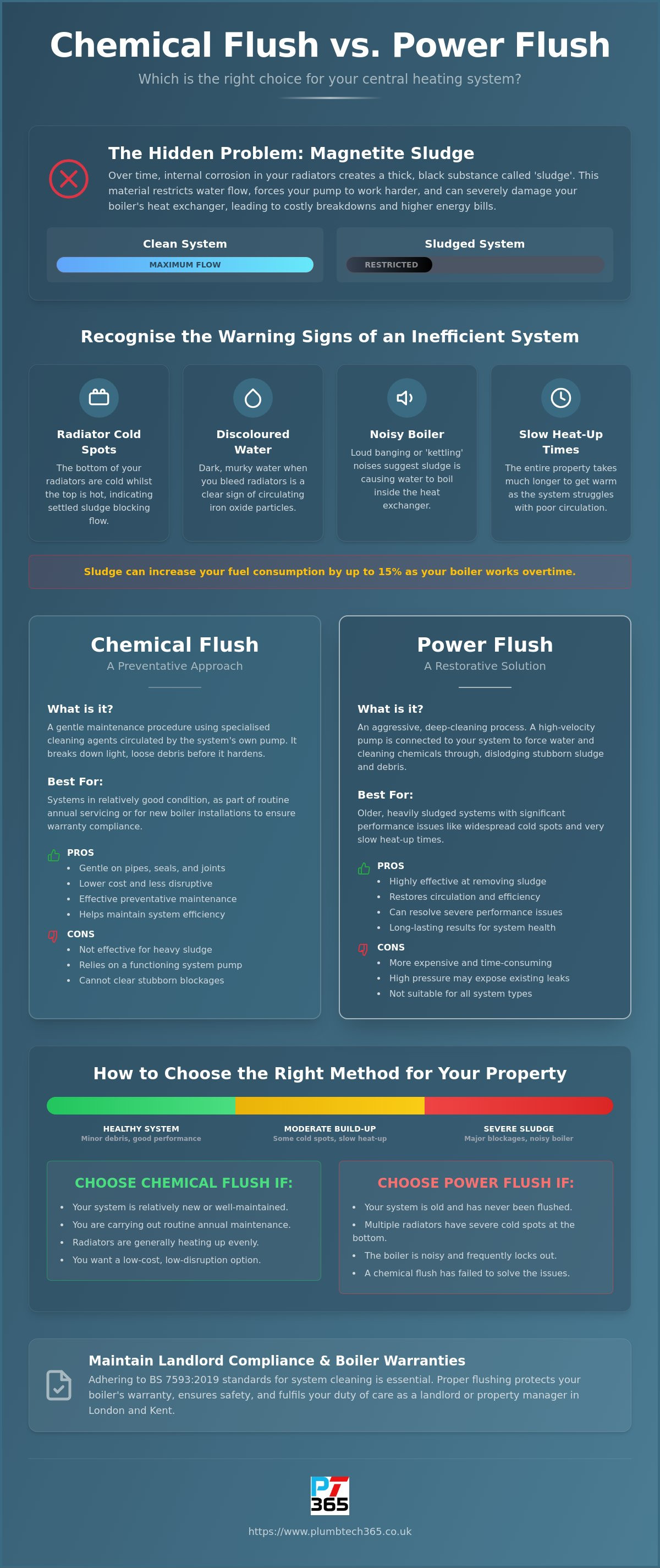
Chemical Flush vs Power Flush: The Definitive Comparison
Deciding chemical flush vs power flush which is better for your property requires a clear understanding of your system's current health and your long-term goals. While both methods aim to remove debris, they operate on entirely different scales of intensity. A chemical flush is a light-touch intervention. It's often the preferred choice for landlords who want to organise routine maintenance without disrupting their tenants. In contrast, a power flush is a heavy-duty operation. It's the only way to restore a system that has been neglected for over a decade.
Your pipework material also dictates the best approach. Standard copper pipes handle both methods well. However, if your property uses microbore pipework, which is much narrower, you must exercise caution. These thin pipes are prone to total blockages that a simple chemical circulation cannot clear. Conversely, an inexperienced engineer using a power flush machine on microbore could cause issues if the flow is not managed correctly. We always recommend a professional assessment to ensure the chosen method matches your specific plumbing infrastructure.
Cost, Duration, and Intensity: A Side-by-Side Breakdown
The time commitment for each method varies significantly. For a standard three-bedroom home, a chemical flush is relatively quick. We add the chemicals, let the system run its normal cycle, and return later to drain it. This involves minimal equipment and low disruption. A power flush is an all-day commitment. It requires a specialised pumping station, magnetic filters, and hoses connected throughout the property. The intensity is much higher because we use mechanical agitation to physically scrub the inside of every radiator. While the chemical method relies on concentration and time, the power flush relies on velocity and turbulence.
Chemical Flush: 1 to 2 hours of active work; low cost; preventative depth.
Power Flush: 4 to 8 hours of active work; higher cost; restorative depth.
Disruption: Chemical is minimal; Power flush requires access to all radiators for the full day.
Impact on Energy Bills and Boiler Longevity
In 2026, energy efficiency is the primary driver for system maintenance. Modern condensing boilers only achieve their advertised efficiency ratings when they can operate in "condensing mode." This requires the return water temperature to be low. Internal sludge acts as an insulator, keeping return temperatures too high and forcing the boiler to work in a less efficient, non-condensing state. By clearing this debris, you allow your boiler to modulate correctly, which can lead to a noticeable reduction in monthly gas consumption.
Clean water also protects expensive internal components. Sludge is the leading cause of failure for circulator pumps and diverter valves. Our Boiler Engineers frequently find that systems failing their annual service simply need a thorough clean to meet manufacturer standards. Keeping the system clear reduces the friction the pump must overcome, which directly extends the lifespan of your appliance. If you are unsure which method your system requires, contact us today for a professional heating assessment to protect your boiler and lower your bills.
Making the Right Choice for Your Property and Budget
Deciding between these two methods shouldn't be based on a guess. We use a turbidity test to provide a clear, visual assessment of your system water quality. By comparing a sample of your heating water against a standard scale, we can see exactly how much suspended magnetite is present. This data, combined with a magnetic probe check, tells us if the sludge is loose or has already settled into a thick layer. We also perform a thermal sweep of your radiators. If the temperature variance across the surface is significant, a chemical flush is unlikely to resolve the blockage. When clients ask us chemical flush vs power flush which is better, we look at the data first.
For landlords in London and Kent, the decision often involves balancing the initial outlay against the risk of tenant dissatisfaction. A cold home leads to complaints and can even result in expensive void periods if the heating fails between tenancies. During a Landlord Gas Safety Certificate inspection, our engineers often identify the early warning signs of circulation failure. Addressing these issues with the correct flush ensures you aren't dealing with a total boiler breakdown during the height of winter. It is a proactive way to maintain your reputation as a responsible property owner whilst keeping gas bills manageable for your tenants.
Professional Assessment: Why a Gas Safe Engineer Must Decide
DIY flushing is a high-risk gamble that rarely pays off. Modern boilers contain delicate sensors and high-efficiency heat exchangers that are easily damaged by incorrect chemical concentrations or improper pressure application. A professional assessment is the only way to settle the debate of chemical flush vs power flush which is better for your specific budget. We might discover that your cold radiators are caused by a faulty thermostatic valve or a failing pump rather than sludge. This saves you from paying for a flush you don't actually need. After every job, we provide a written report on your system's health, which is essential for your property records and proving compliance with BS 7593:2019.
Protecting Your Investment: Maintenance Plans and Magnetic Filters
Once your system is clean, you must take steps to keep it that way. We strongly recommend the installation of a permanent magnetic system filter after any flush. This device acts as a continuous safety net, capturing any new metallic debris before it can reach the boiler's internal components. This is a standard requirement for many modern boiler warranties. Combined with annual servicing to monitor inhibitor levels, this setup prevents the rapid re-accumulation of sludge. We focus on long-term reliability rather than quick fixes. To ensure your property remains efficient and your tenants stay warm, Contact our expert heating engineers to book your system health check today.
Secure Your Property's Heating Performance
Restoring your heating system is about more than just comfort; it's about protecting your investment and ensuring total compliance. Whether you need a gentle chemical treatment to maintain a new boiler or a high-velocity power flush to clear stubborn blockages, the right choice will lower your energy consumption. We've provided expert heating solutions across London and Kent since 1996, focusing on dependable workmanship and safety at every stage.
Don't wait for a total system lockout to take action. Deciding chemical flush vs power flush which is better for your specific home requires professional insight. We provide transparent, honest billing and use only Gas Safe Registered engineers to ensure every job meets the highest industry standards. Take control of your heating performance and enjoy the peace of mind that comes with a clean, efficient system. We're ready to help you maintain a warm, reliable property all year round.
Book a professional system health check with our Gas Safe engineers to keep your radiators hot and your boiler healthy.
Frequently Asked Questions
Is a power flush better than a chemical flush?
Whether a power flush is better depends entirely on the current condition of your heating system. A power flush is superior for removing heavy magnetite sludge and restoring circulation in older, neglected systems. For relatively new systems under five years old, a chemical flush is often the better, more cost-effective preventative measure. We assess each property individually to determine chemical flush vs power flush which is better for your budget and boiler health.
How much does a power flush cost compared to a chemical flush?
A power flush is generally more expensive than a chemical flush because it requires specialised mechanical equipment and a full day of labour. The chemical method is a faster, lower-cost alternative that uses your system's existing pump. However, the higher initial cost of a power flush often provides a better long-term return on investment for heavily sludged systems by significantly reducing monthly gas bills and preventing expensive component failures.
Can a power flush cause leaks in my radiators or pipes?
A professional power flush uses high velocity rather than high pressure, so it won't burst healthy pipes or radiators. However, the process can dislodge the sludge that was previously blocking a tiny corrosion hole. If a leak appears, it's because the radiator was already failing internally. We always conduct a pre-flush inspection to identify vulnerable areas and ensure the process is safe for your specific plumbing infrastructure.
How long does a central heating power flush take?
A professional power flush typically takes between 4 to 8 hours to complete for a standard-sized home. The duration depends on the number of radiators and the severity of the sludge build-up. We focus on completing the job thoroughly within a single day to minimise disruption for tenants and property managers. A chemical flush is much faster, often requiring only 1 to 2 hours of active on-site work.
Do I need a power flush before installing a new boiler?
You must ensure the heating system is thoroughly cleaned before commissioning a new boiler to comply with BS 7593:2019 standards. Most manufacturers will void your warranty if they find sludge from the old system has damaged the new heat exchanger. Whilst a chemical flush might suffice for newer pipework, we often recommend a power flush to guarantee that every trace of debris is removed before the new unit is connected.
Will a chemical flush fix radiators that are cold at the bottom?
A chemical flush is rarely strong enough to clear radiators that are completely cold at the bottom. This symptom indicates that heavy magnetite has settled and solidified, creating a blockage that the system's own pump cannot move. In these cases, the mechanical agitation and high-velocity flow of a power flush are necessary to physically dislodge and remove the build-up.
How often should I have my central heating system flushed?
We recommend having your heating system professionally flushed every five to six years to maintain peak efficiency. Regular flushing prevents the gradual accumulation of sludge that leads to noisy boilers and high energy bills. For landlords, incorporating this into a planned maintenance schedule is a reliable way to extend the lifespan of the boiler and ensure year-round tenant satisfaction across your property portfolio.
Can I perform a chemical flush myself or do I need an engineer?
We strongly advise using a Gas Safe Registered engineer for any system flush. Professional engineers have the tools to test water turbidity and ensure the correct concentration of chemicals is used and, more importantly, thoroughly rinsed out. Incorrect DIY flushing can leave acidic residues that damage your boiler's internal seals. Professional service also provides the necessary documentation to prove compliance with building regulations and maintain your manufacturer's warranty.


Comments