
Cost of Fixing a Burst Pipe: 2026 UK Price Guide and Emergency Checklist
- Darrell Williamson

- Jul 4
- 11 min read
Imagine waking up to the sound of rushing water and discovering a ceiling bulge directly above your expensive furniture. In such a high-stakes moment, most homeowners immediately search for a property maintenance company near me that can stop the deluge before it compromises the building's fabric. Understanding the real-world cost of fixing a burst pipe is your priority, but the speed of your professional response is what truly determines whether you face a simple repair or a total renovation.
We recognise the anxiety caused by sudden emergency call-out fees and the confusion over whether insurance will cover the damage. This article provides a comprehensive 2026 UK price guide to ensure you understand fair market rates for both plumbing and restoration work. We also provide a critical emergency checklist to help you isolate the leak and minimise water damage. From navigating the latest water regulations to finding a reliable tradesman for permanent repairs, this guide gives you the calm authority needed to handle any household plumbing crisis.
Table of Contents
Emergency First Response: A Checklist to Minimise Costs
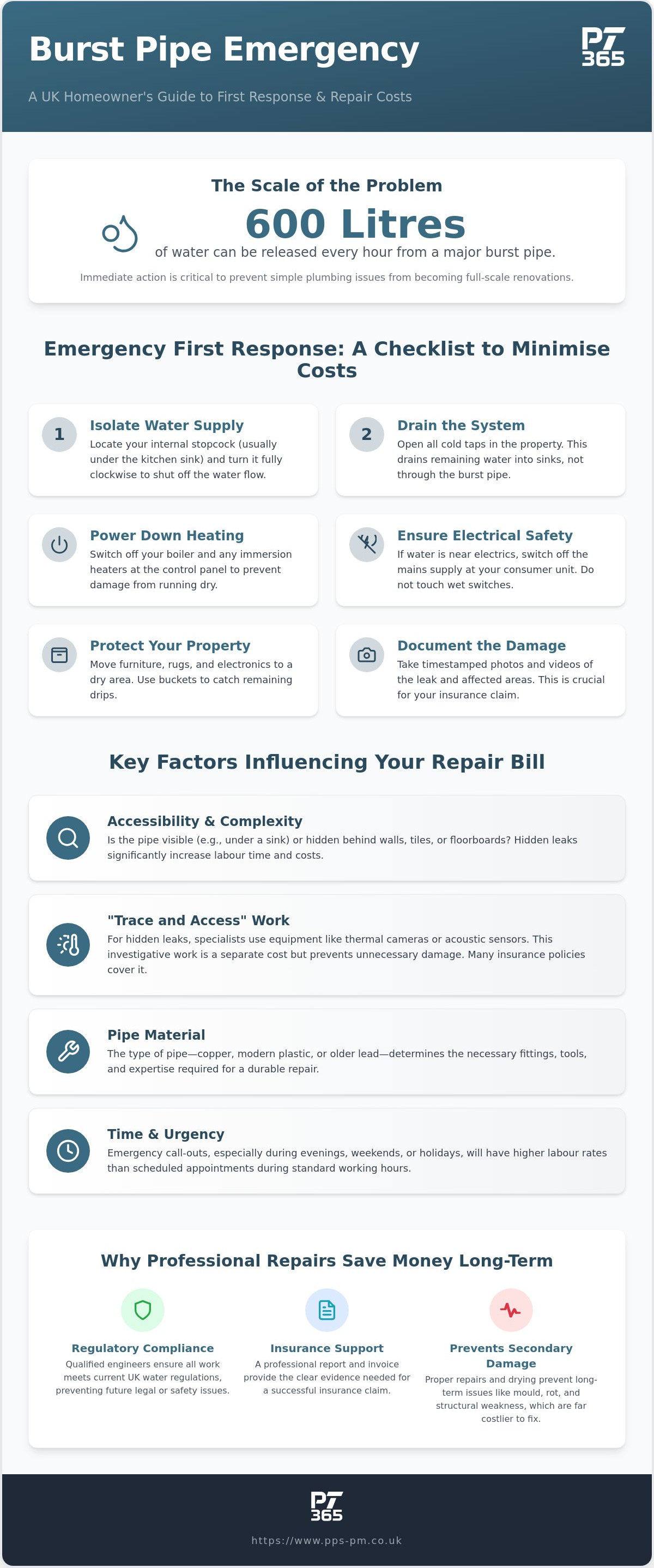
Speed is your most effective tool when a pipe fails. A major burst can release up to 600 litres of water every hour, which is enough to saturate floorboards and compromise structural integrity in minutes. Acting immediately doesn't just protect your home; it's the primary factor in reducing the overall cost of fixing a burst pipe. If you can stop the flow before water migrates into the building's fabric, you limit the repair to a simple plumbing fix rather than a full-scale renovation project.
Insurance companies often look for evidence of "mitigation of loss." This means you have a legal and financial responsibility to prevent the damage from worsening. By following a structured response plan, you create a clear paper trail that supports your claim whilst keeping your repair bill manageable. Professional containment ensures that secondary issues, such as mould growth or collapsed ceilings, never have the chance to develop.
Critical Steps for Water Containment
Your first priority is to kill the supply. Locate your internal stopcock immediately. This valve is typically found under the kitchen sink, in a hallway cupboard, or beneath the stairs. Turn it firmly clockwise to shut off the incoming water. Once the supply is off, you must "drain the drop." Open every cold tap in the property to empty the remaining water from the system into the sinks rather than through the burst pipe.
Don't forget your heating system. Switch off the boiler and any immersion heaters at the control panel. Running a boiler without sufficient water pressure can cause permanent damage to the heat exchanger, leading to an even higher bill from your local gas engineers. If your home has a cold water storage tank in the loft, you should also turn off the stopcock to the tank to prevent it from draining through the leak.
Property and Electrical Safety
Water and electricity are a lethal combination. If you notice water dripping from light fittings or pooling near power sockets, go to your consumer unit and switch off the mains electricity. Do not touch any switches in the affected room. Understanding water damage involves recognising how moisture travels through wall cavities and floor joists. It often appears far from the original source of the leak.
Clear the area to protect your belongings. Move furniture, rugs, and electronics to a dry room. Use buckets or plastic sheeting to catch any remaining drips. Once the site is safe, take timestamped photos and videos of the burst pipe and the surrounding damage. These records are essential for your insurance provider and help your Property Maintenance company provide an accurate assessment of the required repairs. Taking these steps ensures that when the tradesman arrives, they can focus entirely on the fix rather than damage control.
Factors Influencing the Cost of Fixing a Burst Pipe
Every plumbing emergency is unique. The total cost of fixing a burst pipe isn't just a reflection of the plumber's hourly rate; it's a combination of accessibility, materials, and the timing of your call. If the leak is visible, such as a split pipe under a kitchen sink, the repair is usually fast and economical. However, if water is pooling in a ground floor hallway but the source is hidden behind a wall, the complexity increases significantly.
Hidden leaks require "Trace and Access" work. This involves using specialised equipment like thermal imaging cameras or acoustic sensors to find the precise location of the failure. The Association of British Insurers offers essential advice on insurance claims for burst pipes, noting that many home insurance policies include specific coverage for these investigative costs. Pinpointing the leak accurately prevents a general maintenance company from having to rip up entire floors, which keeps your eventual restoration bill much lower.
Accessibility and Complexity
The physical location of the pipe dictates the labour time. A burst in a loft space or behind a tiled bathroom wall is far more difficult to reach than one in an open garage. If a pipe is buried behind tiles, you'll likely need a Handyman service or wall tilers to restore the area once the plumbing is fixed. Material choice also plays a role. While copper is the industry standard, older lead pipes or modern plastic push-fit systems require different fittings and specific expertise. A simple patch on an accessible pipe might take an hour, whilst a full section replacement in a cramped ceiling void could take much longer.
Time and Urgency Factors
When you call a professional, the time of day is a major pricing factor. Most plumbers use a "First Hour" billing model for emergencies. This covers the rapid mobilisation and initial assessment. Weekends, bank holidays, and late-night calls naturally attract higher fees than standard weekday hours. Choosing a reliable local property maintenance service ensures you receive honest billing and financial clarity even in a crisis. By acting during normal business hours if the leak is isolated, you can often avoid the steepest emergency premiums. However, never delay a repair if the water is still flowing, as the damage costs will quickly outweigh the call-out fee.
2026 UK Price Guide: Estimating Your Repair Bill
Understanding the total cost of fixing a burst pipe requires looking beyond the immediate patch or replacement. In 2026, the financial impact of a leak is heavily influenced by the new "Water White Paper" regulations, which emphasise proactive maintenance and stricter infrastructure standards. When you receive a quote, you aren't just paying for a spare part; you're paying for the technical expertise required to navigate these updated safety protocols and the speed of an emergency response that prevents thousands of pounds in secondary damage.
The final bill is typically a combination of a professional call-out fee, an hourly labour rate, and the cost of materials. It's important to recognise that location plays a massive role in these figures. For instance, industry data shows that labour rates in London remain consistently 15% to 20% higher than the UK national average. Whether you're hiring a Property Maintenance company in Kent or an emergency plumber in the City, ensuring they provide a transparent breakdown of these costs is essential for financial clarity.
Average Repair Costs by Pipe Type
The complexity of the repair varies based on how much of the pipe is visible. A minor leak under a kitchen sink is usually a straightforward fix involving a new fitting or a small section of copper piping. However, a major burst inside a ceiling or wall cavity introduces "Trace and Access" costs. This is the biggest variable in any repair bill. If the leak is hidden, professionals must use non-invasive technology to pinpoint the failure before any physical work begins. External water supply pipes are the most expensive to resolve, as these often require excavation equipment to reach the buried infrastructure.
Labour and Call-Out Fee Estimates
Most local plumbers near me and local gas engineers operate on a "First Hour" billing model for emergencies. This initial fee covers the rapid mobilisation to your property and the first 60 minutes of diagnostic work. After this, you'll likely be charged in 30-minute increments. Whilst some firms offer fixed-price repairs for standard jobs like tap replacements, emergency bursts are almost always billed hourly due to their unpredictable nature. You should also account for hidden costs that are often overlooked in initial estimates:
VAT: Most professional service quotes will exclude the standard 20% VAT.
Parking and Congestion: In urban areas, these daily charges are typically passed on to the customer.
Disposal Fees: Removing water-damaged floorboards or saturated insulation often incurs a small environmental disposal charge.
Choosing a "cheap" or unaccredited repair can be a false economy. Low-quality "quick fixes" often fail within weeks, leading to a secondary leak that causes even more extensive structural damage. Investing in a qualified professional from a reputable general maintenance company ensures the repair meets current building regulations and provides long-term security for your property.
Post-Repair Restoration Checklist: Beyond the Pipe
Stopping the water is only the first stage of a successful recovery. The true cost of fixing a burst pipe often escalates in the days following the repair if the property isn't dried correctly. Residual moisture trapped in floor voids or behind skirting boards leads to structural rot and toxic mould growth. You must treat the restoration phase with the same urgency as the initial leak to protect your home's value and your family's health.
Coordinating the aftermath requires a multi-trade approach. Once the plumbing is secure, you may need Plasterers to replace saturated gypsum and painters & decorators to restore the aesthetic finish. If the repair required cutting into cabinetry or flooring, a professional Handyman service or carpenter will be essential to make the area functional again. Always check if your insurance policy covers "Trace and Access" restoration, which specifically pays for the repair of walls or floors damaged whilst locating the leak.
Drying and Dehumidification
Standard household heating isn't enough to tackle a major flood. You need industrial-grade dehumidifiers to pull deep-seated moisture from timber joists and masonry. Professional drying prevents the long-term headache of identifying signs of damp months after you thought the problem was solved. If you find that carpets remain damp or a musty odour persists, it's time to call a Property Maintenance company for a full moisture survey. They use specialised meters to ensure the building fabric is bone dry before any cosmetic work begins.
Winter-Proofing Your Plumbing
Prevention is significantly more affordable than emergency repairs. Ensure every external pipe and those in unheated lofts are fitted with high-quality foam lagging. This simple step acts as a thermal barrier against freezing temperatures. You should also utilise technology; modern smart thermostats often feature a "frost protection" mode. This setting maintains a minimum internal temperature whilst you're away, ensuring water keeps moving and never has the chance to freeze and expand.
Effective restoration takes more than a quick patch. It requires a steady hand and a comprehensive plan to return your home to its original condition. If you need a reliable Property Maintenance company to manage your restoration from start to finish, contact our expert team today for a clear, professional assessment.
Why Professional Emergency Repairs Save Money Long-Term
Relying on a DIY "quick fix" with sealant or tape is a high-stakes gamble that rarely pays off. These temporary measures often fail when system pressure fluctuates, leading to a secondary burst whilst the property is unattended. This oversight dramatically increases the eventual cost of fixing a burst pipe because you're then dealing with both the original plumbing failure and extensive new water damage. Professional intervention secures the system at the source, providing a permanent solution that protects your home from recurring crises.
When leaks occur near heating infrastructure, using Gas Safe registered engineers is a legal necessity. They ensure that moisture hasn't compromised gas valves or electrical control boards. Choosing an integrated general maintenance company allows for a comprehensive assessment of your property's health. This proactive approach aligns with the 2026 "MOT" water infrastructure standards, identifying hidden vulnerabilities before they escalate into catastrophic failures.
The Premier Property Solutions, Property Maintenance Services Advantage
Our team provides a 24/7 rapid response through qualified boiler engineers who are trained to handle high-pressure emergencies. Premier Property Solutions, Property Maintenance Services prioritises financial clarity, offering honest billing with no hidden surprises during a crisis. As a full-service Property Maintenance company, we manage everything from bathroom plumbing to complex structural restoration. We eliminate the stress of managing multiple contractors. Whether you require Plasterers for a ceiling repair or painters & decorators for the final finish, our local property maintenance service delivers a seamless, professional result.
Protecting Your Property Value
All professional repairs must meet current UK building regulations to maintain your home's market value and insurance validity. Using an unaccredited Handyman service for major pipework can jeopardise your insurance claims if a secondary leak occurs. For landlords, professional certification is a mandatory requirement for legal compliance and tenant safety. Transitioning from emergency reaction to a proactive maintenance plan is a smart financial strategy. Regular system health checks prevent the disruption of a burst altogether. Contact our team today for immediate assistance or to discuss a preventative maintenance quote.
Secure Your Property and Control Repair Costs Today
Limiting the financial impact of a plumbing crisis starts with immediate action. As we have discussed, shutting off your stopcock and draining the system are the most effective ways to lower the eventual cost of fixing a burst pipe. By choosing professional "Trace and Access" investigations and following a structured restoration plan, you protect your home's structural integrity and avoid the hidden dangers of mould and rot. Professional repairs ensure that every fitting complies with the latest 2026 water regulations.
Don't leave your property's safety to chance with unverified "quick fixes." Since 1996, our team has provided a steady hand during household emergencies. Our Gas Safe Registered Engineers are ready to provide 24/7 rapid response coverage, ensuring your repairs meet every modern safety standard whilst offering total financial clarity. Whether you are dealing with an active leak or want to winter-proof your system, we are here to help you navigate the situation with total competence.
Contact Plumbfix 365 for 24/7 Emergency Plumbing Repairs and get your home back to normal with the support of a dependable expert. You can manage this crisis effectively with the right professional partner by your side.
Frequently Asked Questions
Is a burst pipe considered a plumbing emergency?
Yes, a burst pipe is a critical plumbing emergency that requires immediate intervention. A standard failure can release between 400 and 600 litres of water every hour, which quickly leads to saturated floorboards and compromised ceilings. You must isolate the water supply and contact a professional immediately to prevent long-term structural damage to your property.
How much does an emergency plumber cost per hour in the UK?
Emergency rates vary significantly based on your geographic location and the specific time of the call. In 2026, you'll find that hourly rates for out-of-hours assistance are higher than standard weekday fees to account for rapid mobilisation. Urban areas like London typically see rates that are 15% to 20% higher than the national average. Always ask for a clear breakdown of the initial call-out fee and subsequent hourly charges before work begins.
Does home insurance cover the cost of fixing a burst pipe?
Most standard UK home insurance policies cover the "escape of water" damage, such as ruined carpets or damaged plasterwork, but they don't always cover the repair of the pipe itself. It's essential to check your policy for specific "Trace and Access" coverage. This ensures the costs involved in finding and reaching a hidden leak are fully protected.
Can I fix a burst pipe myself with repair tape?
No, you shouldn't rely on repair tape as a permanent solution. Whilst it might slow a minor drip, it can't withstand full mains water pressure for long. Relying on DIY patches often leads to a much higher cost of fixing a burst pipe when the tape inevitably fails and causes secondary flooding. Always use a qualified professional to ensure a permanent, regulated repair.
What is "Trace and Access" in plumbing insurance?
Trace and Access is a specific type of insurance coverage that pays for the cost of locating a hidden leak and repairing the damage caused to reach it. This includes tasks like lifting floorboards or removing tiles. Without this coverage, you might be responsible for the restoration costs performed by a general maintenance company after the plumber has finished the repair.
How long does it take to repair a leaking water pipe?
A visible and accessible burst pipe can often be repaired within one to two hours by an experienced engineer. However, if the leak is hidden behind a wall or under a floor, the process takes longer as specialised detection equipment is required. The total time depends on the complexity of the access and the type of pipe material involved.
Why did my pipe burst even though it wasn't freezing?
Pipes can fail for several reasons beyond freezing temperatures, including internal corrosion, excessive water pressure, or simple age-related wear. High pressure puts constant stress on joints and fittings, eventually leading to a catastrophic split. Regular inspections by a Property Maintenance company can identify these weak points before they result in an emergency.
What happens if a burst pipe is left for 24 hours?
Leaving a burst pipe for 24 hours can result in over 14,000 litres of water entering your home's structure. This leads to warped timber joists, collapsed ceilings, and the rapid onset of mould growth. The cost of fixing a burst pipe increases exponentially the longer you wait, as you'll eventually need Plasterers and painters & decorators to manage a full-scale property restoration.


Comments