


How Often Should You Service an Unvented Cylinder? The 2026 Homeowner’s Guide

Your unvented hot water cylinder is a powerful high-pressure vessel that requires more than just a passing glance. It is easy to ignore a system that sits quietly in a cupboard, but neglecting it can lead to serious safety risks or a sudden household crisis. You are likely asking how often should you service an unvented cylinder to ensure your home remains safe and your water pressure stays consistent. We understand the worry that comes with managing complex plumbing, especially when G3 building regulations and manufacturer warranties are at stake.
This 2026 guide provides the definitive answer on mandatory maintenance intervals and the strict safety standards you must follow. You'll discover why an annual check is the only way to keep your 25-year manufacturer warranty valid and protect your property from avoidable pressure failures. We also explain what a G3-qualified engineer looks for during a service and how to find a reliable professional in London or Kent to keep your system running safely and efficiently.
Table of Contents
The Annual Service Requirement: Why Once a Year is Mandatory
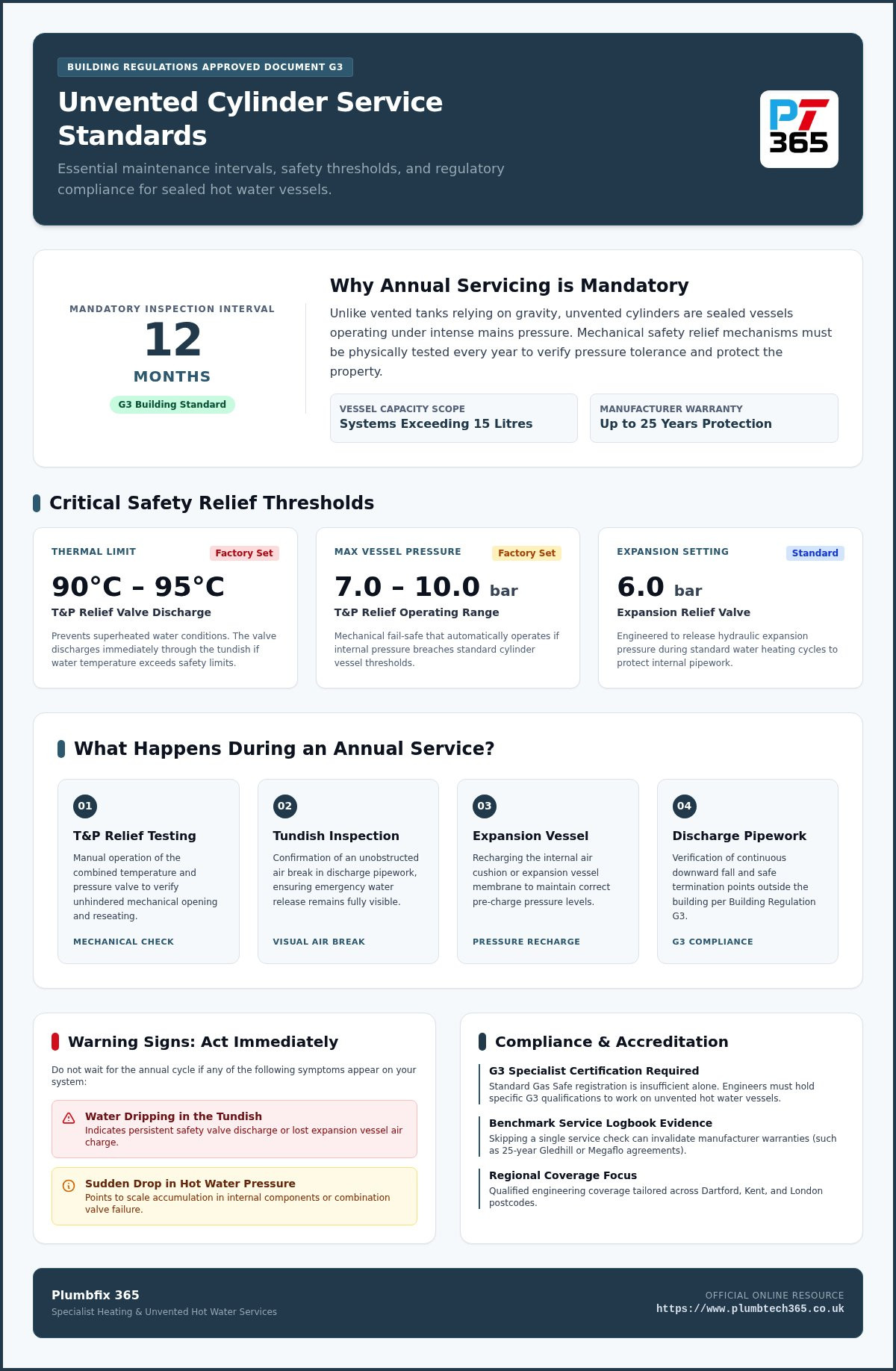
Standard industry advice is clear. You must book a professional inspection every 12 months. When considering how often should you service an unvented cylinder, the answer is always annually. These systems operate under intense pressure directly from your water mains. We are a trusted plumbing & heating company providing reliable, high-quality services across London and Kent. We know that unlike older vented tanks that rely on gravity, unvented cylinders are sealed vessels. This design provides excellent shower pressure but requires mechanical safety valves to function perfectly at all times. A failed valve in a high-pressure system is a serious safety hazard. If you are already experiencing issues, check our guide on unvented cylinder pressure loss for troubleshooting tips.
Testing these safety devices annually is not optional. It is a vital preventative measure against system failure. Over time, internal components can scale up or lose their calibration, especially in hard water areas like London and Kent. Regular checks ensure your cylinder operates at peak energy efficiency; this helps keep your heating bills under control. A quick inspection by a qualified professional prevents small issues from turning into a household crisis.
To better understand this concept, watch this helpful video:
Understanding G3 Building Regulations
Unvented hot water systems with a capacity over 15 litres fall under Approved Document G3 of the Building Regulations. These rules dictate that only engineers with a specific G3 qualification can work on these high-pressure systems. Standard Gas Safe registration is not enough on its own. Our experts hold the necessary certifications to ensure your discharge pipework is safe and compliant. This pipework is critical because it safely directs superheated water away from your living space if a fault occurs. Without a G3 certificate, your home insurance could also be at risk.
The Manufacturer Warranty Link
Your manufacturer warranty depends entirely on regular maintenance. Top brands like Gledhill or Megaflo offer long-term guarantees, often up to 25 years; however, these are conditional. If you skip a single year, you risk voiding the entire multi-year agreement. Engineers must record every visit in your Benchmark service logbook. This document serves as your vital evidence for any future warranty claims. Thinking about how often should you service an unvented cylinder is the first step in protecting that valuable long-term investment. Don't wait for a leak to check your records.
What Happens During a Professional Unvented Cylinder Service?
A professional service is a rigorous technical assessment of a high-pressure system. It goes far beyond a simple visual check. Your engineer will inspect every safety component and verify the integrity of all pipework connections. This process ensures the vessel can handle the mains water pressure without risk of failure. When homeowners ask how often should you service an unvented cylinder, they often don't realise the complexity of the safety mechanisms involved. Each check is designed to prevent a household emergency before it starts. If you suspect an issue between visits, our independent plumbers in London can provide a rapid assessment.
Testing Safety Valves and Expansion Relief
The engineer will manually operate the Temperature and Pressure (T&P) relief valve. This valve is the primary safety mechanism. It is factory-fitted to discharge if water reaches 90°C-95°C or exceeds 7 to 10 bar. During the test, the engineer verifies that water flows freely through the tundish. This visible break in the pipework allows you to see if the system is discharging. We also check the expansion relief valve, which is typically set to open at 6.0 bar. Ensuring the discharge pipework follows a continuous downward fall to a safe exit is a critical part of G3 compliance.
Checking the Expansion Vessel and Pressure
The internal air cushion in the expansion vessel is a frequent point of failure. Without a correct air charge, water has nowhere to expand as it heats up. This causes pressure spikes that force safety valves to drip. Your engineer will use a pump to recharge the vessel to the correct pre-charge; this usually matches the incoming mains pressure of 3.0 to 3.5 bar. We also inspect the pressure reducing valve (PRV) to ensure it correctly limits the water entering your home. If you notice a sudden drop in water pressure, it might be linked to these specific components.
Finally, we clean the internal line strainer. This filter prevents debris from the mains from entering your cylinder and damaging the valves. Keeping this filter clear maintains your flow rate and protects your water quality. If you need a local plumber to carry out these essential checks, our team is ready to help. Regular maintenance is the only way to avoid the stress of a sudden breakdown. Our engineers work efficiently to ensure your hot water supply remains safe and reliable throughout the year.
The Risks of Neglect: Safety, Efficiency, and Legal Compliance
Ignoring your unvented cylinder leads to more than just lukewarm water. These systems are powerful and operate under high pressure. A faulty cylinder can reach dangerous pressure levels that threaten your home's structure if the safety mechanisms fail. Without a professional eye, internal corrosion often goes unnoticed until a major leak occurs. We are a trusted plumbing & heating company providing reliable, high-quality services across London and Kent. We understand that regular central heating maintenance helps, but the cylinder requires its own specific technical assessment to ensure the vessel remains sound.
Sediment buildup is a common problem in hard water areas like Dartford and across Kent. Limescale coats the immersion heaters; this reduces heating speed and forces your system to use more energy to reach the desired temperature. You will see this reflected in rising utility bills. Over time, this thick layer of scale can cause the heater to burn out entirely, leading to a total loss of hot water and an urgent repair call that could have been avoided. Heavy mineral deposits can also settle at the bottom of the tank, reducing the volume of hot water available for your family's needs.
Preventing Dangerous Pressure Buildup
Safety valves are the only mechanical barriers preventing your cylinder from over-pressurising. During an annual service, engineers check for mineral scale or debris that might prevent these valves from opening in an emergency. If these components seize, the vessel has no way to release excess heat or pressure safely. These systems are safe only when safety mechanisms are verified annually by a qualified professional. We ensure that every valve is tested and cleared of any obstructions that could compromise your home's safety. This preventative care is the only way to ensure the mechanical failsafes remain active.
Protecting Your Home Insurance and Warranty
Your home insurance policy likely requires you to keep all major building services in good working order. If a leak causes significant water damage and you cannot provide proof of maintenance, insurers may refuse your claim. This paperwork is also vital when selling your home. Solicitors often request the Benchmark logbook to prove the system is safe and compliant. For those managing rental properties, this maintenance should be part of your wider landlord gas safety certificates process to meet legal obligations.
Knowing how often should you service an unvented cylinder is essential for protecting your financial interests as well as your safety. Professional maintenance ensures you stay on the right side of your policy terms. Failing to keep records can lead to expensive complications during property transactions or insurance assessments. Our engineers provide the necessary documentation to keep your records up to date and your warranty fully protected. Maintaining these records ensures that your long-term investment remains covered against unexpected failures.
Warning Signs: When to Call an Engineer Before Your Annual Check
While you now know how often should you service an unvented cylinder, waiting for the 12-month mark is not always the safest choice. Mechanical components can develop faults early due to heavy household demand or local water conditions. You must stay alert to changes in your system's behaviour. Catching a minor fault in October prevents a total breakdown in the middle of January. If your cylinder starts acting differently, it's trying to tell you that a safety mechanism or internal component is struggling.
Strange noises are a common early warning sign. You might hear humming, vibrating, or distinct banging sounds coming from the cylinder cupboard. These often indicate air locks, loose pipework, or significant scale buildup on the internal heating elements. If your hot water takes much longer to reach temperature than usual, sediment is likely insulating the immersion heater. This forces the system to work harder, wasting energy and increasing your monthly bills. Don't ignore these subtle shifts in performance.
Identifying Visible Leaks and Pressure Drops
The tundish is your most important diagnostic tool. This small plastic device with a visible air gap should always be dry. If you see water dripping or flowing through it, a safety valve has opened to release excess pressure or heat. This is a clear signal that your system is no longer operating within safe limits. You should also monitor your taps for a noticeable drop in hot water pressure. Sudden changes often point to a failed expansion vessel or a blockage in the line strainer. For more detail on these symptoms, read our guide on unvented cylinder pressure loss troubleshooting to identify the likely cause.
Dealing with Fluctuating Water Temperatures
Inconsistent heat is more than a nuisance; it's a safety risk. If your water temperature fluctuates wildly, your thermostat or high-limit cut-out may be failing. Water that is scalding hot is a critical emergency. In this scenario, the thermal cut-out has likely failed to disconnect the heat source, which could lead to superheated water entering your pipework. Never attempt to adjust high-pressure valves or internal wiring yourself. These systems are complex and dangerous if handled without the correct G3 training. Always call a specialist to diagnose temperature issues safely.
If you spot any of these warning signs in your home, book a visit from our boiler engineers in Dartford immediately to prevent a full system failure. We provide rapid responses across London and Kent to ensure your high-pressure system remains safe and efficient. Acting quickly saves you from the stress of a household crisis and protects your property from potential water damage.
Professional Unvented Cylinder Care Across London and Kent
We are a trusted plumbing & heating company providing reliable, high-quality services across London and Kent. Our engineers serve homeowners, letting agents, and management companies in Dartford, Bromley, Maidstone, and Medway. We provide professional safety checks for unvented cylinders as a core part of our heating services. Every technician in our team is fully qualified and Gas Safe Registered. We offer prompt bookings to ensure your hot water system remains compliant and safe. Understanding how often should you service an unvented cylinder is the first step toward total property safety. Our team has been operating since 1996, which adds a layer of local accountability to our technical expertise.
Why Gas Safe Registered Engineers Are Essential
Gas Safe registration confirms an engineer is trained in safe working practices. For unvented systems, they must also hold a G3 qualification. We provide clear, detailed documentation after every service for your insurance records. Our team understands the specific requirements for London and Kent properties, where hard water and varying mains pressure are common. We ensure your discharge pipework and safety valves are perfectly calibrated for your specific installation. Using a qualified professional is the only way to ensure your high-pressure vessel is handled with total competence. Our no-nonsense approach prioritises results over personality flourishes. We arrive on time, solve the problem, and leave you with a safe system.
Booking Your 2026 Maintenance
Organise your annual check before the winter peak to avoid unnecessary delays. Our schedule fills up quickly when the temperature drops. We also offer boiler servicing in London and Kent to keep your whole home warm. We are a trusted plumbing & heating company providing reliable, high-quality services across London and Kent, and we prioritise rapid responses for our local community. Contact our team today to secure your unvented cylinder service. Staying informed on how often should you service an unvented cylinder helps you stay ahead of potential failures. We are here to act as the steady hand for your property maintenance. Our hardworking persona has made us a reliable choice for families and management companies alike.
Secure Your Home’s Hot Water for 2026
Maintaining a high-pressure unvented system is a critical responsibility for every homeowner. You now know exactly how often should you service an unvented cylinder to stay compliant with G3 regulations and keep your manufacturer warranty intact. Annual checks prevent dangerous pressure buildup and ensure your system runs at peak efficiency. This simple preventative measure saves you from rising energy bills and the stress of unexpected water damage.
Don't wait for a safety valve to fail or a leak to appear in your cupboard. Our Gas Safe registered engineers have been serving London and Kent since 1996, providing the expert help you need. We offer emergency response and prompt bookings to keep your property safe. Book your unvented cylinder service with Plumbtech 365 today to protect your home and your peace of mind. Taking action now ensures your family enjoys a reliable, safe hot water supply throughout the year ahead.
Frequently Asked Questions
What is the difference between a vented and an unvented cylinder?
Vented cylinders rely on a cold water storage tank in the loft and use gravity to provide pressure. Unvented cylinders connect directly to the water mains, providing high-pressure hot water without needing a loft tank. This setup delivers superior shower performance but requires mechanical safety valves to manage the intense pressure safely. Understanding this difference helps you realise why knowing how often should you service an unvented cylinder is vital for your home safety.
Can I service an unvented hot water cylinder myself?
No, you cannot safely or legally service an unvented cylinder yourself. These are high-pressure vessels that fall under strict G3 Building Regulations. Only engineers with a specific unvented hot water qualification can perform this work. Attempting a DIY service risks serious injury, property damage, and will immediately void your home insurance and manufacturer warranty. Always trust a Gas Safe Registered professional to handle the technical safety checks in Dartford or London properties.
How long does a professional unvented cylinder service take?
A standard unvented cylinder service typically takes between 45 and 60 minutes to complete properly. During this time, our engineer will test all safety valves, check the expansion vessel pre-charge, and clean the internal line strainer. If we identify components that need replacement or if the system requires a complete air cushion recharge, the visit may take slightly longer. We work efficiently across Kent to ensure your home remains safe and compliant.
Why is water dripping from my unvented cylinder discharge pipe?
Dripping water usually indicates that a safety valve is releasing excess pressure or heat. This often happens because the expansion vessel has lost its air charge or the pressure reducing valve has failed. If you see water in the tundish, your system is no longer operating within safe limits. You should book a repair immediately to prevent further damage. Our engineers in Dartford and Bromley can quickly diagnose and fix these pressure issues.
Do unvented cylinders need a G3 certificate every year?
Yes, you should receive a record of the service in your Benchmark logbook every year to prove compliance with G3 regulations. While the G3 qualification itself is held by the engineer, the annual inspection ensures the installation continues to meet the safety standards set out in Approved Document G. This documentation is essential for landlords and homeowners, especially when selling a property or making an insurance claim for water damage in London.
Will skipping a service void my Megaflo or Gledhill warranty?
Skipping even one annual service will almost certainly void your manufacturer warranty. Brands like Megaflo and Gledhill offer long-term guarantees, but these are strictly conditional on having a continuous service history. You must have each visit recorded in your Benchmark logbook by a qualified engineer. Regular maintenance is the only way to protect your investment and avoid expensive out-of-pocket repair costs if a major component fails in your Kent home.
What qualifications should I look for in an unvented cylinder engineer?
You must ensure your engineer is Gas Safe Registered and holds a specific G3 unvented hot water qualification. Standard plumbing or gas certificates are not enough to work on these high-pressure systems. At Plumbfix 365, all our technicians hold the necessary unvented tickets and have been serving London and Kent since 1996. Always ask to see their Gas Safe ID card to verify they are authorised for unvented work before they start.
Is an unvented cylinder service the same as a boiler service?
No, these are two distinct technical procedures. A boiler service focuses on the gas burner, heat exchanger, and flue safety. An unvented cylinder service focuses on the mains pressure vessel, expansion vessel, and mechanical safety relief valves. However, many homeowners in Dartford and Medway choose to book both together. This ensures your entire heating system is verified and helps you remember how often should you service an unvented cylinder alongside your annual gas safety check.


Comments