


How to Fix a Boiler That Keeps Locking Out: A Step-by-Step Troubleshooting Guide

Your boiler shutting down without warning is not an annoying glitch; it is an active safety mechanism designed to protect your home. When you wake up to freezing radiators and a flashing fault code, your immediate instinct is to find out how to fix a boiler that keeps locking out before the rooms turn ice-cold. We understand the sharp spike of panic this triggers. Cryptic error codes are confusing, an unheated house is miserable, and nobody wants the worry of gas safety risks or unexpected repair bills.
Fortunately, many lockouts do not require immediate professional intervention. You can resolve several common faults yourself without opening the boiler casing or breaking UK gas safety regulations. This guide shows you how to identify why your heating system is shutting down, which safe DIY checks can restore your hot water quickly, and how to avoid paying for an unnecessary call-out. You will learn the exact steps to check system pressure, inspect external discharge lines, and recognise the critical warning signs that require a Gas Safe registered engineer.
Table of Contents
Understanding Boiler Lockouts and Why They Happen
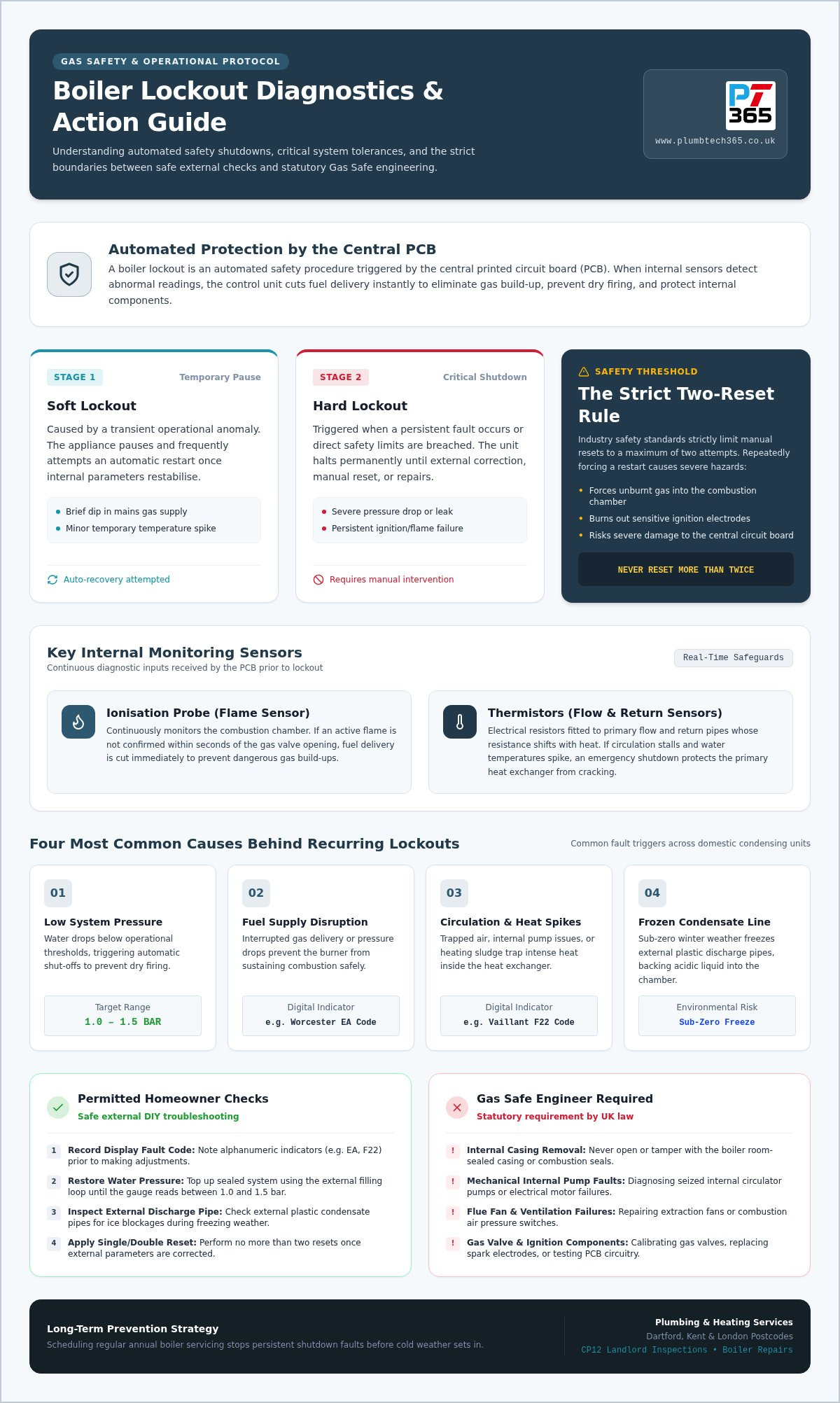
A boiler lockout is an automated safety procedure triggered by the appliance's central printed circuit board (PCB). When internal sensors detect abnormal readings, such as inadequate water pressure, overheating, or a failure to detect a flame, the control unit cuts the fuel supply and halts operation immediately. Rather than a mechanical failure on its own, the shutdown prevents dangerous gas build-ups and protects expensive internal parts from severe damage. Knowing the underlying cause is the first step in learning how to fix a boiler that keeps locking out without causing further system stress.
Modern units communicate these safety interruptions through specific alphanumeric fault codes shown on the digital display. A code such as EA on a Worcester Bosch or F22 on a Vaillant pinpoints the exact operational limit that was breached. Understanding modern condensing boiler mechanics helps demystify these alerts, as contemporary units rely on tight sensor tolerances to maintain safe, energy-efficient heating.
To see how an engineer approaches an ignition shutdown in real time, watch this helpful walkthrough:
Soft Lockout vs Hard Lockout
Heating systems differentiate between temporary disruptions and persistent component faults through two distinct lockout stages:
Soft Lockout: A temporary pause caused by a transient anomaly, such as a brief dip in mains gas pressure or a minor temperature spike. The system pauses and often attempts an automatic restart once internal parameters stabilise.
Hard Lockout: A permanent shutdown triggered when an error persists or directly compromises safety. The unit remains offline until manually reset or repaired by an engineer.
Never hit the reset button continuously. Industry safety limits recommend resetting a boiler no more than twice; repeatedly overriding a hard lockout forces unburnt gas into the combustion chamber and can quickly burn out ignition electrodes.
The Role of the Flame Sensors and Thermistors
Your appliance monitors its combustion chamber continuously through an ionisation probe, or flame sensor. If the sensor does not detect an active flame within seconds of opening the gas valve, the PCB cuts fuel delivery instantly to eliminate the risk of an unburnt gas explosion.
A thermistor is an electrical resistor whose resistance changes significantly with temperature. By fitting thermistors to the primary flow and return pipes, the PCB tracks water heat in real time. If circulation stalls and water temperatures spike unexpectedly, these sensors initiate an emergency shutdown before the primary heat exchanger cracks, showing why regular central heating maintenance remains essential.
Identifying the Common Causes Behind a Recurring Lockout
Diagnosing why your heating refuses to stay on requires a process of elimination. While many assume a lockout points to a catastrophic breakdown, the trigger is frequently an external imbalance in water pressure, fuel supply, or ventilation. Resolving these issues is central to understanding how to fix a boiler that keeps locking out before booking an engineer call-out.
Lockouts usually stem from four common issues:
Low system pressure: Dropping below safe operational thresholds causes automatic shut-offs to prevent dry firing.
Fuel disruption: Interrupted gas delivery prevents the burner from sustaining combustion.
Circulation blockages and overheating: Trapped air, failing water pumps, or central heating sludge trap intense heat inside the heat exchanger.
Frozen condensate discharge lines: Sub-zero winter temperatures freeze external plastic discharge pipes, backing up acidic liquid into the combustion chamber.
When reviewing these issues, consult the Health and Safety Executive domestic gas guidance to know precisely where external homeowner troubleshooting ends and statutory professional duties begin.
Pressure Problems and System Leaks
Sealed domestic systems require steady hydraulic pressure to move hot water through pipework. Check the circular pressure dial or digital readout on your front control fascia. A cold system should sit firmly between 1.0 bar and 1.5 bar. If the needle drops below 0.5 bar, internal pressure switches trip a low-water lockout, displaying codes like F22 on Vaillant or E119 on Baxi.
A sudden pressure drop often happens right after you bleed radiators to remove trapped air. If you have not bled radiators recently, a recurring drop points toward hidden leaks. Inspect radiator valves, exposed joints, and pipework connections. Learning how to spot hidden leaks protects your flooring and stops repeated pressure loss from cutting your heating.
Fuel Supply and Ignition Faults
A boiler cannot operate without steady fuel delivery. If your display shows an EA fault code on a Worcester Bosch or an ignition lockout code on an Ideal unit, check whether other gas appliances work. Turn on your gas hob or cooker. If the burners fail to ignite or produce weak, sputtering flames, the fault lies with your external supply.
Pre-payment gas meters frequently cause sudden shutdowns if emergency credit runs out or the isolation valve snaps shut after a top-up. If your supply is active elsewhere, the issue sits inside the boiler room casing: carbon debris covering the burner, worn ignition leads, or a sticking gas solenoid valve. When simple supply checks do not clear the fault, contacting Plumbfix 365 ensures a certified professional inspects your internal gas train promptly.
DIY Troubleshooting: Safe Checks You Can Perform at Home
Before assuming mechanical failure, run through basic external checks. Start with the electrical supply: verify that the switched fused spur next to your unit is on and illuminated. Next, check your room thermostat and programmer. A dead thermostat battery, an accidental schedule change, or an altered target temperature can stop the boiler receiving a heat demand. If your gas meter has credit and the valves are open, you can begin hands-on steps on how to fix a boiler that keeps locking out without removing any panels.
Always align your actions with the Health and Safety Executive gas safety guidelines, restricting DIY troubleshooting strictly to external components.
How to Repressurise Your Boiler Safely
Low pressure triggers the majority of sudden shut-offs. Look underneath the boiler casing to find the filling loop, which is either a silver braided flexible hose with two small black levers or an integrated keyless knob.
Turn off the boiler at the electrical switch.
Open both valves slowly until you hear water entering the system.
Watch the pressure dial until the needle reaches precisely 1.5 bar.
Close both valves completely and wipe away any minor drips.
Ensure both levers are shut tight. Leaving a filling loop open allows mains pressure to flood the system, forcing the pressure relief valve to dump water outside.
Thawing a Frozen Condensate Pipe
During freezing weather, condensing boilers produce acidic discharge that can freeze solid inside external plastic pipework. This creates back-pressure that trips the appliance. Find the external white or grey plastic pipe leading from your boiler to an outside drain.
Pour warm water over the exposed pipework, starting from the outlet and working back toward the wall. Never use boiling water, as thermal shock will crack cold plastic. You can also place a hot water bottle against stubborn frozen bends. Once the ice clears, perform a single system reset to restart ignition.
Bleeding Radiators to Remove Air
Air pockets inside radiators restrict water flow, raising internal system heat and causing circulation lockouts. If your radiators feel burning hot at the bottom but freezing cold at the top, air is trapped inside the panels. Use a radiator key to release the air until water trickles out, or consult our guide on how to fix cold radiators upstairs safely for multi-storey systems. Bleeding releases system volume, so always check your boiler dial and repressurise back to 1.5 bar immediately afterwards.
When a Reset Is Not Enough: Mechanical and Electrical Faults
Basic external adjustments will not resolve deeper component failures. If pressure levels sit at 1.5 bar and external lines remain clear, learning how to fix a boiler that keeps locking out shifts from basic homeowner maintenance to diagnosing internal hardware. When internal mechanisms fail, resetting the unit only subjects the system to avoidable wear.
Severe lockouts frequently involve four core mechanical and electrical assemblies:
Circulation pump failure: A seized motor or broken impeller stops heated water moving away from the burner, triggering rapid overheat shut-offs within seconds of ignition.
Flue fan malfunction: The fan extracts combustion gases safely outside. If its hall sensor fails or the bearings seize, air pressure switches prevent the gas valve from opening.
Printed Circuit Board (PCB) failure: As the central processor, a compromised board with blown capacitors sends erratic signals, causing random shutdowns without clear logic.
Stuck diverter valve: A diverter valve directing flow between hot water and central heating can stick mid-position. This often produces reliable hot water at the taps while locking out immediately when heating is requested.
The Impact of Limescale and Sludge
Properties across London and Kent contend with exceptionally hard water containing heavy concentrations of dissolved calcium and magnesium. Over time, high temperatures inside the heat exchanger cause limescale to bake onto internal surfaces. This narrow pathway restricts water flow and creates localised boiling known as kettle noise.
Corrosion inside steel radiators also forms black iron oxide sludge, or magnetite. This dense debris settles in low-flow areas, coating pump impellers and clogging heat exchangers until internal safety sensors register an overheat condition. While magnetic system filters capture circulating metallic particles, heavily fouled circuits require a professional power flushing service to scour out stubborn deposits and restore normal circulation.
Electrical Component Failure
Constant thermal expansion, operational vibration, and internal condensation compromise delicate electrical wiring. Negative Temperature Coefficient (NTC) thermistors degrade over years of heating cycles. When an NTC sensor loses calibration, it feeds erroneous temperature figures to the PCB, tripping false overheat lockouts even though the water remains cold.
Under the Gas Safety (Installation and Use) Regulations 1998, working inside the room-sealed boiler casing to test or replace internal electrical components is legally restricted to certified personnel. Homeowners must not test wiring harnesses or replace sensors themselves. If mechanical failures or persistent circuit faults keep cutting your warmth, book a Gas Safe repair engineer with Plumbfix 365 to diagnose the internal hardware safely.
Professional Boiler Repairs and Preventing Future Lockouts
Safe heating maintenance requires knowing when to put your tools away. Under the Gas Safety (Installation and Use) Regulations 1998, any diagnostic or repair work that requires opening the sealed casing, touching gas valves, or inspecting combustion chambers must be completed by a certified engineer. If pressure checks, radiator bleeding, and thawing external pipes do not solve the problem, understanding how to fix a boiler that keeps locking out means handing the job over to a Gas Safe Registered professional.
Older appliances that suffer repeated breakdowns may reach a stage where replacement makes more financial sense than continuous patching. If multiple major assemblies fail at the same time, such as a cracked heat exchanger alongside a seized fan, an engineer can assess whether the unit is beyond economical repair and recommend modern alternatives.
Why Annual Servicing is Essential
Annual servicing prevents lockouts before cold winter weather arrives. During a routine inspection, a heating engineer cleans soot from the burner, strips and clears the internal condensate trap, tests the expansion vessel pressure, and verifies flue integrity using an electronic flue gas analyser.
This proactive care confirms all safety controls trip within manufacturer tolerances under simulated fault conditions. Regular servicing also satisfies manufacturer warranty conditions, keeping your guarantee valid year after year. For a full breakdown of what a certified visit involves, read our expert boiler service guide.
Choosing a Reliable Local Engineer
Always verify your engineer's credentials before allowing work to start. You can confirm registration on the official Gas Safe Register website or inspect the engineer's photo ID card upon arrival, paying close attention to the expiration date and the specific appliance categories listed on the back.
Using a local provider ensures fast call-out times when an unexpected winter failure leaves your home without heat. Plumbfix 365 has served households across Dartford, Bromley, Kent, and South East London since 1996, delivering dependable diagnostics and transparent communication. If DIY checks have failed to resolve your heating failure, contact Plumbfix 365 for rapid emergency boiler repair to restore your hot water safely.
Restore Reliable Warmth to Your Home
A boiler lockout is designed to protect your household, not leave you stranded in the cold. Knowing how to fix a boiler that keeps locking out gives you the confidence to tackle basic checks yourself, whether that means adjusting system pressure back to 1.5 bar or gently thawing an exposed condensate pipe. When simple external checks clear the fault code, you quickly restore comfort without delay.
If the error returns or internal parts fail, prioritise safety by stepping back. Continuing to restart a struggling appliance risks damaging internal components. Our Gas Safe Registered engineers have served London and Kent since 1996, providing rapid 24/7 emergency response whenever heating breakdowns happen. Book a Gas Safe engineer from Plumbfix 365 today to diagnose the fault accurately and bring dependable heat back to your radiators. You don't have to face a freezing home alone.
Frequently Asked Questions
What does it mean when a boiler locks out?
A boiler lockout is an automatic emergency shutdown triggered by the central printed circuit board to protect your home. It cuts the gas supply and halts the burner when internal sensors detect unsafe conditions such as low water pressure, flame failure, or high internal temperatures. Modern boilers halt operation and display a fault code to help you identify the root cause before restarting.
How many times can I reset my boiler before calling an engineer?
You should reset your boiler a maximum of twice. If the appliance fails to fire up after two attempts, stop immediately. Continual resets force unburnt gas into the combustion chamber and can damage internal ignition electrodes or the circuit board. If a single reset fails, contact a Gas Safe registered engineer across London or Kent to inspect the appliance safely.
Why does my boiler lock out every time the heating comes on?
A boiler that locks out specifically when central heating is called usually has a circulation failure or diverter valve defect. While domestic hot water uses a short internal loop, central heating moves water through the entire household pipework. A seized pump or heavy sludge accumulation traps heat quickly, tripping safety thermistors. Understanding these mechanical symptoms helps you evaluate how to fix a boiler that keeps locking out when simple DIY checks fail.
Can low water pressure cause a permanent boiler lockout?
Yes, low system pressure triggers a persistent hard lockout that stops the boiler running until manually resolved. Sealed heating systems must maintain sufficient water volume to circulate safely. When pressure drops below 0.5 bar, internal pressure switches trip to prevent the burner from dry firing and warping the heat exchanger. The unit remains locked out until you repressurise the loop back to 1.5 bar and clear the display fault code.
Is it safe to keep resetting a boiler that keeps locking out?
No, repeatedly resetting an appliance that continues to shut down is unsafe and can cause serious mechanical damage. The lockout is an intentional safety response, not a minor electronic glitch. Overriding the safety circuit without resolving the underlying fault risks flooding the combustion chamber with raw gas, scorching wiring looms, or cracking internal heat exchangers. When learning how to fix a boiler that keeps locking out, always prioritise safe diagnostic checks over repeated resets.
How long does it typically take to fix a recurring boiler lockout?
Simple external fixes take under thirty minutes, while internal mechanical repairs typically require one to two hours. Re-pressurising the system or thawing an external plastic line is quick. However, replacing failed components like a circulation pump, fan assembly, or printed circuit board requires diagnostic testing and physical part installation by a certified engineer. Our local engineers in Dartford, Bromley, and Bexleyheath carry essential replacement components to resolve breakdowns during the initial visit whenever possible.
Why is my boiler showing a red light and not firing up?
A solid or flashing red light indicates that the boiler has entered a lockout state following an operational failure. Most manufacturers use a red warning indicator alongside an error code to signal flame loss, fan failure, or overheating. Check the pressure gauge first; if the needle sits below 1.0 bar, low water pressure is likely triggering the light. Note the accompanying fault digits before attempting a single reset.
Will a power cut cause my boiler to lock out?
Yes, a power cut or electrical surge can trigger an immediate boiler lockout or reset the internal timer. When mains electricity drops suddenly, safety relays trip and the PCB shuts down to protect delicate electronics. Once power returns, many modern boilers run a brief self-diagnostic test and fire up automatically. However, older units or systems that experience a supply spike may require a single manual reset or re-programming of the digital thermostat before normal heating resumes.


Comments