


Is My Boiler Covered by Home Insurance? UK Guide 2026

According to domestic heating research, 57.1% of UK homeowners have experienced an unexpected breakdown, leaving thousands to ask: is my boiler covered by home insurance? Waking up to freezing radiators and zero hot water is deeply frustrating. It is completely natural to assume that your standard buildings insurance will step in to replace or repair failed internal components, but standard property policies rarely work that way.
We understand how exhausting it feels to untangle policy wording between buildings insurance, contents cover, and emergency add-ons during a household crisis. Standard home insurance safeguards your property against sudden external catastrophes, whilst specialised maintenance protects internal mechanical heating parts.
This guide clarifies precisely what domestic policies cover and exclude, explains the difference between emergency callout add-ons and dedicated boiler breakdown plans, and shows how regular Gas Safe servicing protects your heating safety and keeps your insurance valid. Here is your clear roadmap to keeping your household warm and avoiding unexpected claim rejections.
Table of Contents
Does Standard Home Insurance Cover Your Boiler Breakdown?
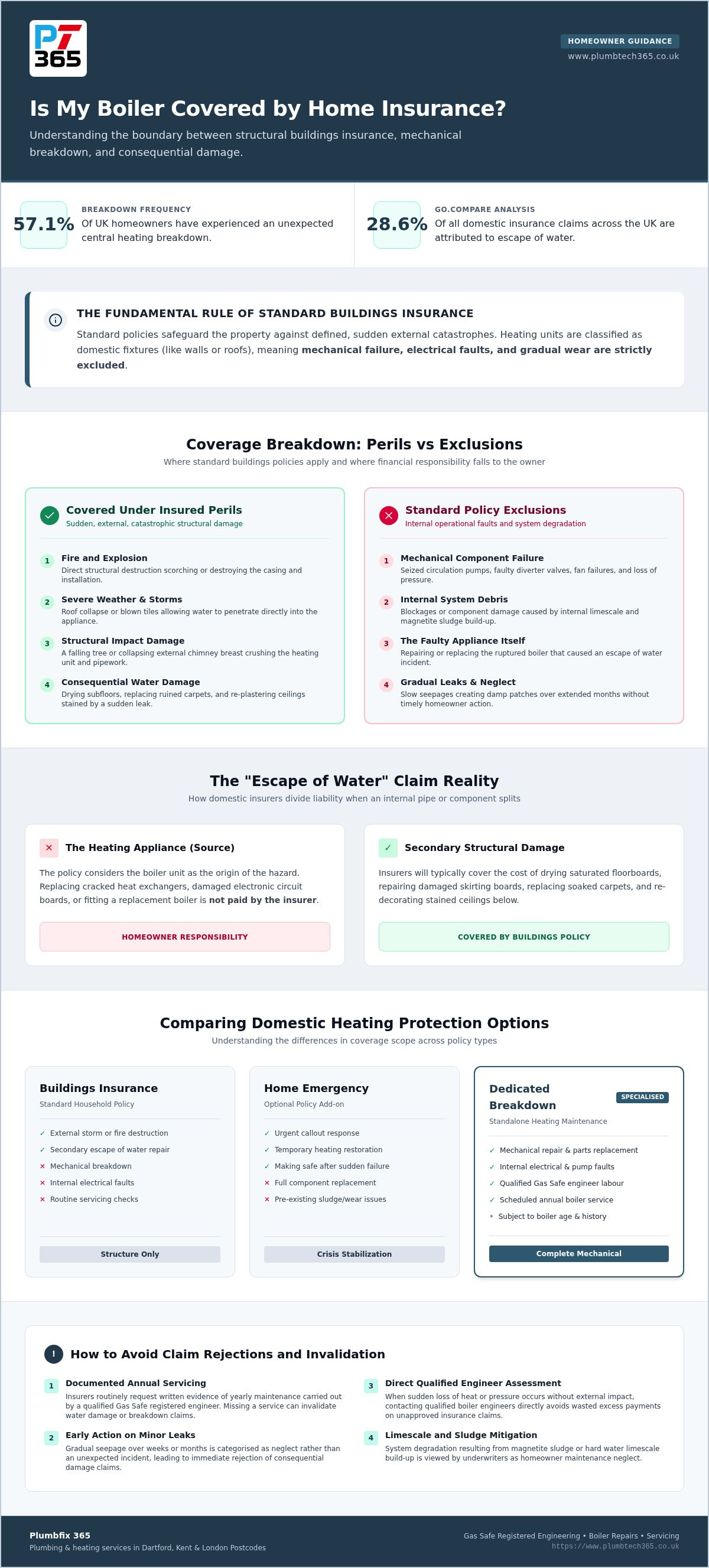
The short answer is almost always no. If you are asking yourself, is my boiler covered by home insurance after your radiators stop heating or your burner cuts out, a standard UK buildings policy will not pay for mechanical repairs. Buildings insurance is designed to safeguard the physical structure of your property; it treats your central heating unit as an immovable domestic fixture rather than a serviced mechanical appliance.
Standard home policies activate only when damage stems from defined, unexpected external disasters. If an internal component snaps, a heat exchanger cracks from metal fatigue, or a circuit board shorts out, the insurer views that incident as ordinary operational breakdown. Resolving that sudden loss of heating requires either a specialised home emergency endorsement or dedicated breakdown cover.
Standard Home Insurance Rule: Buildings policies cover structural damage to the property caused by sudden insured perils, but strictly exclude internal mechanical failure, electrical breakdown, and wear and tear within heating appliances.
Buildings Insurance vs Heating System Failure
Your policy schedule classifies the heating unit as part of the home's fabric, alongside roofs, walls, and fitted kitchens. This classification means your provider only steps in if catastrophic external events damage the casing or pipes. For day-to-day operational issues, you cannot rely on structural insurance:
What buildings insurance protects: Structural destruction caused by storms, falling trees, explosion, or fire.
What buildings insurance excludes: Seized circulation pumps, faulty diverter valves, fan failures, and loss of pressure.
The practical reality: When an internal part quits working, you must contact qualified boiler engineers directly rather than lodging an insurance claim.
Why Mechanical Breakdown Is Typically Excluded
Underwriters price domestic home policies around low-probability, high-impact disasters. Heating appliances contain dynamic components that cycle on and off thousands of times each year. Insurers know these working parts inevitably degrade through continuous friction, thermal stress, and chemical exposure.
If insurers paid for standard mechanical failure, premiums would become unsustainably expensive. Policies explicitly exclude faults caused by internal limescale, magnetite sludge build-up, and general component fatigue. The financial responsibility for maintaining mechanical working order rests squarely with the property owner, not the property insurer.
What Home Insurance Covers: Insured Perils vs Exclusions
To determine when is my boiler covered by home insurance, you must understand the line underwriters draw between secondary property damage and the heating appliance itself. According to Go.Compare claims analysis, escape of water accounts for 28.63% of all domestic insurance claims across the UK. If an internal component splits and floods your kitchen, your insurer will likely pay to dry the subfloor, replace ruined carpets, and re-plaster stained ceilings.
They will not pay to repair or replace the leaking boiler. The policy treats the appliance as the source of the peril, leaving the cost of mechanical heating repairs entirely to you. Similarly, slow, gradual leaks that create damp patches over months are routinely excluded under neglect clauses.
Scenarios Where Insurance May Pay Out
Buildings insurance only responds to catastrophic, sudden insured perils that damage the physical installation alongside your house:
Explosion or fire: Structural destruction that scorches, deforms, or completely destroys the heating unit.
Severe weather events: Extreme storms tearing off roof tiles and allowing water to soak directly into the appliance casing.
Impact damage: A falling tree or collapsing external chimney breast crushing the boiler and associated pipework.
In these rare scenarios, your building claim covers the appliance as part of the total property rebuild.
Common Boiler Exclusions Homeowners Must Know
Standard home policies do not step in for day-to-day central heating breakdowns. Modern units rely on complex moving parts, electronic sensors, and constant water pressure. Underwriters exclude the following failures as routine owner maintenance:
Mechanical component failure: Seized circulating pumps, sticky diverter valves, or worn ignition leads.
System sludge and scale: Heavy magnetite accumulation or limescale clogging the primary heat exchanger.
Unresolved pressure drops: Continually operating a dry system without addressing pressure loss or pipe weeping.
If your boiler is relatively modern, defects in parts or manufacturing are handled by the manufacturer's warranty, not your property policy. For an older system struggling through winter, you can book an inspection with experienced heating specialists to evaluate whether worn components are safe to repair or nearing the end of their operational life.
Home Insurance vs Home Emergency vs Dedicated Boiler Cover
Homeowners often assume their domestic policy provides blanket protection against winter heating failures. In reality, the UK market splits heating coverage into three distinct tiers. If you are checking whether is my boiler covered by home insurance, you must identify which policy tier you hold. Buildings insurance handles major structural disasters, home emergency add-ons triage sudden household crises, and dedicated boiler plans manage ongoing mechanical maintenance.
Standard Buildings Insurance: Protects solely against insured structural perils; zero cover for mechanical failure.
Home Emergency Add-on: Provides rapid callouts to make an uninhabitable or freezing home safe temporarily.
Dedicated Boiler Cover: Covers regular maintenance, replacement components, and continuous mechanical breakdown.
Choosing the right tier depends entirely on your system's age and overall condition. Research from PHAM News indicates that approximately 33% of domestic boilers in the UK are more than 10 years old, whilst 11% exceed 15 years. For older systems, eligibility rules tighten dramatically across all policy types.
Understanding Home Emergency Cover Add-Ons
A home emergency add-on is an optional endorsement attached to your standard buildings or contents policy. Its sole objective is emergency triage rather than permanent system renewal. These policies typically trigger only when a property experiences a total loss of heating during designated winter months.
Emergency cover gets heat restored quickly to protect vulnerable occupants, but it comes with tight operational parameters:
Labour and claim caps: Insurers strictly cap the value of callout labour and materials per incident.
Temporary fixes: Technicians focus on making the situation safe, which may leave underlying component issues unaddressed.
Age restrictions: Most insurers decline emergency claims on appliances older than 10 to 15 years.
Benefits of Standalone Boiler Care Plans
Standalone policies offer ongoing operational support rather than reactive disaster relief. These specialised contracts focus on the working life of the system. Most comprehensive contracts include a mandatory annual inspection carried out by Gas Safe Registered engineers to keep internal mechanics safe and reliable.
Under these plans, key working parts like diverter valves, printed circuit boards, and internal sensors are covered for repair or replacement. However, if your unit is declared Beyond Economical Repair (BER), most providers offer only a fixed contribution toward a replacement rather than funding an entire appliance upgrade. When systems reach this stage, reviewing signs your boiler is beyond economical repair helps you decide between continuous repairs and installing modern heating equipment.
How to Keep Your Heating Cover Valid and Avoid Claim Rejections
Securing an active policy is only half the battle. If you ever have to ask your insurer, is my boiler covered by home insurance during a midwinter breakdown, your claim acceptance hinges on proven maintenance. Data from the Financial Conduct Authority reveals that domestic insurance claim acceptance rates hover between 62% and 71%, with claims frequently rejected due to unfulfilled maintenance clauses or gradual wear.
Insurance providers do not cover preventable neglect. When sudden heating loss strikes, loss adjusters scrutinise your maintenance history. If you cannot produce documented evidence of routine upkeep, insurers can legally decline to pay for secondary damage or emergency repairs.
The Essential Role of Annual Gas Safe Servicing
Boiler manufacturers and home emergency underwriters demand proof of an annual boiler service completed every 12 months by a qualified Gas Safe registered engineer. DIY interventions or work done by unregistered tradespeople immediately void your protection and breach the Gas Safety (Installation and Use) Regulations 1998.
Routine checks detect deteriorating gaskets, burner irregularities, flue blockages, and corrosion long before they cause system shutdowns. Always keep your signed Benchmark logbook, digital service sheets, or invoices in a safe place. If an internal component fails, presenting these service records proves you fulfilled your duty of care, preventing claims handlers from dismissing the incident as wear and tear.
Property Care and Winter Frost Precautions
Freezing temperatures create substantial risks for domestic heating networks. More than half of all boiler breakdowns occur during winter, often triggered by frozen external condensate pipes or severe pressure drops. Policyholders can take straightforward preventative steps to ensure uninterrupted cover:
Maintain frost protection: If leaving your property unoccupied during cold spells, set the thermostat to a constant low temperature (usually between 12°C and 15°C) to stop interior pipework from freezing.
Bleed radiators: Purge trapped air pockets from radiators regularly to stop cold spots and reduce strain on the circulating pump.
Monitor pressure: Inspect your boiler pressure gauge periodically to ensure it stays within the recommended operating zone, typically between 1.0 and 1.5 bar.
For detailed advice on maintaining system pressure and component longevity, consult expert guidance on preventing central heating breakdowns. If your system is due for its yearly inspection, schedule a Gas Safe boiler service today to protect your household and maintain your insurance cover.
What to Do When Your Boiler Fails: Repair or Replace?
When your heating cuts out unexpectedly, panic can set in quickly. Before wondering is my boiler covered by home insurance, carry out a few basic checks to rule out simple external triggers. Check your main consumer unit to confirm a tripped circuit breaker hasn't cut power to the fused spur. Next, inspect the pressure gauge on the front control panel; if the needle rests below 1.0 bar, repressurise the filling loop in accordance with the manufacturer's user manual.
If basic checks fail to restore operation and you hold active home emergency cover, call your insurer's designated claims line immediately. Never hire an unapproved tradesperson without insurer authorisation, as unapproved callouts are rarely reimbursed. If you only hold standard buildings cover, your policy will not fund mechanical repairs, meaning you should contact an independent Gas Safe engineer directly to diagnose the issue.
Assessing Whether a Boiler Is Beyond Economical Repair
At a certain point, repeated breakdowns signal total system fatigue rather than an isolated mechanical fault. When an appliance requires frequent replacement parts across successive winters, continuing to repair individual components becomes impractical. Sourcing obsolete replacement parts for older, discontinued boilers is often slow and unreliable.
If major components like the main heat exchanger or printed circuit board fail on a unit that has operated for over a decade, investing in a modern replacement is generally the most sensible route. Review the homeowner checklist for boilers beyond economical repair to assess your appliance's condition before committing to further repairs.
Choosing Qualified Professional Heating Support
Under UK gas safety regulations, anyone removing a boiler casing or servicing internal gas valves must hold an active Gas Safe registration. Never allow unqualified contractors to work on gas appliances. Unregistered work directly invalidates home insurance policies, breaches safety regulations, and introduces genuine hazards into your living space.
Always inspect the engineer's Gas Safe photo ID card before allowing work to proceed on your property. For reliable diagnostic support and maintenance, explore professional heating and boiler engineering services. Whether you require urgent breakdown diagnostics or a planned heating upgrade, you can book an assessment via the Plumbfix 365 homepage today.
Securing Reliable Heating and Policy Protection
Clarifying the answer to is my boiler covered by home insurance ultimately comes down to recognising the boundary between structural catastrophe and routine appliance wear. While buildings insurance defends your property from sudden external disasters, dependable central heating depends entirely on proactive maintenance. Skipping scheduled inspections leaves your household vulnerable to sudden winter cold snaps and unexpected claim rejections.
Keeping your heating safe and efficient is straightforward when you partner with certified professionals. Operating as independent heating specialists serving UK homes since 1996, Plumbfix 365 offers year-round assistance for urgent domestic boiler repairs, servicing, and installations. When you need immediate diagnostic support or routine maintenance to protect your policy standing, contact our Gas Safe Registered engineers at Plumbfix 365. Take control of your home comfort today and rest easy knowing your heating is in reliable hands.
Frequently Asked Questions
Does standard buildings insurance pay for a new boiler if mine breaks down?
No, standard buildings insurance won't pay for a replacement unit after an operational breakdown. Buildings policies cover the appliance solely as a permanent domestic fixture against catastrophic insured perils like house fires, lightning strikes, or severe storm impacts. If you are asking whether is my boiler covered by home insurance when internal mechanics fail, standard policies exclude that completely, leaving equipment replacement to manufacturer warranties or homeowner funds.
Will home insurance cover water damage caused by a leaking boiler?
Yes, standard buildings and contents insurance usually covers secondary damage caused by sudden escape of water. Your policy will typically pay to dry subflooring, repair waterlogged ceilings, and replace ruined plasterwork. However, underwriters firmly exclude the cost of repairing or replacing the leaking boiler itself. Additionally, gradual leaks left unchecked over extended periods are often rejected under general maintenance neglect exclusions.
What is the difference between home emergency cover and boiler insurance?
Home emergency cover acts as rapid triage to make an uninhabitable house safe during complete heating failure, usually capping engineer labour hours and basic parts. Dedicated boiler insurance focuses on ongoing system reliability, regular component repairs, and annual maintenance checks. While emergency policies provide quick temporary relief during cold snaps, dedicated boiler care plans manage continuous operational wear and component servicing throughout the entire year.
Does an unserviced boiler invalidate my home insurance policy?
Yes, failing to carry out regular servicing can easily invalidate home emergency claims and boiler breakdown endorsements. Insurers require verified proof of an annual service completed every 12 months by a certified Gas Safe registered engineer. If a breakdown occurs and you cannot provide up-to-date service paperwork or benchmark records, underwriters frequently decline claims under policy clauses excluding unmaintained appliances and mechanical neglect.
Are frozen condensate pipes covered under standard home insurance?
No, standard buildings insurance does not cover callouts to thaw external frozen condensate pipes. Insurers classify frozen external pipework as routine winter maintenance rather than property damage. If frozen pipes trigger an automatic boiler shutdown, resolving the blockage remains the homeowner's responsibility. Some home emergency add-ons assist with severe cold-weather heating loss, but standard property policies require you to clear external blockages safely yourself.
Can I claim on insurance if my boiler is over ten years old?
Claiming becomes significantly harder once a heating unit passes ten years of age. When questioning is my boiler covered by home insurance through an emergency policy add-on, older units face strict exclusions. Most underwriters decline new cover or refuse breakdown claims for systems older than 10 to 15 years, usually offering only limited contributions toward a replacement when an aged system is declared beyond economical repair.
What should I do if my home emergency heating claim is rejected?
First, request a written explanation detailing the exact policy exclusion cited by the insurer. Review your terms to verify whether service documentation or wear clauses apply correctly. If the rejection stands, immediately contact an independent Gas Safe registered heating specialist to assess the fault and provide an honest diagnostic breakdown. An independent assessment gives you an accurate evaluation of whether to proceed with targeted repairs or plan an installation.


Comments