


Landlord Withholding Deposit for Plumbing: 2026 UK Guide

If your landlord claims a leaking pipe or a blocked drain is your fault, are you prepared to lose over £1,000 of your deposit overnight? Facing a landlord withholding deposit for plumbing issues is a stressful experience that often leaves tenants feeling helpless and confused. It's completely understandable to feel anxious when a significant sum of money is at stake, especially if you aren't sure whether the internal pipework was your responsibility or simply a victim of age. You shouldn't be penalised for the natural deterioration of a property's infrastructure.
This 2026 guide provides the clarity you need to distinguish between tenant negligence and fair wear and tear. You'll learn exactly how to use UK rental laws to protect your tenancy deposit from unfair plumbing-related deductions. We will cover the essential evidence required to win a TDP dispute, including the importance of professional engineer reports for tenants in London and Kent. By the end of this article, you'll have a clear roadmap to secure the full return of your funds and hold your landlord accountable for their legal maintenance duties.
Table of Contents
Understanding the Legal Rules for Plumbing Deposit Deductions
Facing a landlord withholding deposit for plumbing issues is a high-stakes situation that requires immediate clarity. In 2026, the legal landscape for renters in London and Kent is more protective than ever, yet many tenants still lose money due to a lack of technical knowledge. You must understand that your deposit is your money; it remains yours until the landlord proves they have a legitimate claim to it. Under the current framework for tenancy_deposit_schemes, the burden of proof rests entirely on the landlord. They cannot simply state that a pipe is blocked; they must provide evidence that your specific actions caused the failure.
Landlords often attempt to charge for "betterment," which is strictly prohibited. If a fifteen-year-old boiler fails, the landlord cannot use your deposit to fund a brand-new boiler installation. They are only entitled to be put back in the position they would have been in had the damage not occurred, accounting for the age and expected lifespan of the fixture. If they replace a basic tap with a designer model, they are breaking the law. You are not an insurance policy for their property upgrades.
The Landlord and Tenant Act 1985: Section 11
This legislation is your primary shield. Section 11 dictates that landlords are legally responsible for keeping the supply of water, gas, and electricity in repair. This includes basins, sinks, baths, and sanitary conveniences. Most importantly, it covers the installation for space heating and heating water. Whether you live in Dartford or central London, these statutory duties override any conflicting clauses in your private tenancy agreement. If your contract says you are responsible for internal pipework, that clause is likely unenforceable. You can read more about these specific landlord boiler breakdown responsibilities to see how the law protects you during a heating crisis.
TDP Dispute Resolution: How the Process Works
If you cannot reach an agreement, you must use the formal dispute resolution service provided by the DPS, MyDeposits, or TDS. You have a limited window to act, so don't delay. Once a dispute is raised, an independent adjudicator reviews the evidence. Their decision is final and binding. To win, you need to show that the property's condition matches the original inventory, minus fair wear and tear. Landlords must provide a valid CP12 certificate and maintenance records to prove the plumbing was in good working order at the start of your tenancy. Without this paper trail, their claim for plumbing-related deductions will likely fail.
Fair Wear and Tear vs Tenant Damage in Plumbing
Distinguishing between daily usage and actual damage is the most common flashpoint in deposit disputes. Fair wear and tear refers to the reasonable deterioration you'd expect over time through normal use. A landlord withholding deposit for plumbing issues must prove that the damage goes beyond this natural decline. If you've lived in a London flat for five years, a few minor scuffs on a radiator are expected. However, a cracked cistern from a heavy physical impact is clearly tenant damage.
Adjudicators follow official government guidance to decide who pays. They look for evidence of misuse versus mechanical failure. For example, if a drain is blocked by "flushable" wipes or cooking fat, the tenant is liable. If the blockage is caused by tree roots or a collapsed pipe, it's a structural issue for the landlord. The key is determining if the failure was preventable through basic tenant care.
Common Plumbing Issues Liability Table
Dripping Taps: Usually fair wear and tear. Washers and seals have a finite life. Unless you've used excessive force on the handle, this is a maintenance task for the landlord.
Blocked Drains: Context matters. If a plumber finds grease, hair, or foreign objects, you'll pay. If it's a structural failure or old, corroded pipework, the landlord pays.
Leaking Radiators: Pinhole leaks caused by internal corrosion (sludge) are a landlord maintenance issue. Physical dents or loose valves caused by moving furniture are considered damage.
The "Lifespan" of Plumbing Fixtures
Plumbing components don't last forever. A standard kitchen tap typically has a 10-year lifespan, whilst a toilet might last 15 years. If you break a 5-year-old tap, the landlord cannot charge you for a brand-new replacement. They can only charge for the remaining "lost" value of the original fixture. If they try to overcharge, check the cost to replace bathroom taps London to ensure the quote is realistic.
Calculating depreciation is vital for your defence. If a £100 item has a 10-year life and is 8 years old, its remaining value is only £20. Charging you £100 is "betterment" and is illegal under UK rental law. To protect your funds, always request an itemised breakdown of any plumbing repair costs. If you need a professional second opinion on a repair quote, our local plumbers can help verify the technical cause of the failure.
Grey Areas: Boilers, Limescale, and Mould
Complex plumbing systems often lead to "grey areas" during check-outs. A landlord withholding deposit for plumbing issues frequently points to boiler failures or limescale buildup as evidence of neglect. However, these issues are often technical in nature and outside a tenant's control. Understanding the specific rules on deposit deductions is vital when facing these claims. Adjudicators look for clear evidence that a tenant's specific behaviour caused the problem, rather than general system age or mechanical failure.
Boiler Maintenance and Breakdowns
Your landlord is legally responsible for the boiler's internal components. If a heat exchanger fails or a pump stops working, it's almost certainly fair wear and tear. Tenants are only liable if they've actively caused damage. This might include running the system whilst the pressure is at zero or ignoring an obvious leak until it causes structural damage. You should check the landlord boiler breakdown responsibilities to see how the law protects you. A valid CP12 Landlord Gas Safety Certificate is the landlord's only proof that the system was safe and maintained. If they've missed an annual service, they'll struggle to blame you for a mechanical breakdown.
Limescale Damage in Hard Water Areas
Hard water is a significant factor for properties in Dartford, Kent, and London. Limescale naturally accumulates on showerheads, taps, and inside boilers in these regions. Most deposit schemes consider this regional reality as fair wear and tear. Whilst you're expected to perform basic cleaning, you aren't responsible for the internal descaling of appliances or pipework. If a landlord tries to charge for a new tap because of scale, remind them that this is a predictable consequence of the local water supply. Only extreme neglect, such as never cleaning a showerhead until it's completely blocked and physically damaged, might lead to a valid deduction.
Plumbing Leaks vs. Condensation Mould
Mould is a common point of contention. Landlords often blame tenant lifestyle, but many mould issues stem from hidden plumbing leaks. Small drips behind a kitchen unit or under floorboards can cause significant dampness. Under the landlords Awaab's damp mould law, there's a higher standard of accountability for property owners. If you spot mould, report it immediately. If the mould is caused by a leaking pipe rather than poor ventilation, the repair and any resulting redecoration costs belong to the landlord. A professional engineer can use moisture meters to prove a leak exists, providing the evidence you need to secure your deposit.
How to Successfully Dispute a Withheld Deposit
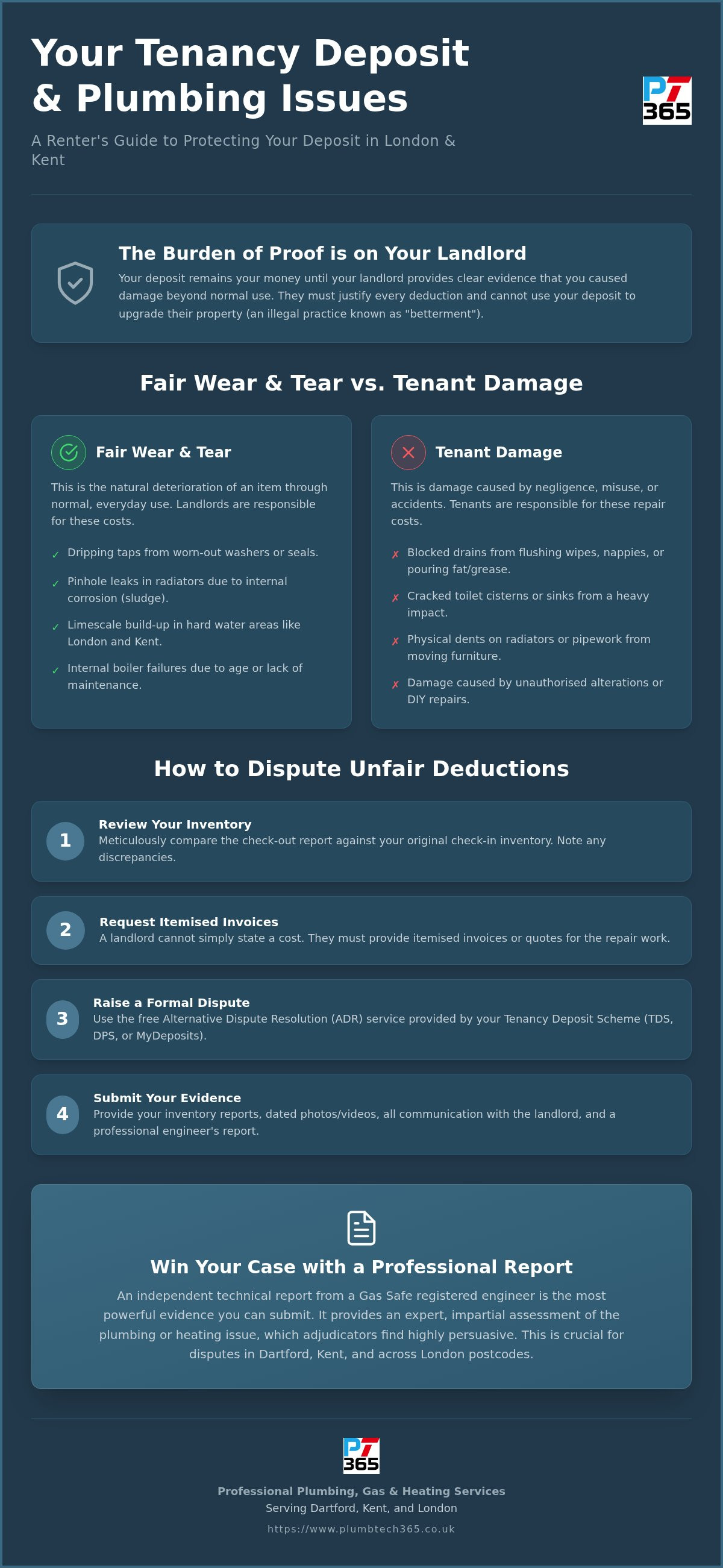
Winning a dispute requires a methodical approach. Don't panic if you receive an email about a landlord withholding deposit for plumbing issues; instead, start building your case immediately. You must move from emotional frustration to evidence-based logic. The Tenancy Deposit Protection (TDP) schemes are designed to be fair, but they rely heavily on the quality of documentation you provide. If the landlord's claims don't match the reality of the property's condition, you have every right to fight back.
Step 1: Review the Reports. Compare your check-out report against the initial inventory. If a plumbing fixture was already noted as "aged" or "worn" at the start of your tenancy, the landlord cannot claim for a total failure now.
Step 2: Demand Financial Clarity. Request a formal breakdown of costs. Landlords must provide genuine quotes or invoices from trade professionals. They cannot simply pick a round number like £200 out of thin air.
Step 3: Gather Technical Evidence. Use high-resolution photos and videos of the affected area. If a pipe leaked, show that there was no physical damage to the pipe itself, which suggests a mechanical or structural failure.
Step 4: Launch the Formal Dispute. If the landlord refuses to budge, escalate the case to your TDP scheme provider. This service is free and the adjudicator's decision is final.
The Power of a Professional Plumbing Report
In a technical dispute, the opinion of a Gas Safe registered engineer carries significantly more weight than a landlord’s amateur estimate. A professional assessment identifies the "root cause" of a failure, such as internal corrosion or a faulty valve, which is almost always the landlord's responsibility. An independent report can settle a "he-said-she-said" dispute by providing an objective assessment of whether a failure was caused by mechanical fatigue or tenant misuse. If you are in a standoff, having a technical document that proves a boiler part failed due to age rather than neglect is your strongest weapon.
Communication Strategies with Landlords
Keep all correspondence professional and in writing. When discussing potential settlements, use the phrase "Without Prejudice" at the top of your emails to ensure your offers of compromise cannot be used against you in a formal adjudication. Propose a settlement based on the depreciation rules we discussed in Section 2, reminding the landlord that they aren't entitled to a brand-new upgrade at your expense. If the landlord claims a repair is urgent but refuses to show an invoice, you should involve a local plumber in Dartford for a neutral assessment. Our team can provide the clear, honest billing and technical reports needed to verify the true cost of any required plumbing repairs.
Preventing Plumbing Disputes: Guidance for 2026
Proactive maintenance is the most effective way to stop a landlord withholding deposit for plumbing issues before the tenancy ends. A documented history of system health creates an undeniable paper trail for any adjudicator. For example, a professional power flush can prove that radiators were efficient and the central heating system was clean during the tenancy. This level of technical evidence makes it very difficult for a landlord to claim that tenant neglect caused a circulation failure or a boiler breakdown later on. Both parties benefit when the property's infrastructure is treated with professional care.
Landlord Compliance and CP12 Certificates
Landlords must prioritise legal compliance to protect their investment and their tenants. An annual gas safety check isn't just a recommendation; it's a statutory requirement. You should ensure your records are up to date by following the Landlord Gas Safety Certificates 2026 Guide. These certificates prove that gas hobs, gas cookers, and boilers were safe at the time of inspection. A consistent history of maintenance reports from Gas Safe registered engineers in London and Kent postcodes provides the evidence needed to resolve disputes quickly. It demonstrates that the landlord has met their duty of care, making it easier to identify if a specific tenant action actually caused damage.
Tenant Best Practices for Plumbing
Tenants have a legal duty to behave in a "tenant-like manner" and mitigate damage where possible. This starts with knowing the location of the main stopcock. If a pipe bursts, turning off the water immediately can prevent thousands of pounds in flood damage and save your deposit. You're also expected to perform basic upkeep, such as clearing hair from shower drains and using standard descaling products on taps in hard water areas like Dartford. Clear communication is your best defence against unfair claims. If you spot a small drip under a sink, report it immediately to prevent rot and mould. If you're currently moving out or starting a new tenancy, you should book a professional plumbing inspection with Plumbfix 365. Our independent boiler engineers in Dartford and Bexleyheath provide the technical clarity needed to keep your tenancy running smoothly and your deposit safe.
Secure Your Deposit and Protect Your Rights
Protecting your financial interests requires a combination of legal knowledge and technical evidence. You now understand that the burden of proof rests with your landlord and that they cannot charge you for the natural lifespan of fixtures or mechanical boiler failures. By identifying the root cause of issues like limescale in Kent or structural pipe leaks, you can effectively challenge any landlord withholding deposit for plumbing issues. Documentation is your most powerful tool in any 2026 tenancy dispute.
If you find yourself in a standoff, an objective technical report is your strongest asset. As We are a trusted plumbing & heating company providing reliable, high-quality services across London and Kent, we have provided expert landlord CP12 certification and engineering services across London and Kent postcodes since 1996. Our Gas Safe Registered engineers deliver the clarity needed to settle disputes fairly and quickly. Need a professional report for a deposit dispute? Contact us today for a neutral assessment that protects your rights. You have the law on your side; stay calm and focus on the facts.
Frequently Asked Questions
Can a landlord charge for a professional plumber to clear a blocked drain?
Yes, a landlord can charge if they prove the blockage was caused by your misuse. If our Gas Safe registered engineers find hair, cooking fat, or foreign objects, it's considered tenant damage. However, if the issue is a collapsed pipe or tree roots, the landlord must pay for the repair. You shouldn't face a landlord withholding deposit for plumbing issues if the fault lies with the property's aging infrastructure or structural failures.
Is a broken boiler considered fair wear and tear?
Internal component failures are almost always considered fair wear and tear. A landlord is legally responsible for the boiler's repair under the Landlord and Tenant Act 1985. You are only liable if you've actively caused damage, such as ignoring a warning light or leaving the system with zero pressure. Since we've served London and Kent since 1996, we've seen that most boiler breakdowns are simply due to mechanical fatigue and age.
How much can a landlord deduct for a dripping tap in 2026?
Deductions for a dripping tap should be minimal and based on the cost of a washer or a professional repair, not a replacement. Landlords cannot charge for a brand-new tap installation if the old one was simply worn out. If a deduction is made, it must account for the fixture's age and expected lifespan. A large deduction for a ten-year-old tap is likely "betterment," which is strictly prohibited under UK tenancy deposit schemes.
What happens if the landlord didn’t provide a Gas Safety Certificate?
If a landlord hasn't provided a valid CP12 Gas Safety Certificate, they are in breach of the Gas Safety Regulations 1998. This makes it very difficult for them to prove the system was safe and maintained at the start of your tenancy. In a dispute, this lack of compliance often leads adjudicators to side with the tenant. You should report this failure to the Health and Safety Executive to protect your rights and safety.
Can I use my own plumber to fix an issue before I move out?
You can use your own qualified plumber, but you must ensure they are Gas Safe registered for any work involving gas hobs, cookers, or boilers. It's best to get written consent from your landlord first to avoid claims of "unauthorised repairs." If you use an independent professional from Plumbfix 365, keep the invoice and a detailed report of the work completed. This provides evidence that you've maintained the property in a tenant-like manner.
How long does a landlord have to return a deposit after a plumbing dispute?
Once the landlord and tenant agree on the amount, or an adjudicator makes a binding decision, the deposit must be returned within 10 days. If you are dealing with a landlord withholding deposit for plumbing issues, the dispute resolution process itself can take several weeks. However, the final payment is strictly timed. If the scheme hasn't paid out within this 10-day window after a final decision, contact them immediately to escalate the payment.
Is limescale damage the tenant’s responsibility in London and Kent?
In hard water areas like Dartford and Northfleet, limescale buildup is generally seen as fair wear and tear. While you're expected to keep taps and showerheads clean, you aren't responsible for internal scale damage to the boiler or pipework. Landlords in Kent and London must accept that local water conditions lead to faster deterioration. Unless you've been extremely negligent with basic cleaning, these costs should not be deducted from your protected funds.
What if the plumbing issue caused damage to my personal belongings?
Damage to your personal belongings is typically a matter for your own contents insurance or a separate legal claim, rather than the deposit scheme. Tenancy deposits are specifically held to cover damage to the landlord's property. If a leaking pipe ruins your computer, you may need to seek compensation through the Small Claims Court if the landlord was negligent. Keep all receipts and photos of the damaged items as evidence for your separate claim.


Comments