


Low Water Pressure in Shower London Flat: Causes and 2026 Solutions

Living in one of the world's most modern cities shouldn't mean settling for a shower that barely manages a dribble. Yet, for many residents, low water pressure in shower london flat environments is a persistent headache that ruins the morning routine. You've likely felt that surge of frustration when the water slows to a crawl just because a neighbour elsewhere in the building turned on a tap. It's a common struggle in a city where 19th-century Victorian infrastructure meets the high demands of 21st-century living.
We understand how stressful it is to face fluctuating temperatures and weak flow while worrying about the potential cost of professional repairs. This guide promises to clear the confusion. You'll discover exactly why your pressure has dropped and learn the exact steps needed to restore a powerful, high-pressure experience. We'll preview the latest 2026 solutions, from navigating the impact of the July 2026 Thames Water hosepipe ban to the technical benefits of upgrading to unvented cylinders. Whether the issue lies with the water board or your internal pipework, you'll gain the clarity required to take immediate action and finally enjoy the shower you deserve.
Table of Contents
What Causes Low Water Pressure in London Flat Showers?
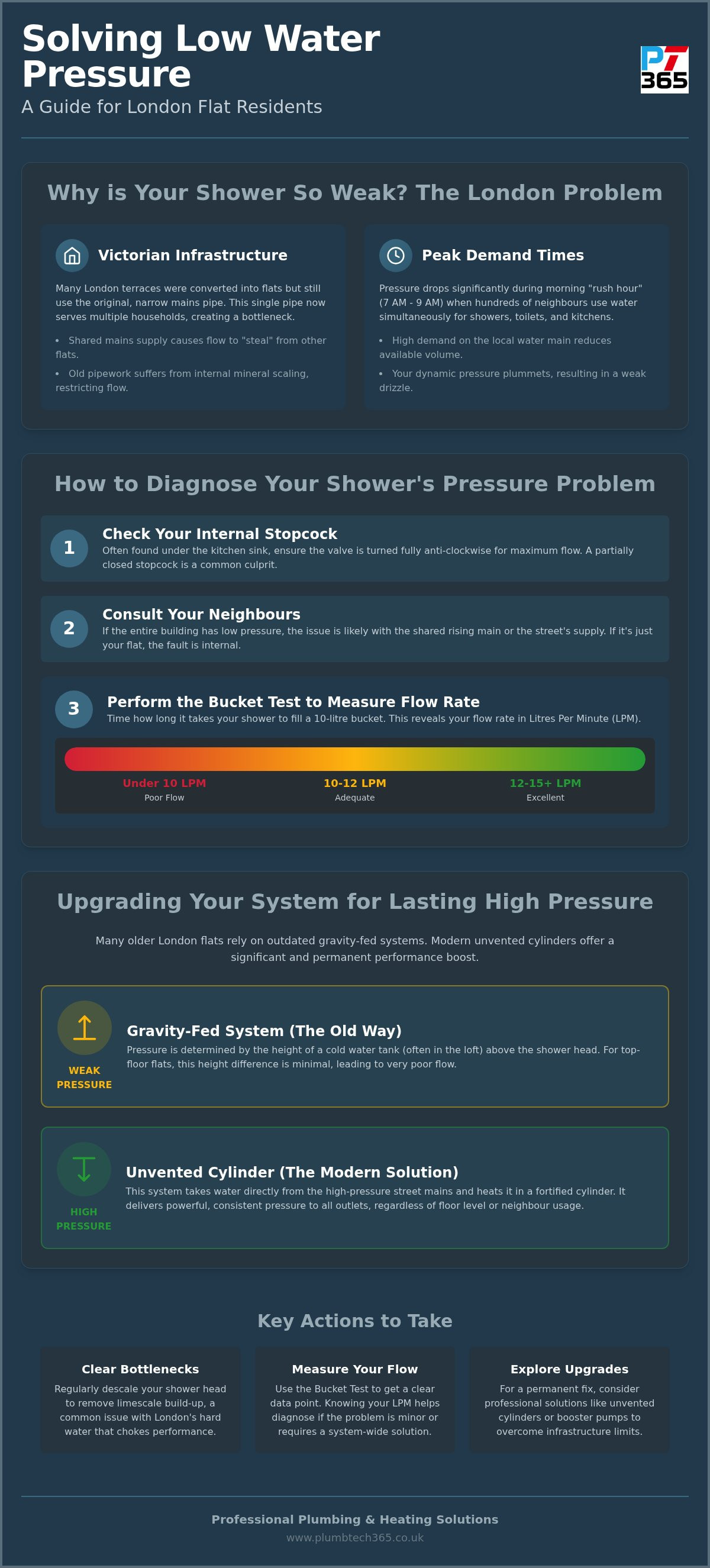
London flats present a unique plumbing challenge. Unlike a detached house, your water supply is often inextricably linked to your neighbours. Understanding what is water pressure is vital, specifically the difference between static and dynamic pressure. Static pressure is the force measured when all taps are closed. Dynamic pressure is the actual force available when water is flowing through your shower head. You might have decent static pressure, but as soon as you open the shower valve, the flow vanishes.
Low water pressure in shower london flat units frequently peaks between 7 AM and 9 AM. This is because hundreds of people in your immediate street and building are using the mains simultaneously. When demand spikes, the available volume drops. This leaves your shower with a pathetic drizzle instead of a powerful spray. To better understand why this happens, watch this helpful video:
London's Victorian Infrastructure and Shared Mains
Most London conversions were originally single-family homes. When these Victorian terraces were split into flats, the original lead or narrow-bore copper mains pipe often remained. This single pipe now serves multiple households. If your downstairs neighbour turns on their kitchen tap, they effectively "steal" the flow before it reaches your floor. Old pipes also suffer from internal scaling. This mineral buildup physically restricts the space water has to move through, which further kills your dynamic pressure.
Gravity-Fed vs. High-Pressure Systems
Many older London buildings still rely on gravity-fed systems. If you have a cold water tank in the loft, your pressure is determined by the height of that tank above your shower head. For top-floor flats, this "head" of water is often less than a metre, resulting in a weak flow. Modern unvented cylinders, such as Megaflo systems, take water directly from the mains. Plumbfix 365 specialists recommend these systems because they transform a weak shower into a high-pressure experience. They utilise the full power of the street's supply rather than relying on gravity.
How to Diagnose Your Shower Pressure Issues
Diagnosing low water pressure in shower london flat units requires a methodical approach. Start at the source by checking your internal stopcock. It's usually located under the kitchen sink or near the front door. Ensure it's turned fully anti-clockwise to allow maximum flow. A partially closed valve is a frequent and easily fixed culprit that many residents overlook during a crisis.
Next, consult your neighbours. In converted Victorian terraces, shared mains mean your performance is often linked to theirs. If everyone in the building is suffering, the problem likely lies with the street's infrastructure or a fault in the building’s rising main. If the issue is isolated to your flat, the blockage or restriction is definitely internal and within your control to fix.
The Bucket Test: Measuring Your Flow Rate
Grab a 10-litre bucket and a stopwatch to get an accurate reading. Turn your shower on full and time how long it takes to fill the bucket. Alternatively, run the water for six seconds and multiply the amount caught by ten to calculate your litres per minute (LPM). A poor flow rate is anything under 10 litres per minute. For a truly satisfying experience in 2026, you should aim for at least 12 to 15 LPM. Anything less indicates a system that is significantly underperforming.
Isolating the Fault: Shower Head vs. Pipework
Determine if the problem is the fixture or the pipes. Unscrew the shower head and hose, then test the flow directly from the bracket or outlet. If the water gushes out, your shower head is likely choked with limescale. London’s hard water quickly blocks fine nozzles, especially in eco-friendly models. Check the hose for internal collapses or kinks that restrict flow. If the pressure is still low without the head, the issue sits deeper in your system.
Check your Pressure Reducing Valve (PRV) if your flat has one. These are often installed in modern conversions to protect pipework but can fail or become misaligned over time. Whilst researching solutions for low water pressure, you might find DIY fixes helpful, but persistent issues usually require a professional eye. If your tests suggest the fault is within your internal pipework, booking local plumbers for a formal inspection is the fastest way to secure a permanent fix.
Top Reasons for a Weak Shower Flow in London
Identifying the root cause is the first step toward a permanent solution. Whilst many residents assume a hidden leak is to blame, low water pressure in shower london flat units usually stems from more predictable, localised issues. London’s unique environment, characterised by mineral-heavy water and aging systems, creates specific bottlenecks that require expert diagnosis. Understanding these common failures allows you to move from frustration to action.
Limescale and Hard Water Damage
London's water is notoriously hard. Calcium and magnesium deposits don't just sit on the surface; they migrate deep into your plumbing fixtures. These minerals choke thermostatic mixing valves and physically restrict the internal diameter of your pipework. Regular descaling is essential for anyone in a London postcode to maintain performance. Scale buildup is also a primary reason for needing to fix a dripping tap, as it prevents internal seals from closing properly and eventually kills the flow entirely.
Faulty Thermostatic Mixing Valves (TMVs)
If your shower flow is weak and the temperature fluctuates wildly, your thermostatic cartridge has likely failed. These cartridges act as the "brain" of your shower, balancing hot and cold feeds to prevent scalding. Cheap, low-quality mixers often struggle with the varying pressure levels found in multi-occupancy buildings. When these internal components seize due to debris or wear, a new tap installation or a high-grade shower upgrade is often the only way to restore a reliable experience.
Airlocks are another frequent culprit, especially following maintenance work or local water cuts. If Thames Water has recently worked on your street, air can become trapped in the high points of your pipework, creating a physical barrier that prevents water from reaching your shower head. Consulting Thames Water's guide to low water pressure can help you determine if local network works have introduced air into your system.
Finally, never underestimate the impact of poorly planned renovations. Incorrectly sized pipework is a common DIY error in London conversions. Installing 15mm pipework where 22mm is required significantly chokes the volume of water reaching your bathroom. This mistake ensures that even if the street pressure is perfect, your shower will always feel underpowered. Professional local plumbers can quickly identify if your pipework is the bottleneck and suggest the necessary modifications.
Practical Steps to Increase Shower Pressure in Your Flat
Improving low water pressure in shower london flat units doesn't always require a complete system overhaul. Before calling in the experts, several DIY-friendly steps can yield immediate results. London's specific environmental factors, such as hard water and aging street mains, often cause simple blockages that are easy to clear if you know where to look. Taking action now can prevent further stress and restore a functional morning routine.
Quick Fixes for Immediate Improvement
Start with the shower head. London's mineral-rich water creates internal blockages that you can't see from the outside. Submerge your shower head and hose in a bowl of white vinegar for at least four hours to dissolve deep-seated limescale. Many modern heads also contain "eco" restrictor disks. Whilst these are designed to save water, they often cripple the performance of a shower already struggling with low mains pressure. Removing this disk can provide an instant boost to your flow rate.
Check your riser rail height if you have a gravity-fed system. In London flats with a tank in the loft, every centimetre of height matters. Lowering the shower head on the rail increases the "head" of water, which naturally improves the pressure. Additionally, inspect the small mesh filters located where the shower hose connects to the mixer. These frequently trap grit and sediment disturbed during local Thames Water maintenance works.
Clearing Airlocks and Grit
Airlocks occur when air becomes trapped in the highest point of the pipework. This physical barrier stops water in its tracks, particularly in gravity-fed systems common in older London conversions. You can often clear this using the "two-hose" method. Connect a hose from a high-pressure cold mains tap to your shower outlet. Turn both on to force the mains water back through the system, pushing the trapped air out into the header tank. This technique is a reliable way to restore flow after the water has been turned off for repairs.
Finally, locate your Pressure Reducing Valve (PRV) if your flat is a modern build. These valves are often tucked away in a utility cupboard or near the stopcock. They are designed to protect your internal pipework from high-pressure surges, but they can be adjusted or may fail over time. If the DIY approach doesn't restore your power, contact our local plumbers for a professional diagnostic visit. We can accurately measure your pressure and ensure any adjustments meet current UK building regulations.
Professional Solutions for Permanent Pressure Gains
When DIY methods fail, the underlying issue usually involves the building's core engineering. Resolving low water pressure in shower london flat units often requires a shift from gravity-fed systems to modern, high-pressure setups. These upgrades don't just patch a leak; they re-engineer how water moves through your home. Investing in professional modernisation ensures your shower performs consistently, even when the rest of the building is at peak demand.
Upgrading to an Unvented Hot Water Cylinder
An unvented hot water cylinder, often referred to by the brand name Megaflo, is the gold standard for London flat renovations in 2026. Unlike traditional tanks that rely on gravity, unvented systems take water directly from the mains. This provides high-pressure hot water to every tap simultaneously. For a safe, G3-compliant installation, consulting Plumbfix 365 is essential. Our engineers ensure the system is correctly balanced to handle London's variable street pressure without risking damage to your internal pipework.
If your street pressure is fundamentally too low, a whole-house booster pump is the next logical step. However, UK Water Regulations are strict. You cannot legally pump more than 12 litres per minute directly from the mains supply. To achieve higher flow rates safely, we install a break tank. This tank acts as a reservoir, allowing the pump to draw water without affecting the street's supply or violating local bylaws. It is a complex installation that requires professional planning to ensure compliance and efficiency.
In older Victorian conversions, the bottleneck is often the physical pipework. Replacing old lead or narrow-gauge 15mm copper pipes with modern 22mm alternatives significantly reduces friction. This allows a greater volume of water to reach your bathroom. For systems that have become sluggish over decades, a professional power flush can also work wonders. This process uses high-velocity water and chemicals to strip away internal sludge and corrosion that a standard descaling cannot reach.
When to Call a Professional Engineer
Certain issues involve the main building stack or shared services, which are beyond a tenant's or individual owner's remit. If your diagnosis points toward a building-wide failure, you must involve qualified experts. Working near boiler systems or high-pressure cylinders requires Gas Safe registration to guarantee safety and compliance with UK building codes. Don't leave your comfort to chance. Book a water pressure assessment with Plumbfix 365 today to secure a permanent, high-pressure solution for your London home.
Restore Your Shower’s Performance Today
Don't let a weak shower dictate your morning routine. Resolving low water pressure in shower london flat environments is entirely possible with the right diagnostic approach and modern engineering. Whether the issue stems from simple limescale blockages or the limitations of outdated Victorian infrastructure, you now have the roadmap to regain control. By identifying the root cause through simple home tests or upgrading to a high-performance unvented cylinder, you can secure a reliable flow that remains powerful regardless of your neighbours' water usage.
Since 1996, our Gas Safe Registered engineers have specialised in transforming underperforming systems across London and Kent. We bring total competence to every household crisis, ensuring your plumbing meets 2026 standards for efficiency and pressure. If DIY fixes haven't restored your shower's strength, it's time to consult the expert unvented cylinder specialists who understand the unique complexities of multi-occupancy buildings.
Solve your London flat's low pressure issues with Plumbfix 365. Trust our decades of experience to deliver the permanent, high-pressure results your home deserves. You are only one step away from a better shower experience.
Frequently Asked Questions
Is my landlord responsible for low water pressure in my London flat?
Landlords are legally required to keep the supply of water in good repair under the Landlord and Tenant Act 1985. If the low water pressure in shower london flat units is caused by faulty internal pipework or a failing boiler, it's their responsibility to fix it. However, they aren't usually forced to upgrade systems if they already meet the minimum legal service standards provided by the water board.
Can I install a shower pump in a rented London flat?
You must obtain written consent from your landlord before making any plumbing alterations. Installing a pump is complex because UK Water Regulations prohibit drawing more than 12 litres per minute directly from the mains. This often necessitates a break tank, which requires significant space. If you proceed without permission or a qualified engineer, you risk your deposit and potentially violate building safety regulations.
Why does my shower pressure drop when someone else in the building uses water?
This happens because your flat likely shares a single rising main with other units in the building. When a neighbour opens a tap, the available volume of water is split between multiple outlets. In older Victorian terraces, the original narrow-bore pipes simply don't have the capacity to serve modern multi-occupancy demand simultaneously. Upgrading to an unvented cylinder can help mitigate this by storing mains-pressure water locally.
Will a new shower head really fix my low pressure issues?
A specialist low-pressure shower head can improve the feel of the spray by aerating the water, but it doesn't increase the actual pressure. If your current head is choked with London’s hard water scale, a new one will provide an immediate boost. However, if the root cause is a shared main or a low-head gravity system, a new fixture is only a temporary sticking plaster for a deeper plumbing problem.
What is the minimum legal water pressure required for London homes in 2026?
The guaranteed minimum water pressure water companies must provide is 7 metres static head, which is approximately 0.7 bar. This standard was established by the Water Industry Act 1991. Whilst this is the legal minimum, most modern appliances and showers require closer to 1.0 or 1.5 bar to function correctly. If your pressure is consistently below 0.7 bar, you should contact Thames Water to investigate the street supply.
How much does it cost to install an unvented hot water cylinder in London?
Costs vary significantly based on the size of the cylinder and the complexity of your existing pipework. Since this involves high-pressure systems and G3 building regulations, you must use a qualified professional for the installation. Factors like the brand of the cylinder and whether you need to relocate your boiler will influence the final bill. We recommend a site survey to receive a clear, honest quote tailored to your flat.
Can hard water scale actually stop my shower from working entirely?
Yes, extreme limescale buildup can completely block the flow. Over time, calcium deposits seize the thermostatic mixing valve, preventing it from balancing hot and cold water. In severe cases, the internal filters or the shower head nozzles become so encrusted that water cannot pass through at all. Regular maintenance and professional descaling are the only ways to prevent these minerals from causing a total system failure in hard water areas.
What should I do if my water pressure suddenly drops to zero?
First, check your internal stopcock to ensure it hasn't been accidentally closed. Next, check other taps in the flat to see if the issue is isolated to the shower. If the entire property has no water, check the Thames Water website for local burst mains or emergency maintenance. If the outage is isolated to your property and the street supply is fine, call an emergency plumber immediately to check for internal bursts or airlocks.


Comments