


Troubleshooting a Boiler Fan That Is Constantly Running: A 2026 Guide

What if that low hum coming from your utility cupboard isn't just background noise, but a final warning before your heating fails entirely? It's incredibly frustrating to hear your boiler fan whirring away for hours, even when the thermostat is turned right down. You're likely worried about your electricity bill climbing or, worse, waking up to a freezing house during a winter cold snap.
In this 2026 guide, we'll walk you through troubleshooting a boiler fan that is constantly running so you can determine if it's a simple setting or a serious component failure. You'll learn exactly when it's safe to monitor the situation and when you must call a Gas Safe engineer to protect your home. We'll explore common culprits like faulty PCBs and stuck relays, giving you the facts needed to restore your home's comfort and safety. This guide ensures you have a steady hand to rely on during a household crisis, providing the clarity you need to act fast.
Table of Contents
Understanding Why Your Boiler Fan Is Running Continuously
The fan is the first component to start and the last to stop in any modern heating system. It creates the necessary boiler draft to pull oxygen into the burner and force toxic combustion byproducts safely outside. Without this constant flow, the boiler would quickly become a hazard, which is why the system is designed to shut down immediately if the fan's performance drops. It acts as a mechanical sentry, ensuring the environment inside the combustion chamber is safe before any gas is released.
The Role of the Fan in Boiler Safety
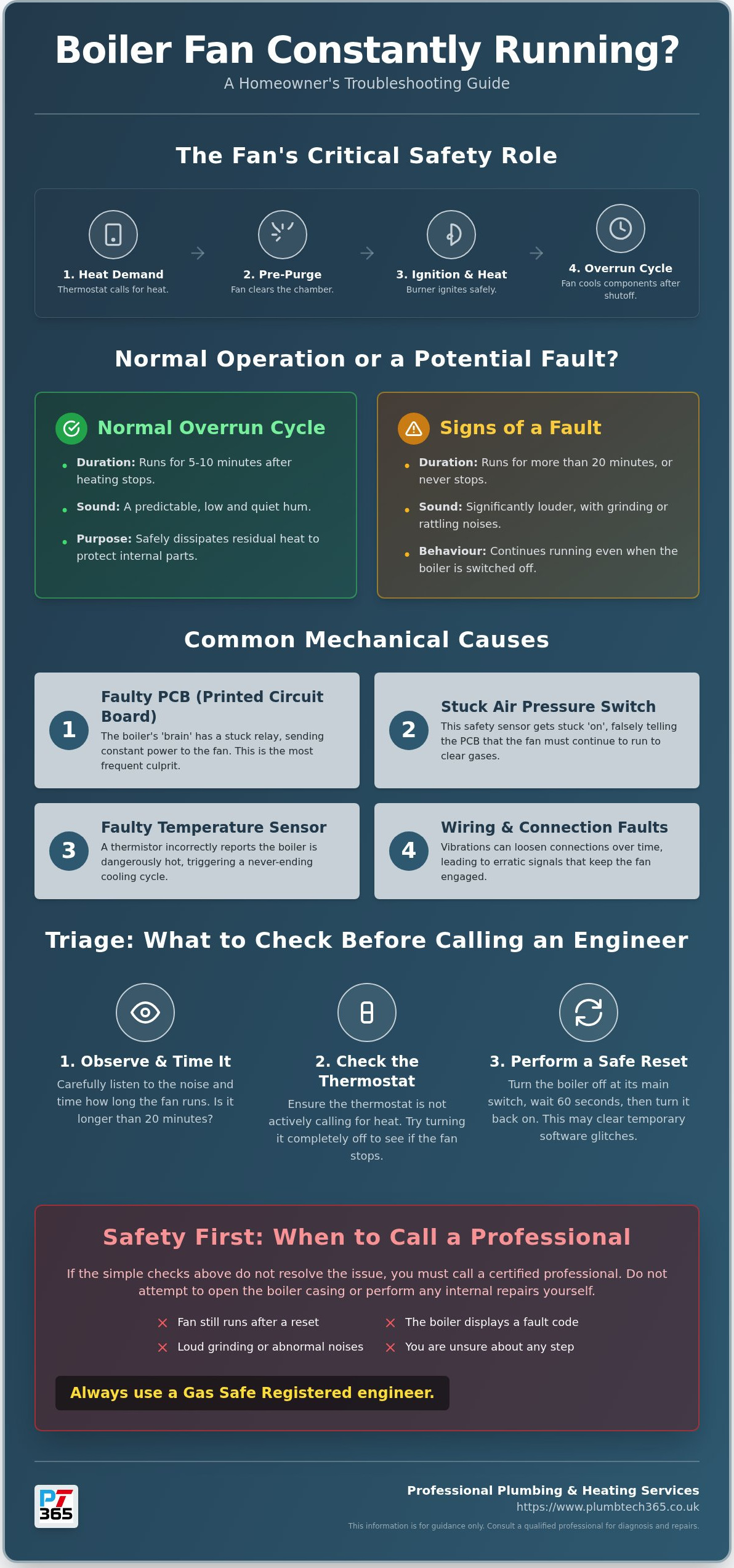
Every time your boiler prepares to ignite, the fan begins a "pre-purge" to clear the combustion chamber. It works in tandem with the air pressure switch, a sensor that confirms air is moving at the correct velocity. If the fan doesn't spin fast enough, the switch won't click over, and the PCB (Printed Circuit Board) will block the gas valve from opening. This sequence keeps your family safe from gas leaks and carbon monoxide buildup. When you begin troubleshooting a boiler fan that is constantly running, you're essentially checking if this safety dialogue has become "stuck" in the "on" position.
What Is a Normal Overrun Cycle?
It's common to hear a low hum for several minutes after the flames have gone out. This is the boiler's overrun cycle, a protective measure designed to dissipate residual heat. By keeping the fan running for roughly 5 to 10 minutes, the system prevents the heat exchanger from overheating once the water pump stops. This protects the internal seals and prevents the metal from warping under extreme temperature shifts.
A healthy overrun cycle is predictable and quiet. You should suspect a fault if:
The fan runs for more than 20 minutes without stopping.
The noise is significantly louder or more "grinding" than usual.
The boiler displays a fault code whilst the fan is spinning.
The fan continues to run even when the boiler is switched to "off" at the control panel.
If the fan never stops, it's often because the PCB thinks the boiler is still hot or is receiving a false "demand" for heat from a faulty thermostat. This constant operation wastes electricity and shortens the lifespan of the motor. Understanding these patterns is the first step in troubleshooting a boiler fan that is constantly running before the system fails entirely. If the noise persists, you may need to consult local boiler engineers near me to diagnose the underlying electrical glitch.
Common Mechanical Causes for a Stuck Boiler Fan
When you are troubleshooting a boiler fan that is constantly running, you are looking for a breakdown in communication between the boiler's internal components. The fan doesn't decide to run on its own. It receives instructions from the Printed Circuit Board (PCB), which relies on data from various sensors. If any of these messengers fail, the fan may stay active indefinitely, wasting energy and risking a total system breakdown during the colder months. Identifying the specific component at fault is the only way to restore efficiency and peace of mind.
PCB Faults: The Most Frequent Culprit
The PCB acts as the brain of your heating system. Inside this control board are small electrical switches called relays. A common failure occurs when the fan relay becomes welded or stuck in the closed position. This creates a permanent electrical path, meaning the fan receives power even when the heating demand has ended. If your fan continues to spin even after a hard reset, a damaged PCB is the likely suspect. You might also notice erratic behaviour, such as the boiler failing to fire up or status lights flashing without a clear pattern. Because the PCB involves complex circuitry, maintaining boiler safety requires a qualified expert to diagnose and replace these boards safely.
Air Pressure Switch and Sensor Failures
The Air Pressure Switch (APS) is a critical safety sensor that monitors the airflow created by the fan. Sometimes, this switch can become physically stuck in the "on" position due to age or internal wear. When this happens, the PCB receives a false signal that the fan is still needed to clear gases, keeping the motor running. Similarly, faulty thermistors, or temperature sensors, can mislead the system. If a thermistor incorrectly reports that the heat exchanger is still dangerously hot, the fan will stay on to cool it down, never reaching the end of its cycle. These sensors are incredibly sensitive to dust, moisture, and debris that can accumulate over years of use.
Wiring faults or loose connections can also trigger this behaviour. Vibrations from the boiler's operation can occasionally loosen the plugs that connect the fan to the main control board, leading to intermittent signals that keep the motor engaged. If you suspect your system is working harder than it should, reaching out to local plumbers near me for a professional inspection can prevent a minor electrical glitch from turning into an expensive emergency. Troubleshooting a boiler fan that is constantly running requires a methodical approach to ensure no small connection is overlooked before replacing major parts.
Distinguishing Normal Cooling from Faulty Behaviour
Not every whirring fan signals a disaster. Modern boilers are designed to be active; however, there's a clear line between a safety cycle and a mechanical glitch. When troubleshooting a boiler fan that is constantly running, you must first determine if the system is simply performing its duties. A healthy fan has a smooth, consistent pitch. If you hear grinding, rattling, or high-pitched squealing, the bearings are likely failing. These audible warnings often precede a total motor seizure.
Look at the boiler interface for clues. If the display shows no active demand for hot water or central heating, yet the fan has been spinning for over twenty minutes, you're witnessing "ghost running." This differs from a standard overrun, which clears residual heat from the heat exchanger. If the fan is spinning but the pump is silent, the boiler isn't moving water; it's just stuck in a loop. Recognising these warning signs of inefficiency early can save you from a complete system lockout during a cold spell.
Visual and Audible Indicators of a Problem
Check for fault codes on the digital panel. A boiler in "lockout" mode will often keep the fan running as a safety precaution while disabling the burner. If you see a flashing light or a specific error code, the fan is acting as a warning signal rather than the primary fault. This state indicates that the boiler has detected an internal issue and has shut down to prevent damage. You should also listen for the rhythm of the boiler. A fan that starts and stops every few seconds suggests a sensor is struggling to maintain a steady reading, which is a different issue entirely from a fan that never stops.
Thermostat and External Control Conflicts
External controls are often overlooked during troubleshooting. Many combi boilers have a "pre-heat" function. This feature keeps a small amount of water hot inside the unit so you get warm water faster at the tap. To maintain this temperature, the fan may fire up periodically throughout the day. This is perfectly normal behaviour and doesn't indicate a fault.
However, smart thermostats can sometimes glitch. If your app shows the heating is "off" but the receiver unit is still sending a signal, the boiler will stay in a state of readiness. Check your thermostat's "always on" or "frost protection" settings. If the temperature in the room is near the frost threshold, the fan might run to circulate air and prevent freezing. If you've adjusted these settings and the noise persists, it's time to seek expert boiler engineers to find the hidden electrical conflict. Troubleshooting a boiler fan that is constantly running requires checking these external triggers before assuming the fan itself is broken.
Triage Steps: What to Check Before Calling an Engineer
Troubleshooting a boiler fan that is constantly running starts with a process of elimination. You don't need to be a technical expert to perform these initial checks. Often, a minor software glitch or an external setting is the culprit, rather than a failing motor. By following these triage steps, you can either solve the problem yourself or provide your engineer with vital information that speeds up the eventual repair. Act quickly to prevent high electricity bills or a total system lockout.
How to Safely Reset Your Boiler
Most modern UK boilers, including popular models from Worcester Bosch, Vaillant, and Ideal, have a dedicated reset button on the front panel. Pressing this can clear temporary errors in the PCB's memory that might be keeping the fan engaged. Follow the "once only" rule: if the fan stops and then resumes its constant running after one reset, do not keep trying. Repeatedly resetting a boiler with a mechanical fault can cause further damage to the internal relays and components. If the fan starts again immediately after the reset, the fault is likely hardware-based and requires professional attention.
Checking External Factors and Controls
Before assuming the fan is broken, check these three external elements to see if the boiler is simply doing what it's told:
The Flue Terminal: Step outside and look at your flue exit. If leaves, cobwebs, or bird nests are obstructing the terminal, the air pressure switch may detect a lack of flow. This forces the fan into a high-speed cycle to clear the blockage.
The Thermostat: Turn your room thermostat to its lowest setting or switch it off entirely. If the fan stops within ten minutes, your boiler was responding to a "demand" for heat you didn't realise was active.
The Pressure Gauge: Confirm the needle is between 1.0 and 1.5 bar. If the pressure is incorrect, the system may enter a safety mode that keeps the fan active as a precaution.
Above all, never attempt to open the boiler casing yourself. It's a sealed unit designed to contain toxic gases. Opening it risks a gas leak or carbon monoxide exposure, and it's a task strictly reserved for a Gas Safe professional. If these basic checks don't resolve the noise, your system needs a specialist to diagnose the internal electrical path. Our emergency boiler repair across London and Kent provides the rapid response needed to secure your home and restore your heating immediately.
Professional Repairs and Maintaining Boiler Safety
Troubleshooting a boiler fan that is constantly running often leads to the same conclusion: professional intervention is mandatory. Whilst basic triage steps like resetting the system are safe for homeowners, any work involving the internal components of a gas appliance is strictly regulated. The fan is a primary safety device. It ensures that poisonous combustion byproducts, including carbon monoxide, are expelled from your home. If the fan is running incorrectly because of a faulty PCB or a damaged air pressure switch, the delicate balance of your boiler's internal atmosphere is compromised. Ignoring this warning sign can lead to a dangerous backdraft of gases into your living space.
A qualified engineer doesn't just swap parts. They use precision diagnostic tools to measure electrical resistance and airflow, identifying whether the issue lies in the wiring, the sensor, or the control board itself. This methodical approach prevents you from paying for expensive parts you don't actually need. Annual boiler servicing in Dartford and across Kent is the most effective way to catch these electrical glitches before they result in a total system failure during a cold snap. Regular maintenance keeps the fan bearings lubricated and the sensors free from the dust and debris that cause mechanical sticking.
Why Gas Safe Registration Is Non-Negotiable
Opening a boiler casing breaks the combustion seal. This seal is the only thing standing between your living space and toxic flue gases. Only a Gas Safe registered engineer has the training and equipment to test the integrity of this seal after a repair. They perform flue gas analysis to ensure the burner is firing efficiently and that no leaks are present. You can learn more about how local boiler engineers keep homes safe through rigorous testing and compliance standards. This isn't just about fixing a noise; it's about protecting your family from invisible hazards that a DIY attempt could easily trigger.
Booking a Reliable Engineer in London and Kent
When your heating system fails, you need a steady hand and a rapid response. Plumbfix 365 has been serving the community since 1996, providing expert support to residents in Bromley, Dartford, and Sidcup. We understand the urgency of a boiler crisis. Our team prioritises safety and clear communication, ensuring you aren't left in the dark about the state of your appliance. For property owners, maintaining a valid landlord gas safety certificate is a legal duty. Addressing a stuck fan immediately ensures your property remains compliant and your tenants stay warm. Don't wait for a total breakdown. Act today to secure your home and restore your peace of mind with a professional repair.
Secure Your Home and Restore Your Heating Efficiency
A boiler fan that refuses to shut down is often a silent warning of a failing PCB or a stuck relay. Whilst a system reset might clear temporary software glitches, persistent running wastes energy and risks a total breakdown during the coldest months. Troubleshooting a boiler fan that is constantly running ensures you catch these faults before they compromise your home's safety or lead to a dangerous backdraft of flue gases.
Don't let a minor electrical glitch turn into a household crisis. Our Gas Safe Registered engineers provide 24/7 emergency repairs across London and Kent, offering the rapid response you need in Dartford and Bromley. We have been the steady hand for local homeowners since 1996, prioritising safety and honest billing for every repair. Book a Gas Safe Engineer for Your Boiler Troubleshooting to secure your system today. Your comfort and safety are our priority.
Frequently Asked Questions
Is it dangerous if my boiler fan is constantly running?
Yes, it can be dangerous because the fan is a primary safety component responsible for expelling toxic gases. If the fan is running incorrectly, it may fail to clear the combustion chamber properly during the next ignition attempt. This increases the risk of carbon monoxide entering your home. Any deviation from the normal cooling cycle indicates a fault that requires an immediate safety inspection by a Gas Safe registered professional.
Will a constantly running fan increase my electricity bill significantly?
A constantly running fan will certainly increase your electricity bill, although the fan motor itself is relatively low wattage. The real concern is that a stuck fan often means the boiler's internal electronics are trapped in a high-power state. Over several weeks, this unnecessary electrical draw adds up. Addressing the issue early prevents financial waste and avoids putting excessive strain on the boiler's delicate Printed Circuit Board.
Can I replace a boiler fan myself if I have the parts?
It is illegal and extremely hazardous to replace a boiler fan yourself. In the UK, any work that involves opening the boiler's combustion casing must be performed by a Gas Safe registered engineer. This is because the fan is part of the gas-tight seal that prevents lethal fumes from entering your living space. Attempting a DIY repair voids your warranty and puts your family at risk of carbon monoxide poisoning.
How long should a boiler fan run after the hot water is turned off?
A healthy boiler fan should typically run for 5 to 10 minutes after you turn off the hot water or heating. This is known as the "overrun" cycle and is designed to dissipate residual heat from the heat exchanger. If you find yourself troubleshooting a boiler fan that is constantly running for more than 20 minutes, it's a clear sign that a sensor or relay has failed.
Does a running fan mean I need a new boiler installation?
Not usually. A running fan is often caused by a faulty air pressure switch or a stuck relay on the PCB, both of which are repairable components. However, if your boiler is over 15 years old and requires frequent repairs, a new boiler installation might be more cost-effective. Our local experts in Bromley can assess your system's overall health to help you make an informed decision.
What are the most common fault codes for fan issues in Vaillant or Baxi boilers?
Vaillant boilers often display the F.32 fault code, whilst Baxi models typically show E160 or E161 when the fan fails. These codes indicate that the PCB cannot confirm the fan is spinning at the correct speed for safe combustion. If your boiler displays these errors whilst the fan is whirring, the system has detected a safety-critical communication error that requires a professional diagnostic check to resolve safely.
Why is my boiler fan noisy as well as constantly running?
Grinding or rattling noises combined with constant operation usually indicate that the fan's internal bearings are failing. As the motor struggles to spin, it generates excess heat and vibrates, which can mislead the boiler's sensors into keeping the fan active. Troubleshooting a boiler fan that is constantly running and noisy is a priority, as a seizing motor can eventually lead to a total system lockout and an expensive emergency call-out.
Should I turn off the electricity to my boiler if the fan won't stop?
If a system reset doesn't stop the fan, you should turn off the electricity at the fused spur to prevent further damage. Leaving a faulty fan running can burn out the motor or damage the PCB relays. Once you've isolated the power, call our team for a rapid response in Dartford or Medway. We'll send a qualified engineer to identify the fault and restore your heating safely.


Comments