


Troubleshooting Intermittent Hot Water from a Combi Boiler: 2026 Guide

Does your combi boiler keep the radiators warm while the hot water turns cold halfway through a shower? It’s frustrating, and the pattern can be difficult to explain. But working radiators don’t rule out a boiler problem, and intermittent hot water doesn’t automatically mean the boiler needs replacing.
This guide to troubleshooting intermittent hot water from combi boiler systems covers likely causes, safe observations and what to tell an engineer. You’ll also learn when to stop checking and arrange professional help.
Start by comparing what happens at different taps. Note any display messages or pressure readings, and follow your boiler manual when checking them. Don’t remove the casing or attempt internal repairs. Components such as a diverter valve, heat exchanger or temperature sensor need assessment by a Gas Safe registered engineer. These observations can help you describe the fault, but they can’t confirm its cause.
Table of Contents
Why does a combi boiler give intermittent hot water?
Hot water that turns cold during a shower or while washing up is disruptive, particularly when the boiler seems to be working otherwise. The temperature change is a symptom, not a diagnosis. Several issues can cause similar experiences, so troubleshooting intermittent hot water from combi boiler systems starts with observing the pattern rather than guessing which part has failed.
A combi, or combination, boiler heats water for taps on demand and also provides central heating. It doesn’t store domestic hot water in a separate cylinder. It’s one type of boiler. Because the tap-water and radiator functions are different, one can appear to work normally while the other is affected.
This video from Baxi gives further context on reduced hot water from a combi boiler:
What does intermittent hot water look like?
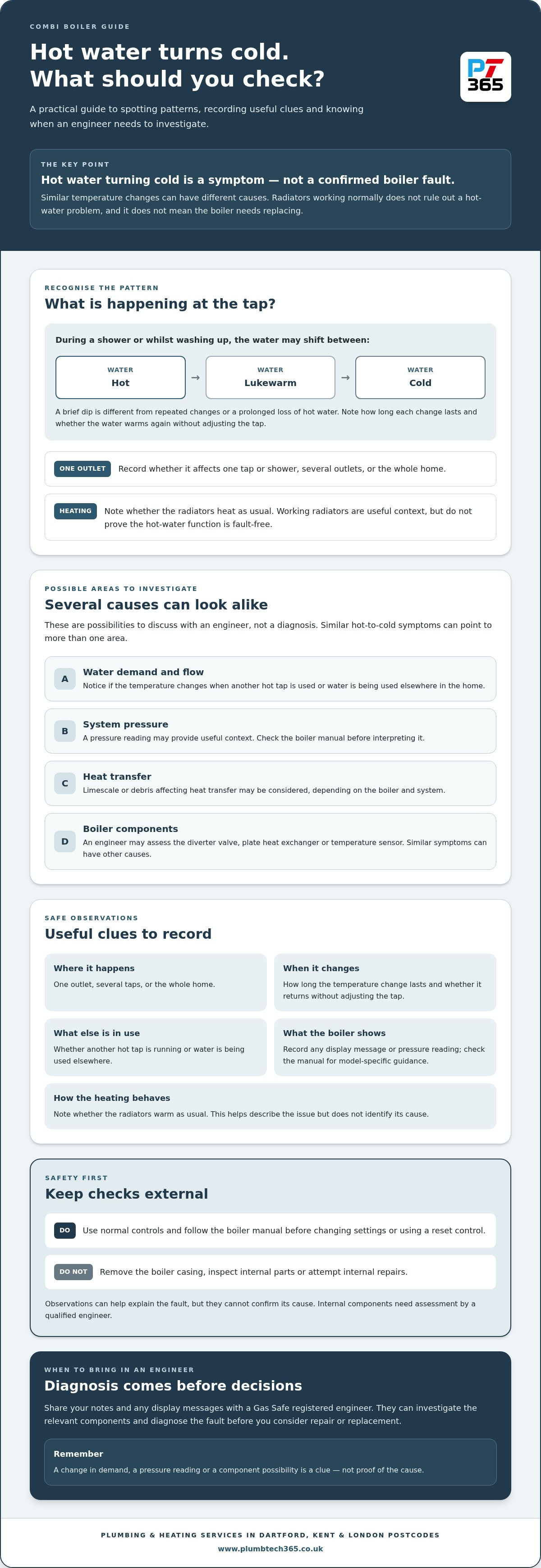
The water may alternate between hot, lukewarm and cold while a tap or shower is running. A brief dip is different from repeated fluctuations or a prolonged loss of hot water. Note how long each change lasts and whether the water warms up again without you adjusting the tap.
Check whether the problem affects one outlet, several taps or the whole home. An issue at one tap gives an engineer a different starting point from a fault affecting multiple outlets. Neither pattern identifies the cause, but recording it makes your description more useful.
Why can heating work while hot water does not?
Your boiler responds differently to a demand for radiator heating and a demand for hot water. Radiators that warm up normally are useful to mention, but they don’t prove the boiler is fault-free or identify a failed component. The hot-water function may still need assessment even if the heating appears unaffected.
Note whether the radiators heat as usual, how many outlets are affected and whether the display shows a message. These are observations, not a diagnosis. Don’t open the boiler casing or attempt internal repairs. If you have lost hot water completely, see this guide to what to do when your boiler has no hot water.
Common causes of intermittent hot water from a combi boiler
The same change in tap-water temperature can have several explanations. Changes in water flow, low system pressure, limescale or a boiler component fault may produce overlapping symptoms. These are possibilities to discuss, not a diagnosis. When troubleshooting intermittent hot water from combi boiler systems, observations help an engineer decide what to investigate.
Could flow rate or water demand affect the temperature?
Notice whether the temperature changes when another hot tap is turned on or someone uses water elsewhere in the home. A change in demand may coincide with a change in flow and outlet temperature. Record what you observe, including whether it happens at one outlet or several. This can help guide an investigation, but it doesn’t prove that flow is the cause.
Could a boiler component or system condition be responsible?
An engineer may need to check several internal components. A diverter valve directs heat towards either the radiators or tap water. The plate heat exchanger transfers heat to water flowing through the boiler, while a temperature sensor reports water temperature to the boiler controls. A problem with any of these may be considered, but similar symptoms can have other causes.
Limescale or debris affecting heat transfer may also be considered, depending on the boiler and system. Don’t try to inspect or clean internal parts yourself. Only a qualified engineer can test the relevant components and confirm whether one has failed.
Other details can help too. A pressure reading may show whether system pressure needs investigating, while a display message or change in heating behaviour gives useful context. Check your boiler manual before interpreting pressure readings or display codes, as guidance varies by model. Record what the display shows rather than assuming a code identifies the cause.
In short: changing hot-water demand, system pressure, heat transfer, valve operation and temperature-sensor readings are all possible areas to investigate. Similar hot-to-cold symptoms can point to more than one of them.
Keep a brief record of when the temperature changes, which taps are affected, whether the radiators still heat and any visible pressure reading or display message. If these observations don’t clarify the pattern, a qualified engineer can diagnose the fault before you consider repair or replacement. You can find more information about boiler support.
How to tell which intermittent hot-water pattern you have
Look for a pattern before trying to explain the cause. Check whether one outlet or several are affected, and whether the problem happens every time or only under certain conditions. These observations can help an engineer decide what to inspect, but they can’t confirm a fault by themselves.
Use this comparison as a guide, not a diagnosis:
What does it suggest if only one tap is affected?
Compare the affected outlet with another hot tap while the boiler is responding to a hot-water demand. If the second outlet stays hot, the issue may be local to the first tap or shower rather than the boiler. That’s a useful clue, not proof. If the cause isn’t clear, ask a plumber or heating engineer to assess it instead of dismantling fittings or boiler parts.
What if every hot tap is affected?
Note whether the boiler display changes as the water turns cold and whether the radiators keep heating. Record any message or code without assuming what it means. If hot water stops altogether, read what to do when your boiler has no hot water.
A repeated whole-home pattern makes the boiler or a shared part of the hot-water system worth investigating, but it doesn’t identify the cause. Symptoms can overlap, and radiators working normally don’t rule out a hot-water fault. Diagnosis should come before decisions about repair or replacement. Intermittent hot water alone doesn’t mean you need a new boiler. A qualified engineer can assess the evidence and advise on the next step.
Safe checks to make before calling about intermittent hot water
Careful observations can help an engineer assess the fault without putting you at risk. Limit checks to the boiler’s external display, visible pressure reading and normal user controls. Don’t remove the casing or try to reach internal parts.
What can you observe without opening the boiler?
Follow this simple sequence. Check your boiler manual before changing settings or using a reset control, as instructions vary by model.
Compare outlets. Note whether the temperature changes at one tap or shower, several outlets or all hot taps.
Read the display. Record the pressure reading and compare it with your manual. Don’t adjust pressure unless the manual clearly explains a user-level procedure you’re confident carrying out.
Note messages and behaviour. Write down any displayed message or warning light, and whether the display changes as the water cools. Record whether the radiators continue to heat.
Describe the pattern. Note when the hot water cuts out, whether it returns on its own and whether the problem happens again. Avoid repeated resets.
These details don’t confirm a diagnosis, but they give an engineer a clearer starting point when troubleshooting intermittent hot water from combi boiler systems.
When should you stop troubleshooting and get help?
If the fault keeps returning or the hot water remains unreliable, arrange an assessment by a qualified heating engineer. Stop at external checks. Don’t remove the boiler casing, attempt internal repairs or repeatedly reset the appliance to clear a recurring fault.
Gas-related work on a boiler must be carried out by a Gas Safe registered engineer. If you suspect a gas or carbon monoxide danger, stop using the appliance, leave the property and seek urgent help. Don’t attempt to investigate or repair the boiler yourself.
Once you’ve recorded the symptoms and checked the manual, seek professional advice if the cause remains unclear. Plumbtech 365 provides boiler servicing and installation, with technical work carried out by Gas Safe registered engineers. Contact Plumbtech 365 to discuss boiler servicing.
When an engineer should diagnose intermittent combi boiler hot water
If the hot water keeps cutting out, returns unpredictably or remains unreliable after safe external checks, arrange a professional diagnosis. A record of the symptoms can help the engineer assess what’s happening. It won’t confirm the fault, but it can make the first discussion clearer.
What information should you give the engineer?
Describe what you observed rather than suggesting a particular part has failed. Useful details include:
When the water turns lukewarm or cold, and whether it becomes hot again by itself.
Whether the problem affects one outlet, several taps or the whole home.
Whether the radiators continue to heat during the hot-water interruption.
Any message or warning light on the display, and the pressure reading if visible.
Whether the pattern changes when another hot tap is used.
Use the boiler manual when noting readings or display messages. Don’t open the casing, change internal components or try to test boiler parts yourself.
What happens during a professional boiler diagnosis?
The engineer will assess the symptoms and check the appliance safely. Depending on what they find, they may investigate the diverter valve, plate heat exchanger, temperature sensors or boiler controls. These are possible areas to examine, not a checklist of faults that applies to every intermittent hot-water problem.
If the pressure reading is also changing, mention that when arranging an assessment. You can read more in this guide to why a boiler may be losing pressure. Don’t adjust the system unless your boiler manual clearly describes a suitable user-level check.
Diagnosis comes before a decision about repair or replacement. Intermittent hot water alone doesn’t mean you need a new boiler. A Gas Safe registered engineer can assess the boiler and explain the next steps. Plumbfix 365 offers boiler servicing and installation, with technical work carried out by Gas Safe registered engineers. Ask Plumbfix 365 about boiler servicing.
Take the next step towards reliable hot water
Intermittent hot water is a symptom, not a diagnosis, and several issues can cause similar temperature changes. Check whether one outlet or several are affected, note any display messages or pressure readings, and follow your boiler manual for user-level checks. Don’t open the casing or attempt internal repairs.
Your observations can help an engineer assess the fault, but they can’t confirm which component, if any, has failed. Diagnosis should come before a decision about repair or replacement. Radiators that still heat don’t rule out a separate hot-water problem.
Plumbfix 365 provides boiler servicing and installation, with technical work carried out by Gas Safe registered engineers. If your hot water keeps cutting out, contact Plumbfix 365 to discuss boiler servicing.
Frequently Asked Questions
Why does my combi boiler keep switching between hot and cold water?
Several issues can cause a combi boiler’s hot water to fluctuate, so the temperature change alone can’t confirm the fault. Changing water demand, low system pressure, limescale or a problem with a valve, heat exchanger or temperature sensor may be among the possibilities. When troubleshooting intermittent hot water from combi boiler systems, note which taps are affected, when the temperature changes and whether the boiler display changes too.
Can low boiler pressure cause intermittent hot water?
Low system pressure can affect boiler operation, but it isn’t the only possible cause of intermittent hot water. Check the pressure reading on the boiler display or gauge and compare it with your boiler manual. Don’t adjust the system unless the manual describes a suitable user-level step. If pressure keeps falling or the hot-water problem continues, arrange an assessment by a qualified engineer.
Why does my hot water go cold in the shower but work at other taps?
If other hot taps work normally, the problem may be limited to the shower, its controls or nearby pipework rather than the boiler. Compare the shower with another outlet and note whether the temperature changes when someone uses another tap. This pattern is a clue, not a diagnosis. If the cause isn’t clear or the issue persists, ask a plumber or heating engineer to investigate.
Can I reset my combi boiler when the hot water keeps cutting out?
Only use a reset control if your boiler manual advises it for the message or fault shown. Follow the manufacturer’s instructions and don’t keep resetting the boiler if the problem returns. A reset may not address the underlying cause. Record any display message and arrange a qualified assessment if the hot water continues to cut out, the boiler repeatedly locks out or you’re unsure what the manual means.
How much boiler pressure should a combi boiler have?
Many combi boilers are designed to operate at around 1.0 to 1.5 bar, but the correct reading depends on the appliance and its instructions. Check your specific boiler manual rather than relying on a general range. Note the reading and whether it changes, but don’t adjust the pressure unless the manual clearly explains a user-level procedure. Ask an engineer if the reading is outside the stated guidance.
Does intermittent hot water mean my combi boiler needs replacing?
No. Intermittent hot water doesn’t automatically mean the boiler needs replacing. Different issues can cause similar symptoms, and an engineer should diagnose the problem before you decide between repair and replacement. Note which outlets are affected, whether the radiators still heat and any display messages. A qualified engineer can assess the boiler and explain the options based on what they find.
When should I call an engineer for intermittent hot water?
Call a qualified engineer if the hot water keeps cutting out, the fault repeatedly returns or safe checks haven’t clarified what’s happening. Share when the temperature changes, which outlets are affected, whether heating continues and any pressure readings or display messages. Don’t remove the boiler casing or attempt internal repairs. Boiler work should be carried out by a Gas Safe registered engineer.


Comments