


What Causes a Boiler to Lose Pressure With No Visible Leak?

What if the water vanishing from your central heating system isn't leaking onto your floor, but is actually being "breathed" out of your house entirely? It's a common mystery that leaves many homeowners staring at a dropping gauge in total confusion. You know the pressure is falling because the boiler keeps cutting out, yet your carpets remain dry and there's no sign of a damp patch anywhere.
We understand the anxiety this causes, especially when you're worried about escalating repair costs or a total system lockout during a freezing winter. You're looking for a clear answer to what causes a boiler to lose pressure with no visible leak so you can regain control of your home's warmth and stop the constant cycle of topping up the filling loop.
This article explains the hidden internal faults, such as a failing expansion vessel or a passing pressure relief valve, that allow water to escape without leaving a trace. You'll learn how to identify these "invisible" issues, understand when a simple DIY top-up is enough, and know exactly when you need a professional to step in and secure your system.
Table of Contents
Understanding Boiler Pressure and the Mystery of the Missing Water
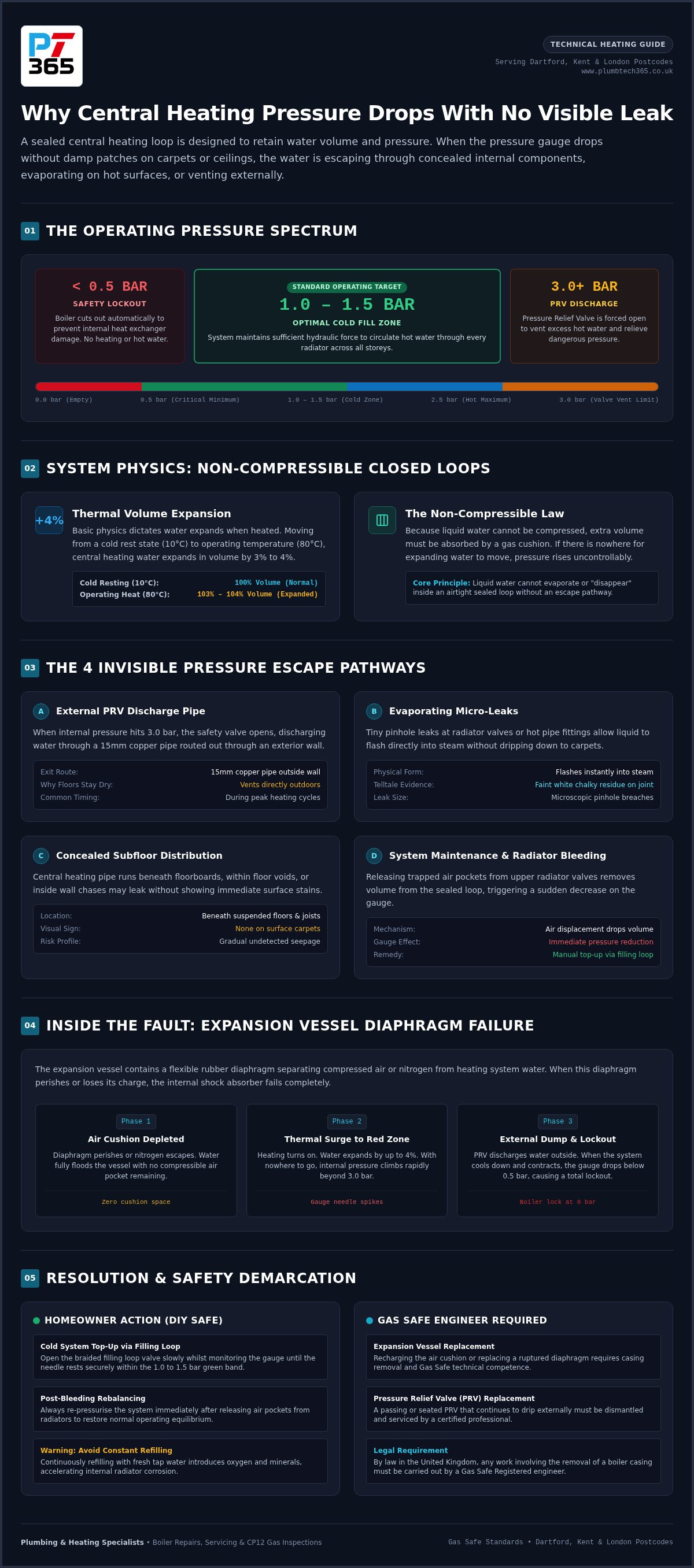
Your central heating system is a sealed loop designed to hold a specific volume of water at a constant pressure. When the system is cold, the needle on your pressure gauge should ideally sit between 1.0 and 1.5 bar. This "green zone" ensures there is enough force to push hot water through every radiator in your home. If the needle drops below 0.5 bar, most modern boilers will trigger a safety lockout to prevent internal damage. This leaves you without heating or hot water exactly when you need it most.
It is incredibly common to experience a system failure where the gauge hits zero despite your floors and ceilings remaining perfectly dry. To better understand this concept and see how water can vanish without a trace, watch this helpful video:
How a Sealed System Maintains Equilibrium
Basic physics dictates that water expands when it is heated. In a standard central heating circuit, the water volume increases by approximately 3% to 4% as it moves from 10°C to 80°C. To manage this extra volume, boilers rely on an expansion tank and diaphragm function to absorb the surge. The pressure gauge acts as a vital health monitor for this process. Since water is non-compressible, it cannot simply "disappear" within a closed loop. If the pressure falls, water is exiting the system somewhere, even if you cannot see a puddle. A minor dip over several months might be normal, but a persistent drop indicates a mechanical fault or a hidden breach.
The Problem With Invisible Pressure Loss
Validating the frustration of dry carpets whilst the gauge drops is the first step toward a fix. You are likely dealing with an internal component failure rather than a burst pipe. When considering what causes a boiler to lose pressure with no visible leak, we often find the water is being discharged outside through a safety pipe or evaporating before it can drip. Small pinhole leaks on hot radiator valves often turn to steam instantly, leaving only a faint white residue behind. If you are experiencing a Sudden Drop In Water Pressure Common Causes Explained in our related guide can help you narrow down the culprit. Understanding that the leak is "invisible" because of where it occurs, rather than because the water has vanished, is key to restoring your heating system.
Faulty Internal Components: The Expansion Vessel and PRV
When you find your system empty but your floors are dry, the "leak" is often happening inside the boiler itself. Identifying what causes a boiler to lose pressure with no visible leak often reveals a mechanical failure rather than a plumbing disaster. The most frequent culprits are the expansion vessel and the pressure relief valve (PRV). These two parts work together to manage the intense forces created when water heats up and expands within your radiators and pipework.
The Role of the Expansion Vessel
An expansion vessel acts as a vital shock absorber for hot water. Inside this metal tank sits a flexible rubber diaphragm that separates a cushion of compressed air or nitrogen from the heating water. Over time, this diaphragm can perish or simply lose its air charge. When this happens, there is no compressible space for the water to move into as it heats up. You will notice the pressure gauge needle climbing rapidly toward the red zone as soon as the heating turns on. If the diaphragm has ruptured, water may even escape through the internal air valve, rendering the vessel useless and requiring a professional replacement.
The Pressure Relief Valve (PRV) Discharge
The PRV is your system’s safety exit. It is designed to open and dump water if the pressure exceeds 3.0 bar, preventing the boiler from becoming over-pressurised. If your expansion vessel is failing, the PRV will trigger frequently. This water doesn't end up on your kitchen floor. Instead, it is routed through a 15mm copper discharge pipe that exits through an external wall. Because this discharge often happens whilst you sleep or when the heating is at its peak, the water may evaporate or soak into the ground before you notice it. Understanding what causes a boiler to lose pressure with no visible leak is the first step in avoiding a full system lockout during the winter months.
A dripping PRV is often caused by tiny bits of grit or debris amongst the valve seat. Once the valve has opened to relieve pressure, these particles can prevent it from sealing shut again. This creates a slow, constant "let-by" that empties your system over several hours. According to HSE domestic gas safety requirements, any component inside the boiler casing must only be handled by a qualified engineer. If you suspect your safety valve is passing water, you should contact local boiler engineers to diagnose the fault safely and ensure your system remains compliant.
Hidden Leaks Within the Central Heating Pipework
If your boiler's internal components are functioning correctly, the issue likely lies within the network of pipes connecting your radiators. Much of this pipework is tucked away under floorboards or hidden behind decorative boxing, making visual inspection difficult. In many London flats and modern Kent homes, pipes are often buried directly in concrete screed floors. A small breach in these areas won't cause an immediate puddle. Instead, the water is absorbed by the subfloor or screed, remaining undetected for months whilst your pressure gauge slowly drops. This is a primary reason why homeowners struggle to identify what causes a boiler to lose pressure with no visible leak.
Another common but overlooked culprit is the automatic air vent (AAV). These small brass components are usually located inside the boiler or at the highest points of your heating system. They are designed to purge trapped air automatically. However, if the internal float becomes coated in system sludge or debris, the vent may start leaking water instead of air. Because these vents are often positioned near hot components, the escaping moisture can evaporate before it ever has a chance to drip onto your floor.
Evaporating Micro-Leaks
Tiny pinhole leaks are a frequent answer to what causes a boiler to lose pressure with no visible leak. These often occur around radiator tails, valve glands, or old compression joints. When your heating is running at high temperatures, a microscopic drip can dry instantly against the hot metal surface. This process leaves behind nothing but a faint green or white calcification mark, which is easy to miss during a quick glance. To find these, wait for the system to go stone cold. Wrap a piece of dry tissue around every joint and valve. If the tissue comes away damp, you've found your breach. You can find more detail on how to spot hidden leaks before damage spreads in our expert guide.
Leaks in Unvented Systems
If you live in a larger property in Bromley or Dartford, you might have an unvented hot water cylinder. These systems are more complex and feature their own set of expansion vessels and safety valves. A fault in the cylinder's primary coil can allow heating water to bleed into your domestic hot water supply, causing a mysterious pressure loss in the boiler circuit. Multi-zone heating systems, which use multiple motorised valves to control different floors, also increase the number of potential leak points. For specific advice on these setups, refer to our unvented cylinder pressure loss troubleshooting guide to narrow down the fault.
Air Trapped in the System and Recent Maintenance
Air in your heating system is often the simplest answer to what causes a boiler to lose pressure with no visible leak. If you have recently had a professional power flushing service or a minor repair, air can remain trapped in the pipework. This is normal after maintenance. As this air works its way out through vents or radiators, the overall volume of the system decreases. This causes the pressure gauge to fall. It requires manual intervention to correct, but it doesn't necessarily mean you have a permanent fault.
The Impact of Bleeding Radiators
Many homeowners believe bleeding radiators is a solution for low pressure. In reality, bleeding your radiators is exactly what causes a boiler to lose pressure with no visible leak in many instances. When you release air from a radiator, you are reducing the total volume of fluid and gas in the sealed circuit. This leads to a drop on the pressure gauge. If your radiators are "cold at the top", you must bleed them, but you must also re-pressurise the system immediately afterward.
Locate your filling loop, which usually consists of two silver braided hoses under the boiler.
Open the valves slowly whilst watching the pressure gauge.
Stop when the needle reaches 1.2 or 1.5 bar.
Close the valves tightly to prevent over-pressurisation.
Always check the gauge whilst using the filling loop. Overfilling the system can put unnecessary stress on your pipework and components.
Automatic Air Vents (AAV)
An automatic air vent is a small, brass valve designed to let air out while keeping water in. These are typically found inside the boiler casing or at the highest points of the system. Over time, limescale amongst the internal float mechanism can cause the valve to stick open. This results in a tiny, constant weep of water. Because this water often drips directly into the boiler casing or onto hot internal parts, it evaporates before you see any evidence of a leak on the floor. A leaking AAV often drips into the boiler casing and remains hidden until an engineer removes the cover.
Air locks are particularly troublesome in multi-storey houses. Air naturally rises to the radiators on the upper floors, causing them to fail and the boiler to lock out. If you find yourself constantly topping up the system every few days, it is no longer a simple air lock; you have a persistent fault. Stop the cycle of constant re-pressurising and contact local plumbers to inspect your system today.
When to Call a Gas Safe Registered Engineer in London and Kent
London and Kent are notorious for high mineral content in the water supply. This hard water leads to rapid limescale accumulation within your boiler's delicate internal components. Limescale can seize a pressure relief valve or coat the primary heat exchanger, creating the exact conditions for unexplained water loss. If you are struggling to identify what causes a boiler to lose pressure with no visible leak, local expertise is vital. Plumbfix 365 has been operating across Dartford, Bromley, and London since 1996. We understand how these specific regional water conditions degrade your heating system over time. Our Gas Safe Registered engineers provide the calm authority needed to solve these technical mysteries quickly.
The Risks of DIY Boiler Internal Repairs
It is a legal requirement in the United Kingdom that anyone working on a boiler's internal gas-carrying components must be on the Gas Safe Register. Opening the casing yourself is dangerous. You risk disturbing the airtight combustion seal or causing a serious electrical short circuit. A botched DIY attempt could lead to a carbon monoxide leak or a total system failure that voids your warranty. For your peace of mind and family safety, always book an Expert Boiler Service in London & Kent to handle complex pressure issues. We arrive on time, diagnose the fault accurately, and provide honest billing with total financial clarity.
Professional Diagnostics and Long-Term Solutions
A professional engineer uses specialized diagnostic tools to find what the naked eye misses. We perform hydrostatic pressure testing on isolated sections of your pipework to prove if a leak is internal or external. One of the most complex issues we identify is a pinhole leak in the primary heat exchanger. This is the ultimate hidden fault. Water leaks directly into the combustion chamber and discharges harmlessly down the condensate drain, giving you no sign of a wet floor. Identifying what causes a boiler to lose pressure with no visible leak in these cases requires the technical competence of a seasoned professional.
Preventative maintenance is the most effective way to stop the anxiety of a dropping pressure gauge. An annual service allows us to check the expansion vessel's air charge and clean the PRV seat before a failure occurs. Our Plumbfix 365 team is available for emergency 24/7 rapid response across London and Kent. Whether you need boiler engineers in Dartford or Bexleyheath, we provide a steady hand during your household crisis. Don't let a small pressure drop turn into a costly breakdown. Contact us today to restore your system to perfect equilibrium.
Secure Your Heating System and Stop the Pressure Drop
Understanding what causes a boiler to lose pressure with no visible leak is the first step toward a warm and worry-free home. You now know that the issue is rarely a mystery; it's usually a mechanical failure like a flat expansion vessel or a small, evaporating micro-leak hidden behind a radiator valve. These faults don't fix themselves. They often lead to total system lockouts if left untreated, especially during the peak of winter.
Since 1996, Plumbfix 365 has provided a steady hand for homeowners across London and Kent. Our Gas Safe Registered engineers are experts at diagnosing these invisible faults and restoring system equilibrium. We offer a 24/7 emergency response to ensure you are never left in the cold. Book a Gas Safe engineer from Plumbfix 365 to find your hidden leak today and regain total confidence in your boiler's performance. You don't have to tolerate a failing system; professional help is just a call away.
Frequently Asked Questions
Why does my boiler pressure keep dropping every few days?
Persistent pressure loss usually indicates a chronic mechanical fault rather than a one-off air lock. If you find yourself topping up the system frequently, you likely have a failing expansion vessel or a passing pressure relief valve. These internal components can discharge water outside your property without leaving visible damp patches indoors. This is a common explanation for what causes a boiler to lose pressure with no visible leak in London and Kent homes.
Can I still use my heating if the boiler pressure is low?
You should avoid running your heating if the pressure gauge falls below 0.5 bar. Most modern boilers will automatically lock out to prevent internal damage when the pressure is too low. Attempting to force the system to run can cause the pump to overheat or the heat exchanger to crack. It's safer to re-pressurise the system to the recommended level before attempting to restart your heating or hot water.
How do I know if my expansion vessel has failed?
A clear sign of expansion vessel failure is a rapid pressure spike on the gauge as soon as your heating turns on. You might see the needle climb from 1.0 bar to over 3.0 bar within minutes. Another test is to check the Schrader valve on the vessel; if water spurts out instead of air when the pin is pressed, the internal rubber diaphragm has likely ruptured and requires professional replacement by a Gas Safe engineer.
Is it normal for a boiler to lose pressure after bleeding radiators?
Yes, it is entirely normal and expected for the pressure gauge to fall after you have bled your radiators. When you release trapped air, you are reducing the total volume of contents within the sealed heating circuit. This drop in volume directly lowers the hydrostatic pressure. You must always use the filling loop to top up the water level back to approximately 1.2 or 1.5 bar once you have finished bleeding.
What is the copper pipe sticking out of my outside wall for?
This is the pressure relief valve (PRV) discharge pipe, often called the "blow-off" pipe. Its purpose is to safely vent excess water outside if the system pressure becomes dangerously high. If you notice water dripping from this pipe, it confirms that your boiler is over-pressurising or the valve seat is fouled with debris. In Dartford and Bromley, hard water limescale often prevents these valves from sealing correctly after they have triggered.
Can a faulty heat exchanger cause pressure loss with no leak?
A pinhole leak in the primary heat exchanger is a leading reason for what causes a boiler to lose pressure with no visible leak. The water escapes directly into the combustion chamber where it either evaporates or drains away through the condensate pipe. Because the water exits through the household drainage system, you won't see a single drop on your floor. This fault requires an expert diagnostic check to confirm before a replacement is ordered.
How much pressure should I add when topping up my boiler?
You should generally aim to fill the system until the needle on the pressure gauge sits between 1.0 and 1.5 bar whilst the system is cold. Most manufacturers recommend a baseline of 1.2 bar for optimal performance. Never overfill the system beyond the green zone, as this puts unnecessary stress on joints and will likely cause the safety relief valve to trigger and dump the excess water outside.
Is a dropping boiler pressure gauge always a sign of a leak?
Whilst a dropping gauge usually indicates water loss, it can also be caused by air being purged from the system. If you have recently had a repair or a power flush, air bubbles will naturally move toward the automatic air vents and radiators. As this air is expelled, the pressure will fall. However, if the drop continues for more than a few days, it is almost certainly a sign of a mechanical leak or component failure.


Comments