


What to Do If You Have a Water Leak in a Flat in London: The 2026 Emergency Checklist
- Darrell Williamson

- Jul 5
- 12 min read
Imagine waking up to the rhythmic sound of dripping water, only to find a dark, damp patch spreading across your ceiling with no clear indication of which flat above is the source. We know that a water leak in a London property is never just a minor inconvenience; it's a high-stakes race against structural damage and escalating repair costs. Knowing exactly what to do if you have a water leak in a flat London is the difference between a controlled situation and a total property disaster. With 68% of UK homes having experienced a leak according to Affinity Water, you aren't alone in this crisis, but you do need to act fast.
We've developed this 2026 emergency checklist to give you a steady hand during a household crisis. You'll learn the immediate steps to stop the water flow, how to navigate the complexities of multi-storey plumbing layouts, and where liability sits under the Landlord and Tenant Act 1985. We'll also explain how current standards like Awaab's Law are shaping response times for landlords and agents. This guide ensures you can move rapidly from initial panic to a professional, insurance-approved resolution that keeps your property safe, compliant, and in excellent condition.
Table of Contents
Immediate Emergency Actions: Stopping the Flow in Your Flat
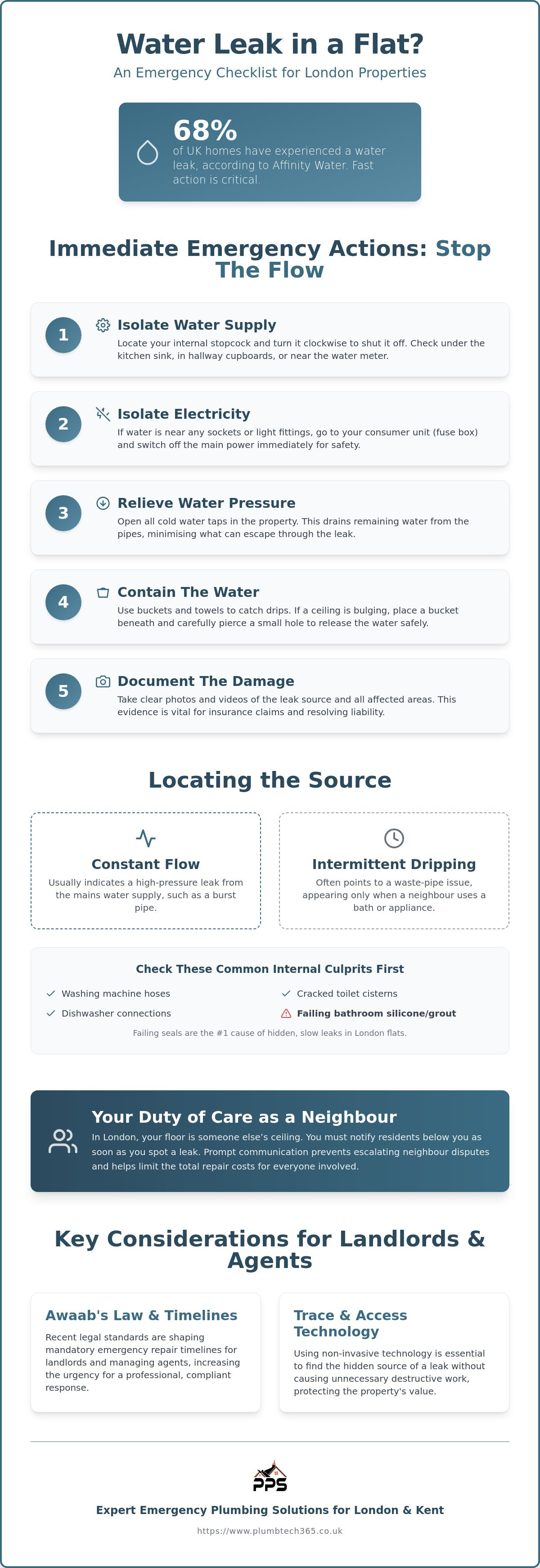
When the ceiling starts to drip, every second counts. Knowing exactly what to do if you have a water leak in a flat London can save your belongings and protect the building's structure from long-term decay. Your first priority is physical containment. Locate your internal stopcock immediately; it's usually found under the kitchen sink, in a hallway cupboard, or near the water meter. Turn it clockwise to shut off the main supply. If water is anywhere near light fittings or sockets, head straight to your consumer unit and switch off the electricity. Safety is paramount, and understanding what constitutes water damage often starts with the dangerous intersection of plumbing and electrical systems.
To see how quickly these situations can escalate in UK properties, watch this short clip:
Once the supply is off, you need to relieve the pressure in the pipes. Open all cold water taps to drain the remaining water into the sinks rather than letting it escape through the leak. Grab buckets and towels to contain the spread. If water is pooling in a sagging ceiling, we recommend placing a bucket underneath and carefully piercing a small hole in the plaster with a screwdriver to release the weight. Finally, document the scene. Take clear photos and videos of the source and the resulting damage before you start mopping. This evidence is vital for insurance claims and resolving liability issues later.
Finding a Hidden Stopcock in London Conversions
Many London properties are Victorian or Edwardian conversions where plumbing layouts are often eccentric. If it's not under the sink, check behind kitchen plinths, under floorboards near the front door, or in communal hallways. You might find a single isolation valve for your flat or a building-wide main supply. If the valve is seized, don't force it with pliers as you risk a total snap. Apply a lubricant if available, but if it remains stuck, you need an expert. We provide rapid responsive maintenance solutions to handle these technical failures before they cause structural ruin.
Protecting the Flat Below: Your Duty of Care
London living means your floor is someone else’s ceiling. You have a duty of care to notify the residents beneath you as soon as you spot a leak. Even if you suspect the issue is a communal pipe or a managing agent's responsibility, you must take every step to stop the flow from your property. Prompt communication prevents escalating neighbour disputes and helps limit the total repair costs. We often see minor drips turn into major insurance claims because of delayed notification. Being a proactive neighbour is just as important as being a proactive homeowner.
Locating the Source: Internal Leaks vs Neighbouring Issues
Identifying the source of water is the next critical phase. In a vertical living environment, the cause isn't always obvious. You might be dealing with a burst pipe behind your own kitchen units or a failing seal in a bathroom three floors up. To understand what to do if you have a water leak in a flat London, you must first determine if the water flow is constant or intermittent. A constant spray usually indicates a mains pressure leak. Intermittent dripping often points to a waste-pipe issue, appearing only when a neighbour drains a bath or runs a dishwasher.
Start your search with the most common culprits. Check the hoses behind your washing machine and the connections under your dishwasher. Inspect your toilet cistern for cracks or overflowing valves. However, the #1 cause of "slow leaks" in London flats is actually failing bathroom silicone and grout. Over time, these seals degrade, allowing water to seep into the floorboards every time someone showers. This type of damage remains hidden for months until a damp patch appears on the ceiling below. If you can't find a visible culprit, it's time to request a professional plumbing assessment to prevent further structural decay.
The "Flat Above" Dilemma: Is it Their Bathroom or Your Ceiling?
If water is dripping from your ceiling, the source is almost certainly in the flat above. Approach your neighbour calmly; they may be completely unaware of the issue. If they aren't home or refuse access, contact your building's managing agent immediately. In the social housing sector, Awaab’s Law sets strict timeframes for investigating hazards like damp and mould. Whilst these specific rules apply to social landlords, the principles of rapid response are becoming the industry standard across London. Most insurance policies require a professional "Trace and Access" investigation to confirm the source before they approve a claim.
Common Plumbing Layouts in London Purpose-Built Blocks
London's high-density housing often relies on a central "soil stack". This is a large communal waste pipe that runs vertically through the building. A blockage or crack in this stack can cause sewage or greywater to back up into multiple flats simultaneously. In more modern developments, unvented hot water cylinders are common. These systems are under high pressure; if you hear "noisy pipes" or banging sounds, it often precedes a significant leak. Identifying these system-wide issues requires an expert eye for multi-storey plumbing architecture.
Legal Responsibilities: Landlords, Managing Agents, and Awaab’s Law
Once you've contained the initial flow, the focus shifts to accountability. Knowing what to do if you have a water leak in a flat London requires a clear grasp of your legal rights and obligations. Under the Landlord and Tenant Act 1985, private landlords are strictly responsible for the structure and exterior of the property. This includes all installations for the supply of water, gas, and electricity. Safety is non-negotiable. If a leak renders a property unfit for human habitation, the landlord must act to restore safety immediately to protect both the tenant and the asset's value.
The legislative landscape has tightened significantly with the 2025 and 2026 updates to Awaab’s Law. Whilst initially targeting the social housing sector, these standards now set the benchmark for all London property management. As of October 2025, landlords must investigate significant damp and mould issues within 10 working days and begin "make safe" repairs within a further 5 days. For emergency hazards, such as a major pipe burst near electrical fittings, the investigation and repair must occur within 24 hours. We provide responsive maintenance solutions that help landlords meet these rigorous compliance windows whilst minimising void periods.
Who Pays for the Plumbing Repair?
Liability usually depends on the location of the failure. If a pipe bursts within your "demised" area, such as the piping under your floorboards or behind your appliances, the individual leaseholder or their landlord is typically responsible. However, if the leak originates from a communal riser or a pipe serving multiple flats, the responsibility often falls on the freeholder or the managing agent. It's vital to check your policy for "Trace and Access" cover. Most standard insurance policies include this, often capped at around £5,000, which covers the professional cost of locating a hidden leak without destructive work.
The Role of the Managing Agent in London Blocks
In large purpose-built blocks or converted Victorian houses, the managing agent acts as the bridge between residents and the freeholder. You must notify them immediately if a leak appears to be coming from a communal area or a shared stack. They manage the service charge funds used for these major repairs. If an agent fails to respond to an emergency within a reasonable timeframe, we recommend documenting all communication to support a potential claim for negligence. Our team works closely with management companies to ensure that every job is completed to a professional standard, on time, and within budget.
Why Professional Trace and Access is Vital for London Properties
Finding the exact source of a leak in a multi-storey building is notoriously difficult without the right tools. If you are wondering what to do if you have a water leak in a flat London, the answer isn't to start ripping up floorboards or smashing through plasterboard. We use non-invasive technology to pinpoint the failure point with surgical precision. This approach protects your property's value and prevents unnecessary repair costs. For properties across London and Kent, we provide a comprehensive report that satisfies insurance requirements, proving exactly where the fault lies and why it occurred.
Pressure testing is our first diagnostic step. It confirms whether the issue sits within your mains water supply or your central heating circuit. Once we identify the system, we employ moisture mapping. This tracks how water has spread through Victorian timber joists or modern concrete slabs. Understanding the path of the water is essential because moisture often travels far from the actual pipe failure, pooling in areas that look like the source but are merely the lowest point of the structure. Our goal is to move rapidly from assessment to resolution with zero guesswork.
Thermal Imaging vs Acoustic Detection
We use infrared cameras to detect heat signatures from hot water leaks behind walls or under floors. For high-pressure mains leaks buried behind thick London masonry, we switch to acoustic microphones that pick up the ultrasonic frequency of escaping water. Trace and Access is the process of locating a hidden leak using specialised equipment before any destructive work begins. If your leak is hidden and causing damage, you need local plumbers near me who specialise in these advanced detection methods.
Handling Damp and Mould Post-Leak
The leak might be stopped, but the damp remains. London flats often suffer from poor ventilation, making them breeding grounds for mould. We use industrial-grade drying equipment to extract moisture from deep within the building's fabric. This is critical for timber-framed conversions where trapped water can lead to structural rot amongst the joists. We always recommend obtaining a professional certificate of dryness. This document is vital for future property sales, providing peace of mind to buyers that the leak was resolved to a professional standard and the property is safe and compliant.
Expert Emergency Plumbing Solutions with Plumbfix 365
We provide immediate peace of mind when technical failures strike your property. Our team understands exactly what to do if you have a water leak in a flat London, offering a steady hand during high-stakes emergencies. We operate a 24/7 rapid response service for emergency call-outs, ensuring that a qualified professional is always available to stop the flow and secure your assets. For letting agents and property management companies, our responsive maintenance solutions are designed to minimise void periods and protect your investment value through dependable workmanship and clear communication.
Whilst we are specialists in plumbing, we provide a comprehensive "one-stop" capability for property care across London and Kent. Our team handles a full range of services, including electrical work, painting and decorating, carpentry, flooring, garden maintenance, and cleaning. This integrated approach is particularly valuable for landlords during end-of-tenancy refurbishments, where we restore properties to a professional standard, on time, and within budget. We ensure every job is completed to a high standard, keeping your property safe, compliant, and in excellent condition for the next occupant.
Transparency is the heartbeat of our service. We provide financial clarity through honest billing and upfront communication. There are no hidden surprises when you are most vulnerable. We treat every call-out as a psychological handshake, building trust through dependable workmanship and jargon-free explanations. By choosing us, you are partnering with a local tradesman operation that has evolved into a sophisticated, modern firm capable of handling any scale of property maintenance.
Our London and Kent Coverage Areas
Serving Dartford, Bromley, Bexleyheath, and the wider South East London area, our local knowledge of London property types is a significant advantage. We understand the specific plumbing and structural quirks of Victorian HMOs and modern luxury developments alike. This familiarity allows us to arrive prepared with the correct parts and tools for your building type. If you are facing an active crisis, use our Emergency Plumber London service for an immediate booking and rapid arrival.
Long-term Maintenance for Landlords and Homeowners
Proactive care is the best defence against future emergencies. We help landlords and homeowners stay ahead of potential disasters through planned maintenance and regular system health checks. Preventing catastrophic leaks often begins with an annual Boiler Service London, which identifies early signs of pressure loss or component wear. Additionally, our comprehensive Landlord Gas Safety Certificates ensure your property remains legally compliant whilst highlighting any plumbing risks before they escalate. Contact us today for a proactive plumbing health check of your London property portfolio.
Secure Your Property with Expert Intervention
A water leak in a multi-storey building requires immediate action and technical precision. By isolating your supply, notifying neighbours, and understanding your legal rights under the latest 2026 property standards, you've already taken the most important steps to protect your home. Now that you understand exactly what to do if you have a water leak in a flat London, you can move from initial panic to a professional, insurance-compliant resolution. We specialise in non-invasive Trace and Access technology to find hidden failures without causing unnecessary damage to your property's structure.
Our Gas Safe Registered Engineers are available 24/7 to handle complex flat plumbing emergencies across London and Kent. We provide the rapid response and honest billing that landlords, letting agents, and homeowners depend on during a household crisis. Don't let a minor drip turn into a structural disaster or a legal dispute. Contact Plumbfix 365 now for 24/7 Emergency Leak Repairs in London and Kent. We are here to keep your property safe, dry, and in excellent condition around the clock.
Frequently Asked Questions
Is a water leak in a flat considered an emergency?
Yes, any active water leak that threatens the structural integrity of the building or risks contact with electrical systems is a high-priority emergency. Knowing what to do if you have a water leak in a flat London begins with recognising that water travels fast through floorboards and can cause ceiling collapses within hours. You should expect an immediate 24-hour response from your landlord or managing agent for any leak that creates a safety hazard or leaves you without essential water services.
What happens if my neighbour’s flat is leaking into mine and they aren’t home?
You must contact your building’s managing agent or the freeholder immediately in this situation. They have the legal authority to force entry into a property during an emergency to prevent significant damage to the wider building. If you are a tenant, notify your landlord so they can coordinate with the block management. Do not attempt to enter the neighbour’s property yourself; wait for the authorised professional or the emergency services to arrive and isolate the supply.
Does my landlord have to pay for a plumber to fix a leak?
Yes, the Landlord and Tenant Act 1985 dictates that landlords are responsible for keeping the supply of water, gas, electricity, and sanitation in good repair. This includes fixing burst pipes, leaking tanks, and broken boilers. Unless the leak was caused by your own negligence or a faulty appliance that you own, the landlord must cover the cost of the plumbing repair and any subsequent work required to make the property habitable again.
How much does it cost to fix a water leak in a London flat in 2026?
Industry data for 2026 suggests that a standard burst pipe repair in London typically ranges between £150 and £270, including the call-out fee. If the leak is hidden and requires professional trace and access services, costs for domestic properties usually fall between £350 and £750. These prices reflect the high demand for skilled labour in the capital. Many insurance policies include trace and access cover up to £5,000, which can help offset these professional investigation costs.
Can I be evicted for reporting a water leak to my landlord?
No, you cannot be legally evicted for reporting a maintenance issue or a water leak. Reporting hazards is a protected right, and "retaliatory evictions" are illegal under UK law. Landlords have a statutory duty to ensure their properties are fit for human habitation. If you feel you are being treated unfairly after reporting a leak, we recommend contacting Citizens Advice or your local council’s housing department for support whilst the repair is being organised.
Who is responsible for a leaking pipe under the floorboards in a leasehold flat?
Responsibility usually depends on whether the pipe serves only your flat or is part of the building's communal system. If the pipe is "demised" to your property, meaning it only supplies your sinks or bathroom, you or your landlord are typically responsible for the repair. However, communal risers and main stacks that serve multiple flats are almost always the responsibility of the freeholder or managing agent. You should consult your lease agreement to confirm the exact boundaries of your responsibility.
How do I find my stopcock if I live in a converted London flat?
Start your search under the kitchen sink or in the hallway, as these are the most common locations. In converted Victorian houses, the stopcock is often hidden behind kitchen plinths or located in a communal cupboard under the stairs. Some conversions have the main isolation valve beneath a small hatch in the floorboards near the front door. If you still cannot find it, ask your neighbours or the managing agent, as they often share the same plumbing layout.
What is Awaab’s Law and how does it protect me from water damage?
Awaab's Law provides a clear framework for what to do if you have a water leak in a flat London by forcing landlords to meet strict safety deadlines. Under the 2025 and 2026 updates, landlords must investigate significant hazards like damp and mould within 10 working days. If the leak is an emergency, they must investigate and make the property safe within 24 hours. This legislation ensures that water damage is not left to fester, protecting tenants from the long-term health risks associated with damp environments.


Comments