


Property Maintenance Companies Near You: Hiring Guide

A nearby firm is only the right fit if it covers your postcode and handles the work your property needs. Finding property maintenance companies near me is a postcode-and-scope decision: match the provider to the job, then look for a clear written quote before work begins.
It’s understandable to want one reliable point of contact, especially when a repair affects tenants, a rental property or your own home. This guide explains which types of maintenance suit landlords, letting agents and homeowners, and how a written quote sets out the agreed work and any conditions that could affect it.
You’ll also learn how to describe a job clearly, what details help assess it, and how to distinguish routine upkeep from work requiring a specialist trade. These steps make it easier to choose the right next action and understand what the quote covers.
Table of Contents
Which property maintenance companies serve my postcode?
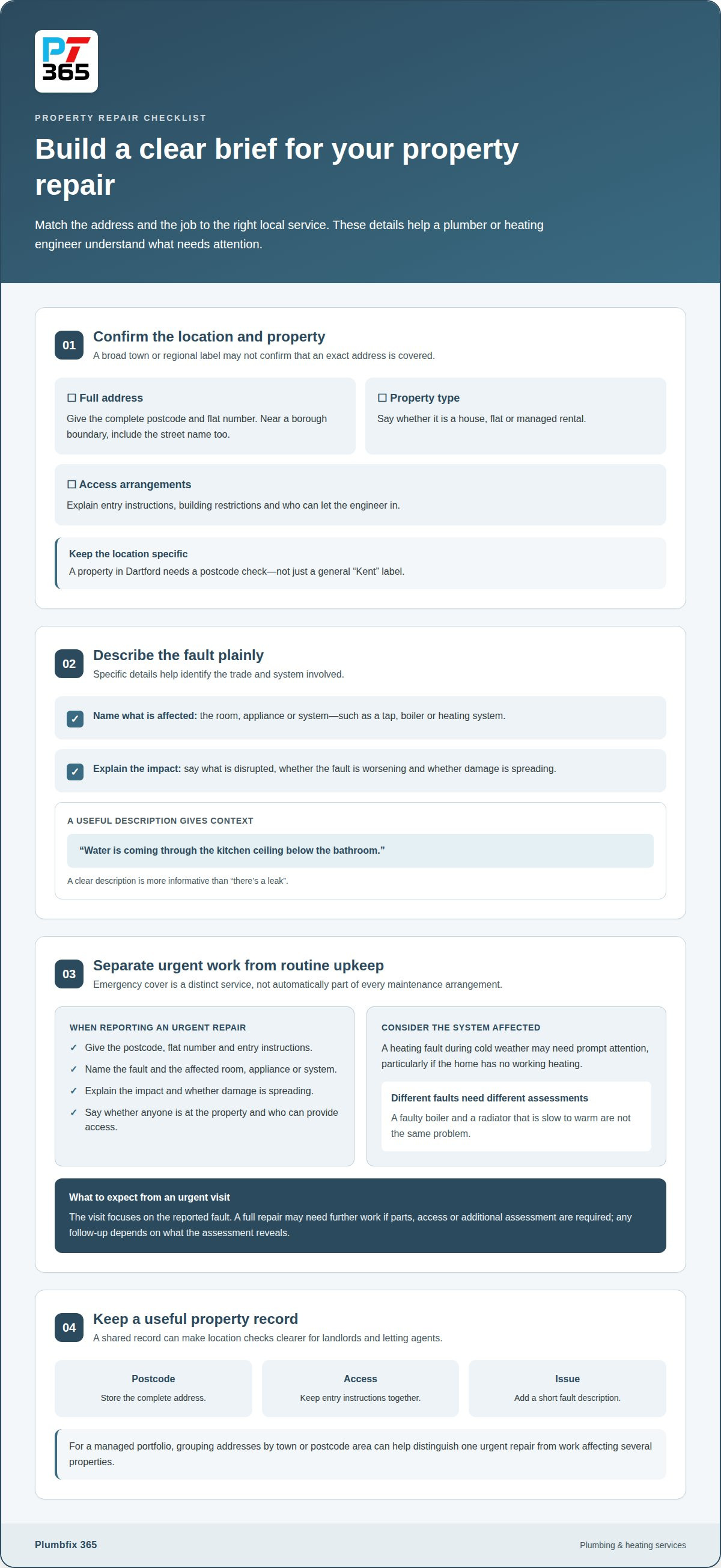
Start with the full postcode, not just the town. A company may cover one district but exclude nearby streets. London boroughs and Kent towns can sit close together. For example, a property in Dartford needs a clear postcode check, not a broad “Kent” label. Choosing property maintenance companies near me starts with confirming the exact address is covered.
Include the postcode when describing the work. For a flat near a borough boundary, provide the street name as well. A town alone may not identify the right local team or clarify the property’s location.
Next, match the company’s services to the repair. A property maintenance company may coordinate several types of work, while a specialist focuses on a particular system. A leaking tap and a faulty heating system need different expertise. Describe the fault plainly, including the room or appliance affected. When comparing property maintenance companies near me, check that the company handles the specific job.
Landlords and letting agents can simplify location checks by keeping a property record. Store the postcode, access instructions and a short issue description together. For a managed portfolio, group addresses by town or postcode area. This helps distinguish one urgent repair from work affecting several properties.
Before arranging a visit, establish what the local service covers. Ask whether the company handles the specific trade, property type and address. A shared building may also have access arrangements or a managing agent. State these details early, so the proposed appointment and work scope fit the property.
Postcode: provide the complete address, including any flat number.
Problem: describe the fault and where it appears.
Property: say whether it is a house, flat or managed rental.
Access: explain entry arrangements or building restrictions.
These details help separate local coverage from a general regional claim. A company may advertise service across Kent or London, yet its practical reach depends on the exact address and job. For example, a property in Dartford and one elsewhere in Kent may need different scheduling arrangements.
For heating-related work, the property’s existing system also matters. A landlord assessing a replacement can use this guide to combi and system boilers to understand why the building’s setup affects the work required. Share relevant system details alongside the postcode.
Use a simple sequence: provide the postcode, explain the fault, identify the property type, then state any access needs. This gives the company practical details to assess the job and plan the next step. It also helps landlords, homeowners and agents avoid confusion about the trade required.
Do local property maintenance companies offer emergency call-outs?
Some property maintenance companies handle urgent repairs, while others schedule work as part of routine maintenance. Emergency cover is a distinct service, not an automatic part of every maintenance arrangement. A burst pipe affecting a room differs from a dripping tap reported for routine repair. The fault, its impact and the trade required shape the response.
For landlords and letting agents, start by classifying the problem clearly. Describe what has failed, where it is happening and whether the fault is worsening. “Water is coming through the kitchen ceiling below the bathroom” gives a clearer picture than “there’s a leak”. Mention whether anyone is currently at the property.
Urgency can also depend on which systems are affected. A heating fault during cold weather may need prompt attention, particularly if the home has no working heating. A faulty boiler and a radiator that is slow to warm are different problems. Clear details help identify the right trade and practical next step.
When reporting an urgent repair, give the company these details:
Address: include the postcode, flat number and entry instructions.
Fault: name the affected appliance, room or system.
Impact: explain what is disrupted and whether damage is spreading.
Access: say who can let the engineer into the property.
For a managed rental, share the same information with whoever is arranging access. A tenant’s description can help distinguish a boiler fault from a wider heating issue. Photographs may show visible damage or the equipment involved. Keep the report factual and note any changes after the initial message.
An urgent visit focuses on the reported fault. A full repair may require further work if parts, access or additional assessment are needed. For example, an engineer may identify the source of a heating problem before setting out a repair plan. The first assessment clarifies the issue; any follow-up depends on what it reveals.
Blocked drains and drainage problems need a different specialist service. A general property maintenance company may not cover that work, so describe the issue accurately from the outset. For plumbing concerns within the home, local plumbing support can be a relevant next step. Give the fault and postcode together so the request has useful context.
How can I compare local property maintenance companies and reviews?
Compare the work described, not just the headline rating. A review about a boiler repair tells you more about heating work than a comment about painting. Match the company’s services to your specific job, then look for details about communication, appointments and how the work was completed.
Ratings need context: an overall score cannot explain every job or service. Read individual comments for details such as clear updates during a repair or an explanation of the work. An account of plumbing work in Dartford, for example, may be more relevant to a local repair than an unrelated review.
Look for useful detail across reviews rather than relying on one glowing or critical comment. Repeated mentions of missed appointments may matter to a letting agent coordinating tenant access. A homeowner may focus more on whether the fault and repair were explained clearly. Patterns help you judge whether feedback relates to your priorities.
Use a consistent comparison for each company:
Trade fit: does the feedback cover the type of repair you need?
Communication: do reviewers describe clear updates and explanations?
Work process: do comments explain how the issue was assessed and resolved?
Property context: do reviews mention homes, flats or managed rentals similar to yours?
Response to concerns: does the company address negative feedback constructively?
A review’s date and detail affect how useful it is. A specific account of a leaking pipe repair gives more context than a short rating without explanation. Older feedback can still describe workmanship, but comments from customers in Kent or London may better reflect local experiences. Treat each review as one account, not proof that every visit will follow the same pattern.
For landlords and agents, look for feedback about access coordination, tenant communication or repeat visits. A comment describing how an engineer arranged entry offers practical insight. For a homeowner, feedback about explaining the fault and agreed work may matter more. Match the reviewer’s situation to your own before weighing their opinion.
Finally, compare the written scope and quote alongside reviews. A detailed review cannot tell you exactly what your own job will involve. Check that the proposed work addresses the reported fault and makes clear what is included. For a plumbing job, feedback about a similar repair is more useful than a general rating alone. Compare the trade, property and communication needs that matter to you.
Property maintenance and repair trades in Leeds are rated an average of 10 out of 10 based on a sample of 60 customer reviews. Treat that result as a snapshot of customer feedback, rather than a guarantee about a particular company or job. When comparing providers, check whether the individual comments relate to the trade and property needs you have already identified. Look for specific descriptions of the work, communication and follow-up, and consider whether the sample gives enough detail to support your decision. A strong average can help frame your research, but the written scope and quote remain important for judging what is actually proposed.
Are local property maintenance companies insured and qualified
Insurance and qualifications answer different questions. Insurance concerns protection if damage or an accident occurs during work. Qualifications relate to a tradesperson’s ability to carry out a particular task. Neither replaces the other. For a boiler fault, the relevant experience must match the heating work involved.
Liability insurance is especially relevant where work could affect a home, tenant or neighbouring property. For a plumbing or heating job, the work still needs a clear scope. For example, repairing a visible pipe leak differs from diagnosing a boiler fault.
Qualifications are trade-specific. A general property maintenance description alone does not explain who will carry out specialist plumbing or heating work. A job description should identify the affected system and task. That makes it clearer which skills the work requires, whether it involves a boiler, pipework or another part of the home.
For gas-related work, the person carrying it out needs the appropriate competence for the task. Avoid treating a general maintenance background as proof of specialist ability. The same principle applies to plumbing: repairing a tap and investigating a heating-system fault require different practical knowledge. Clear job details help match the work to the right trade.
Useful information is specific to the job, not just a broad company description. A written scope can show what the engineer intends to inspect or repair. A clear explanation of the fault and proposed work helps you understand how the task has been assessed. Landlords and agents can keep this information with the property’s maintenance record.
Insurance: establish the type of protection and its relevance to the work.
Trade fit: match the task to plumbing, heating or another specialist skill.
Scope: record the fault, the proposed work and any follow-up needed.
Property record: retain the job details for the owner, agent or tenant.
For boiler or gas work, keep the job description distinct from general property repairs. A heating fault may need diagnosis before the repair can be defined. For example, a boiler that stops working could have different causes. Recording the reported symptoms helps the engineer focus the assessment and explain the next step.
Insurance offers financial protection, but it cannot show that a particular repair has been completed correctly. A qualification, in turn, does not describe insurance cover. Consider both in relation to the actual job. For a plumbing or heating issue, clear trade-specific work details and relevant liability cover provide a more useful picture than a general maintenance claim alone.
What should I check before hiring a property maintenance company
Start with the job itself. A dripping tap, failed boiler and loose bathroom fitting need different skills. Describe the fault, its location and any effect on the property. For a rental, include whether access needs to be arranged through an agent.
Next, make sure the proposed work matches the problem. A written scope should explain what will be inspected, repaired or replaced. If a boiler has stopped working, diagnosis may come before a repair plan. This helps distinguish the immediate task from possible follow-up work.
Clarify what the quote includes before agreeing to proceed. It should identify the work, relevant materials, and any exclusions or conditions. If the scope changes after an inspection, the revised work should be explained before it goes ahead. A clear written record reduces confusion for homeowners, landlords and managing agents.
Job details: record the fault, affected room and property address.
Work scope: identify the proposed repair or installation.
Quote: understand what is included and what falls outside it.
Access: agree how entry will be arranged for a tenant or engineer.
Updates: establish how changes to the work will be communicated.
For specialist work, consider whether the relevant trade fits the task. A plumbing repair and a heating-system fault are not interchangeable. A useful description names the affected equipment, such as a boiler or radiator. This gives the work a clear technical focus before the visit.
Also agree how the property will be left. For example, clarify that the work area should be cleared of tools and materials after the repair. Landlords can record completed work against the property address, creating a practical maintenance history for future reports or repeat issues.
Do not treat a broad promise to “fix everything” as a defined scope. A specific description, such as repairing a leaking pipe beneath a kitchen sink, is easier to understand. It also helps everyone distinguish the original fault from additional issues discovered during the work.
Keep the key details in one written record. Include the reported fault, agreed scope, access arrangements and any changes. For a rental property, share relevant information with the tenant or managing agent. Clear documentation makes it easier to follow up if the repair needs further attention.
If your property needs plumbing or heating work, send the job details for a clear next step. Include the postcode, affected equipment and a concise description of the fault. Those details help define the request from the outset.
We are a trusted Plumbing & heating company providing reliable, high-quality services across London and Kent: local plumbers near me
Plumbfix 365 is a plumbing and heating specialist serving homes and businesses across London and Kent. Turn to the team for plumbing or heating work that needs a focused trade, rather than general property maintenance.
For heating systems, services include boiler installation, boiler servicing and boiler repairs. Boiler engineers can assess the issue and explain the work needed. Homeowners, landlords and letting agents can share the property postcode, the fault and any access details to help describe the job clearly.
If a boiler has stopped working or needs servicing, provide the symptoms and relevant details when getting in touch. For a planned installation, explain the property’s requirements so the work can be discussed in context.
Contact Plumbfix 365 to discuss your plumbing or heating requirements.
Take the next step with confidence
Choosing property maintenance companies near me should lead to a practical next step, not more uncertainty. Once you’ve identified the work your property needs, describe the issue clearly and decide what outcome matters most. For a landlord, that could mean arranging access with a tenant. For a homeowner, it may mean getting a fault assessed before it worsens.
Keep the property details and job description together when making an enquiry. The business, We are a trusted Plumbing & heating company providing reliable, high-quality services across London and Kent, can discuss plumbing and heating work in context.
Contact our trusted plumbing and heating team to talk through your property’s requirements. A clear first step can make organising the right work feel more manageable, whether you own the home or oversee a rental.
Frequently Asked Questions
Do property maintenance companies provide free quotes or maintenance plans?
Some companies provide quotes or offer planned maintenance arrangements, but these vary. A quote should set out the proposed work and its scope. A maintenance plan may cover recurring inspections or repairs, with arrangements defined by the provider. Plumbfix 365 focuses on plumbing and heating services, including boiler installation and servicing. For work on these systems, share the property details and describe the issue to discuss the appropriate scope.
How quickly can local property maintenance companies attend?
Some companies offer emergency call-outs, while others schedule work during normal appointments. Landlords commonly aim to resolve minor repairs within 1-2 weeks.


Comments