


Worcester Boiler Low Pressure: A Step-by-Step 2026 Troubleshooting Guide
- darrell
- Apr 21
- 13 min read
Imagine waking up on a Tuesday morning in January to a freezing house and a stone-cold shower. You check your unit and see the needle on the pressure dial sitting firmly in the red zone. This common issue with worcester boiler low pressure affects approximately 25% of UK households every winter, often leaving families stranded without heat when they need it most. It's a frustrating situation that feels like an expensive emergency, but it doesn't always require an immediate visit from a boiler engineer.
You're likely worried about a massive repair bill or a system failure that requires a full boiler installation. We know a cold home is a crisis. This guide shows you how to troubleshoot the problem safely so you can restore your heating and hot water immediately. You'll learn how to read the gauge, use the filling link, and identify when you actually need a Gas Safe Registered professional. We'll help you avoid an unnecessary call-out fee by giving you the tools to fix the issue yourself right now.
Key Takeaways
Identify worcester boiler low pressure immediately by reading your hydraulic gauge to restore your heating and hot water.
Master the step-by-step process to safely repressurise your Worcester Bosch boiler using the correct filling loop for your specific model.
Determine if your system requires a simple top-up or if hidden leaks in your taps, toilets, or pipework require urgent action from local plumbers.
Discover how to handle accidental over-pressurisation and when your boiler’s discharge pipe signals a potential safety risk.
Recognise when a DIY fix isn't enough and why calling a Gas Safe Registered engineer is vital for boiler installations and maintaining your warranty.
Table of Contents Understanding Worcester Boiler Low Pressure: Why Your Heating Has Stopped Step-by-Step Guide: How to Repressurise Your Worcester Bosch Boiler Troubleshooting the Root Cause: Is It a Simple Top-Up or a System Leak? What to Do If the Pressure Is Too High After Topping Up When to Call a Gas Safe Registered Engineer
Understanding Worcester Boiler Low Pressure: Why Your Heating Has Stopped
Your central heating system is a sealed loop that relies on constant hydraulic pressure to function. It needs this pressure to push hot water from the boiler through your pipes to every radiator in your home. When you experience
worcester boiler low pressure
, the system loses its ability to circulate heat effectively. Modern units are designed with high-sensitivity safety sensors that monitor the internal environment 365 days a year. If the pressure falls too low, the sensor triggers an immediate shutdown. This safety feature prevents the heat exchanger from overheating or sustaining permanent damage. You'll notice several warning signs before the system fails completely. Lukewarm radiators are a common symptom, as the reduced water volume can't carry enough thermal energy. You might hear strange noises, such as gurgling or banging in the pipes, caused by air pockets forming where water should be. In the worst cases, you'll face the dreaded "no hot water" scenario during a morning shower. These issues aren't just inconvenient; they're your boiler's way of telling you it's struggling to maintain a safe operating state.
How to Read Your Worcester Bosch Pressure Gauge
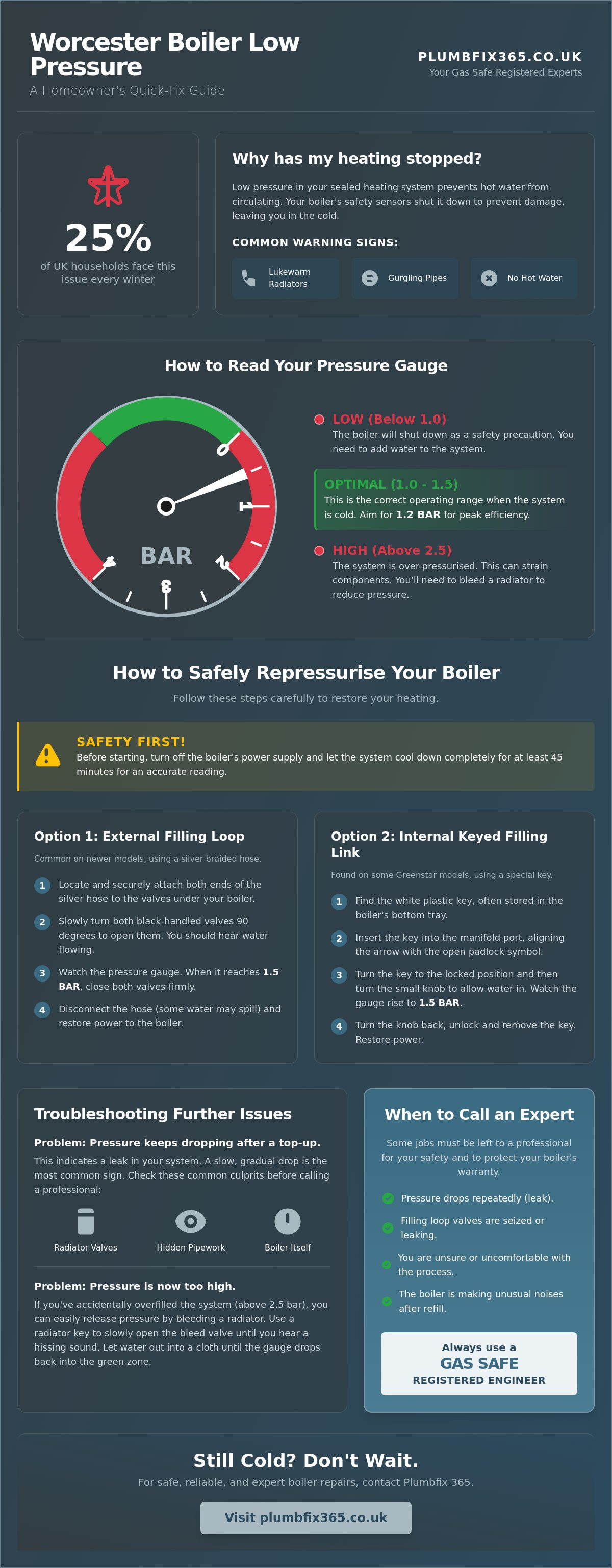
Locating the gauge is your first step. Most Worcester Bosch Greenstar models feature either a digital display on the LCD screen or a traditional round needle gauge behind a flip-down flap. On a manual dial, you'll see a "green zone" which typically spans from 1.0 to 1.5 bar. If the needle drops into the red zone below 1.0, your boiler is under-pressurised. For the most efficient performance, the ideal cold-system pressure is exactly 1.2 bar. Digital displays will often flash a warning code, such as "EA" or "CE," to alert you that the pressure has hit a critical low.
The Immediate Impact of a Pressure Drop
A sudden drop in pressure directly affects your home's energy efficiency. Modern boilers are precision-engineered machines. In 2026, with energy costs remaining a primary concern for UK households, running a system with
worcester boiler low pressure
is expensive. When the water volume is low, the internal pump has to work twice as hard to move heat around the house. This extra strain leads to premature component failure. If the pump runs without sufficient water, it can overheat and seize. This often results in a total system breakdown that requires a professional
Step-by-Step Guide: How to Repressurise Your Worcester Bosch Boiler
Before you touch any valves, safety is the priority. Turn off the electrical supply to the boiler at the fused spur. You must let the system cool down for at least 45 minutes. Water expands when it's hot, so checking the gauge on a warm system will give you an inaccurate reading. Cooling the unit also prevents the risk of thermal shock to the heat exchanger when cold mains water enters the pipes.
Keep your eyes fixed on the pressure gauge throughout this process. Your goal is to reach 1.5 bar exactly. Don't overfill the system beyond this point. If the needle enters the red zone above 2.5 bar, you'll need to bleed your radiators to drop the level back down. Ensure all filling valves are tightly closed before you restore power to the unit.
Option 1: Using an External Filling Loop (Silver Braided Hose)
You'll recognize this setup by the flexible silver braided hose connecting the cold water main to the heating return pipe. It's often located directly underneath the boiler or inside a nearby airing cupboard. Check that both ends of the hose are securely attached to the brass valves. If the hose is missing, you can usually find it tucked away on top of the boiler casing.
Attach the hose and tighten the wing nuts by hand until they're firm.
Slowly turn the two black-handled valves 90 degrees to open them.
Listen for the sound of rushing water and watch the gauge rise.
Close both valves completely once the needle hits 1.5 bar.
If you find the valves are seized or the hose is leaking, don't force them. It's safer to contact local plumbers to replace the external loop components rather than risking a snapped valve.
Option 2: Internal Keyed Filling Link
Older Greenstar models often use a white plastic "key" stored in a dedicated slot in the bottom tray of the boiler. Remove the key and look for the manifold port located near the plastic pipe connections. Insert the key into the port firmly. You must align the arrow on the key with the open padlock symbol on the manifold to engage the internal seal correctly. Turn the key to the "locked" position. Once secure, turn the white nut next to the key clockwise to start the flow of water. When the worcester boiler low pressure issue is resolved and the gauge hits 1.5 bar, close the nut and remove the key.
Option 3: Keyless Internal Filling Link
Modern units, particularly the Greenstar 4000 and 8000 series, feature a keyless link. This is the standard for 2026 Worcester Bosch installations because it eliminates the risk of losing the plastic key. Look for a small blue lever located on the underside of the boiler casing. This uses a "pull and hold" method. Pull the lever down gently to start the water flow. It's designed to be spring-loaded, so the water stops the moment you let go. This gives you total control to prevent over-pressurising the system. It's a fast, efficient way to fix worcester boiler low pressure without any tools.
Troubleshooting the Root Cause: Is It a Simple Top-Up or a System Leak?
Identifying why your worcester boiler low pressure keeps occurring is vital for the long-term health of your heating system. Topping up the system via the filling loop is a temporary fix, not a permanent solution. If you're repressurising the boiler more than twice in a 12-month period, you have an underlying fault that needs professional attention. A sealed central heating system shouldn't lose water. Frequent drops suggest an internal component failure or a hidden leak within your pipework.
Check the Pressure Relief Valve (PRV) first. This is a critical safety device designed to release water if the system pressure exceeds 3 bar. Look at the small copper pipe protruding through the external wall of your property. If this pipe is dripping or shows signs of water staining, the valve is passing. This usually happens because the system is over-pressurising during the heating cycle. Don't ignore a dripping PRV. It leads to constant pressure loss and can eventually damage the boiler's internal electronics. Regular preventative care is the best defense against these issues. You can book a professional boiler service to have these safety components tested by our Gas Safe Registered experts.
Checking Your Radiators and Pipework for Leaks
Finding the source of a leak requires a methodical approach. Start with the radiators. Inspect every Thermostatic Radiator Valve (TRV) and manual lockshield for "weeping." This often appears as slight dampness or a crusty white or green deposit around the joining nut. Even a tiny leak at a joint can cause a massive worcester boiler low pressure drop over several weeks. Check the flooring around the base of your radiators. Damp carpets or warped laminate are clear warning signs of a failing connection. If you have an upstairs bathroom, look for yellow staining on the ceiling below. Our local plumbers can quickly identify and repair these hidden leaks before they cause structural damage to your home.
The Expansion Vessel: The Silent Pressure Killer
The expansion vessel acts like a lung for your heating system. When water heats up, it expands in volume. The vessel contains a rubber diaphragm and an air charge to cushion this expansion. If the vessel fails or loses its charge, the water has nowhere to go. You'll notice the pressure gauge rising rapidly toward the red zone when the heating is active. Once the boiler shuts down and the water cools, the pressure will plummet back to zero. This cycle puts immense stress on your boiler's internal seals. Only a Gas Safe Registered engineer should attempt to repressurise or replace an expansion vessel. This task involves working with internal gas-fired components and high-pressure chambers. Our team provides 24/7 emergency support to handle these technical repairs safely and efficiently.
What to Do If the Pressure Is Too High After Topping Up
If you've been troubleshooting a worcester boiler low pressure fault, it's easy to over-correct and let too much water into the system. Your boiler gauge should ideally sit between 1.0 and 1.5 bar when the heating is cold. If the needle climbs above 2.5 bar, you've over-pressurised the circuit. This creates excessive strain on internal seals and the expansion vessel, which can lead to long-term damage if left unaddressed.
Your Worcester Bosch boiler features a built-in safety mechanism called a Pressure Relief Valve (PRV). When the internal pressure becomes dangerous, this valve opens to vent excess water through a small copper discharge pipe, usually found on the exterior wall directly behind the boiler. If you notice water dripping or spraying from this pipe, the system is actively trying to prevent a critical failure. While the PRV protects the house, you shouldn't rely on it as a permanent solution.
How to Bleed a Radiator to Lower System Pressure
The most effective DIY method to reduce pressure is to bleed a radiator. This process removes water from the sealed loop, causing the gauge to drop immediately. You'll need a radiator key and a dry cloth to catch any drips. Follow these steps to restore balance:
Identify the radiator at the highest point in your home, such as a bathroom towel rail or an upstairs bedroom radiator.
Locate the bleed valve at the top corner and slowly turn the key counter-clockwise.
Let the water flow into a container. Unlike regular bleeding, you're intentionally removing water, not just air.
Ask a second person to stand by the boiler and monitor the gauge in real-time.
Close the valve tightly once the needle hits 1.3 bar.
Don't forget to dry the area thoroughly. Check the valve again after ten minutes to ensure it's tight, as even tiny leaks can cause the worcester boiler low pressure issue to return later.
Identifying a Faulty Filling Loop
If the pressure continues to rise even when the filling loop valves are firmly closed, you likely have a "passing" valve. This occurs when the internal seals within the filling loop fail, allowing mains water to continuously seep into the heating system. This bypasses the safety limits you've set and will eventually cause the PRV to discharge water outside again.
Our local plumbers often see this in older installations where the flexible hose has been left attached. If your gauge won't stabilise, you need emergency plumbing repairs to replace the filling loop. Our central heating engineers specialise in these rapid fixes, ensuring your system remains safe and efficient. We don't just handle boilers; our team is equipped for all bathroom plumbing needs, from toilet repairs and tap replacements to fixing stubborn leaks in your pipework. For professional help with your heating system or a new boiler installation, contact PlumbFix365 today for a sixty-minute response.
When to Call a Gas Safe Registered Engineer
While topping up your system via the filling loop is a standard maintenance task, recurring worcester boiler low pressure signals a mechanical fault that requires expert intervention. DIY fixes have limits. If you're repressurising your boiler more than once every six months, you likely have a hidden leak or a failing expansion vessel. Attempting to repair internal gas components or the heat exchanger without proper certification is dangerous and illegal under UK law. For landlords, professional maintenance isn't just a recommendation; it's a legal requirement to secure your annual Landlord Gas Safety Certificate (CP12).
A professional power flush is often the solution for systems plagued by fluctuating pressure. Over time, magnetite and sludge build up inside your radiators and pipework. This debris restricts flow, causes localized overheating, and forces the pressure relief valve to trigger. Our engineers use specialized chemicals and high-velocity pumps to clear this buildup, restoring your system to 100% efficiency. This process protects your pump and heat exchanger from premature failure, saving you from expensive emergency repairs later in the year.
Protecting Your Boiler Warranty
Worcester Bosch guarantees are comprehensive but conditional. You must have your unit serviced annually by a Gas Safe professional to keep the parts and labour warranty valid. Unauthorised DIY repairs on internal components will void this protection instantly. If your unit is over 12 years old and constantly losing pressure, it might be time to consider a modern replacement. Visit our boiler installation page to explore high-efficiency options that come with fresh 10-year guarantees. We help you choose a model that fits your home's specific heating demands.
The Plumbfix 365 Commitment
We understand that a cold home is a high-stress emergency. Our local plumbers provide a rapid response across London and Kent, often arriving within 60 minutes of your call. We pride ourselves on transparent pricing with no hidden costs. Every one of our heating engineers is fully Gas Safe Registered, ensuring your home remains safe and compliant. We operate 24/7, 365 days a year, to resolve worcester boiler low pressure issues and general plumbing faults like leaking taps, toilet repairs, or burst pipes. You can rely on our dependable experts to restore your heating and hot water with total competence.
24/7 Emergency Support: We're available every day of the year.
Transparent Pricing: You'll know the costs before we start the work.
Local Expertise: Serving London and Kent with rapid response times.
Certified Safety: All engineers carry valid Gas Safe ID cards.
Get Your Heating Back on Track
Dealing with worcester boiler low pressure doesn't have to be a household crisis. Most Worcester Bosch systems require a steady reading between 1.0 and 1.5 bar to function correctly. If your gauge sits below 0.5 bar, your boiler will likely shut down to protect its internal components. While a quick top-up via the filling loop often solves the immediate issue, consistent pressure loss usually signals a leak or a failing expansion vessel that requires expert diagnosis.
PlumbFix365 offers a 24/7 emergency response to ensure you aren't left without heat or hot water. Our Gas Safe Registered Engineers arrive equipped to handle everything from minor leak repairs to full boiler installations. We pride ourselves on transparent pricing and no hidden costs; you'll know exactly what you're paying for before any work begins. As local plumbers, we're committed to keeping your home warm 365 days a year.
Book a Gas Safe Engineer for Your Worcester Boiler Repair and let's get your system running at peak performance today.
Frequently Asked Questions
What bar should my Worcester boiler be at?
Your Worcester boiler pressure should sit between 1.0 and 1.5 bar when the system is cold. If the needle drops below 0.5 bar, the internal safety sensors will trigger a total system lockout to prevent damage. Check the circular gauge on your control panel regularly. This ensures your heating operates efficiently throughout the 365 days of the year.
Can I use my boiler if the pressure is low?
You shouldn't operate your heating system if the pressure is below 1.0 bar. While some units run at 0.8 bar, low pressure forces the pump to work harder, which causes premature wear on internal components. Running a dry system leads to expensive repairs or a full boiler installation if the heat exchanger cracks. Call a central heating engineer immediately if your boiler makes banging noises.
Why does my Worcester boiler keep losing pressure?
Frequent worcester boiler low pressure signals usually indicate a leak in your pipework or a failing radiator valve. Even a tiny pinhole leak can drop the pressure by 0.2 bar every 24 hours. If you can't see water around your radiators, the internal expansion vessel might have failed. This requires a professional assessment from a Gas Safe Registered engineer to ensure your system remains safe and functional.
Is it easy to repressurise a Worcester boiler myself?
Most Worcester Bosch models feature a built-in filling link or an external braided hose that makes repressurising simple. You just need to open the two white plastic taps or the metal lever until the gauge reaches 1.2 bar. If the valves feel seized or you don't feel confident, our local plumbers offer a rapid response to handle it for you. Never force a stuck valve.
What happens if I overfill my boiler pressure?
If the gauge exceeds 2.5 bar, the pressure relief valve will automatically discharge excess water through the copper pipe on your external wall. This is a safety feature designed to prevent pipe bursts. You can fix this yourself by bleeding a radiator using a standard key. Continue bleeding until the needle returns to the 1.2 bar mark, which protects your boiler installations from unnecessary stress.
How much does it cost to fix a boiler pressure issue?
Topping up the water yourself costs nothing. However, if a component like the expansion vessel needs replacing, the price depends on your specific model. According to Checkatrade 2024 data, average boiler repair costs in the UK range from £150 to £400 depending on parts. We provide transparent quotes with no hidden costs for all repairs, from tap replacements to complex boiler work.
Do I need a plumber or a gas engineer for low pressure?
You need a Gas Safe Registered heating engineer for any internal boiler repairs. While local plumbers can fix leaking radiator valves or visible pipework issues, they cannot legally open the boiler casing. Our team consists of fully qualified central heating engineers who handle both external plumbing and internal gas components. This ensures your 24/7 emergency is resolved safely and legally.
How often should I have to top up my boiler?
A healthy, sealed heating system should only require a pressure top up once or twice every 12 months. If you find yourself adding water every few weeks, you have a slow leak or a failing component. Constant topping up introduces fresh oxygen into the system, which causes internal corrosion. This eventually leads to a breakdown that requires an emergency boiler engineer to prevent total system failure.


Comments